| | | | | | | | | | | Axios Science | | By Alison Snyder ·Jan 20, 2022 | | Thanks for reading Axios Science. This week's newsletter is 1,270 words, about a 5-minute read. | | | | | | 1 big thing: Searching for keys to the center of atoms |  | | | Illustration: Eniola Odetunde/Axios | | | | Nuclear physicists trying to piece together how atoms are built are about to get a powerful new tool. Why it matters: When the Facility for Rare Isotope Beams begins experiments later this spring, physicists from around the world will use the particle accelerator to better understand the inner workings of atoms that make up all the matter that can be seen in the universe. - In the more than 13.7 billion years since the Big Bang, all of the elements in the universe lighter than iron have been forged in nuclear reactions, mostly within stars. Heavier elements are suspected to form in the mergers of stars or supernova, explosive scenarios that FRIB will mimic to try to understand the elements' origins in the universe.
- On Earth, modeling how protons and neutrons bind to form nuclei could help to improve medical diagnostics and treatments that use isotopes — different forms of an element.
The big picture: More than 30 years in the making, the $730 million FRIB is operated by Michigan State University and funded by the Department of Energy. - It will complement the Relativistic Heavy Ion Collider and planned Electron-Ion Collider at Brookhaven National Laboratory and the Continuous Electron Beam Accelerator Facility at the Jefferson Lab.
- Those accelerators smash electrons, protons, heavy ions or nuclei together to dislodge and study quarks, which make up protons and neutrons, and gluons, which carry the force that holds the quarks themselves together.
- "The manifestation of those fundamental forces is the atomic nucleus," says Brad Sherrill, a professor of physics at Michigan State University and the scientific director of FRIB.
- But nuclei can have different sizes, densities and shapes — resembling pears, footballs and pancakes — depending on the ratio of protons and neutrons in them. Coming up with a model to describe the many configurations of nuclei is one of physics' toughest, most fundamental problems.
That's where FRIB comes in. - It accelerates a beam of a naturally occurring isotope to about 60% of the speed of light and strikes it against a target, stripping neutrons and protons from the nuclei of atoms in the beam to create rare isotopes.
- The isotope of interest is filtered out by magnets so physicists can study its properties and the reactions that form it.
- FRIB's powerful beam can take any of the roughly 90 naturally occurring elements on Earth and create isotopes of them — many of which vanish almost immediately. These rare isotopes represent the range of possible configurations of the nucleus and give scientists a sketch of nuclear limits, including how many neutrons can be added or subtracted before a nucleus falls apart.
- The goal is to produce about 80% of all theoretically possible isotopes for elements up to and including uranium.
The latest: Last month, physicists reported using FRIB's predecessor — the National Superconducting Cyclotron Laboratory — to make the lightest isotope of magnesium ever seen. - FRIB will build on that research when it switches to operation mode in early February and starts experiments in late May or early June.
- The first experiments will focus on testing existing models of the nucleus to see if they hold for extreme isotopes with many or few neutrons, Sherrill says.
- Early in its operation, it will also look at rates of nuclear reactions at extremely high temperatures, like those in supernovas.
Go deeper. |     | | | | | | 2. Catch up on COVID-19 |  Data: N.Y. Times; Cartogram: Kavya Beheraj/Axios "The U.S. Omicron wave may be peaking, but now COVID deaths are climbing as cases continue to soar in most of the country," Axios' Sam Baker and Kavya Beheraj write. Pfizer-BioNTech's COVID vaccine could be authorized for kids under 5 in the next month, NIAID director Anthony Fauci told CNBC. People with a certain genetic variant may be at higher risk of losing their senses of smell and taste if infected, Erin Garcia de Jesús reports for Science News. Men die from COVID at a higher rate than women, but a new study finds the trend varies depending on where the person lived and when they had COVID, suggesting "social factors — like job types, behavioral patterns and underlying health issues — played a big role in the apparent sex differences," the NYT's Azeen Ghorayshi reports. | | | | | | | | 3. Earth's cosmic bubble | 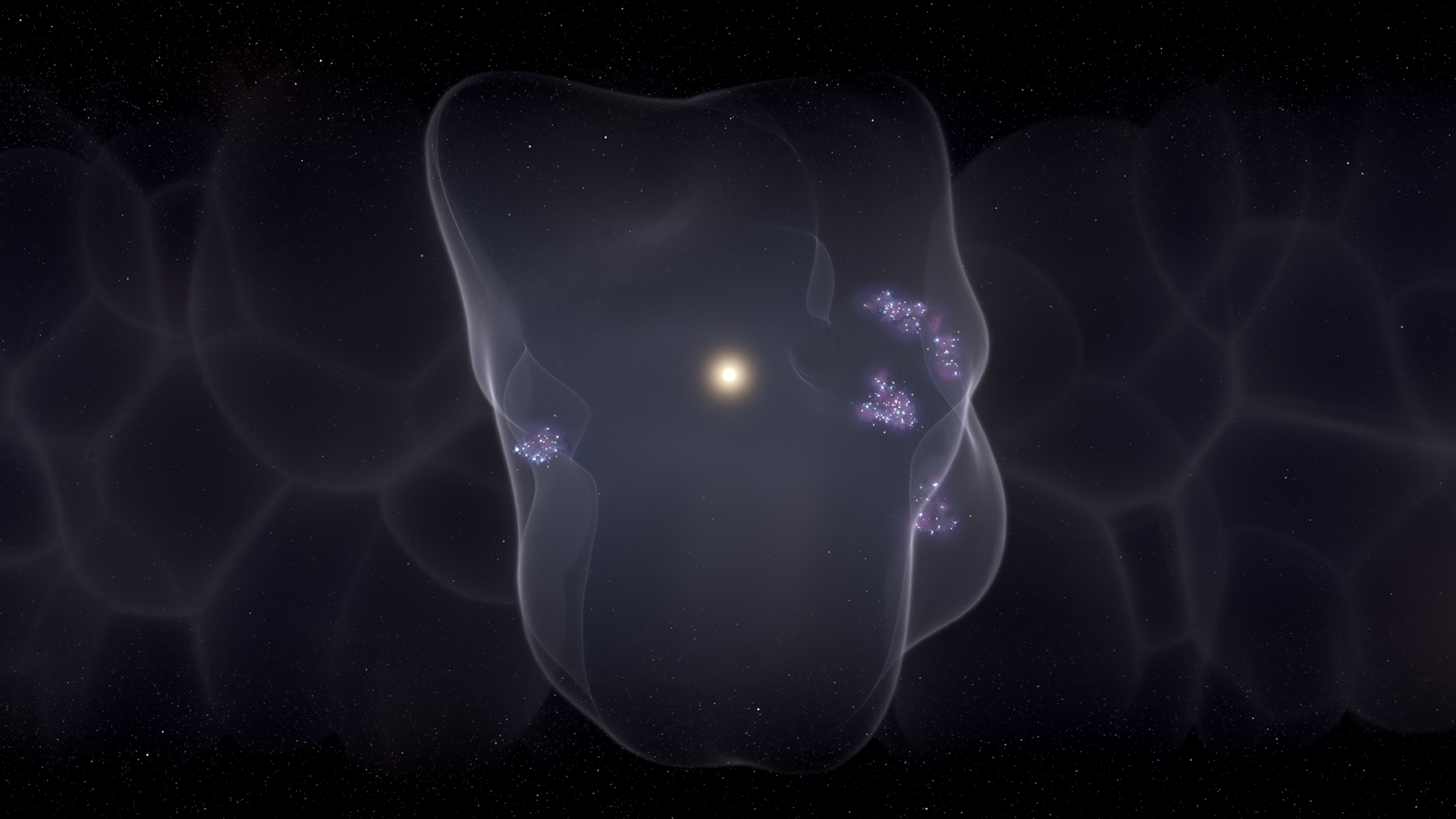 | | | An illustration of the local bubble surrounding Earth. Photo: CfA, Leah Hustak (STScI) | | | | Our Earth and Sun sit almost exactly in the middle of a 1,000 light-year-wide cosmic bubble of plasma, gas and dust propelled by the explosions of surrounding stars, according to a new study, Axios Space author Miriam Kramer writes. Why it matters: By studying the bubble from Earth's vantage point, scientists have the chance to observe stars forming and evolving in a process fed by dying and exploding stars that created this bubble. What's happening: The new study in the journal Nature suggests supernovas that exploded about 14 million years ago created the cosmic bubble we now sit within. - That bubble has allowed for the formation and evolution of young stars around Earth, according to the study.
- The bubble is "coasting along at about 4 miles per second," Catherine Zucker, one of the authors of the study, said in a statement. "It has lost most of its oomph though and has pretty much plateaued in terms of speed."
- The Sun ended up in the middle of the bubble by luck as its path through the galaxy brought us into the center of it instead of remaining on the outskirts, according to João Alves, another author of the study.
The big picture: Our bubble isn't the only one. Scientists now want to learn more about how these interstellar bubbles interact with one another. - "Where do these bubbles touch? How do they interact with each other? How do superbubbles drive the birth of stars like our Sun in the Milky Way?" Zucker said.
| | | | | | | | A message from Axios | | Your 2022 daily news habit | | |  | | | | Get the news that matters in your inbox every morning and afternoon with Axios AM and PM. Delivered daily by Mike Allen, the world's most wired reporter. Subscribe for free | | | | | | 4. Worthy of your time | 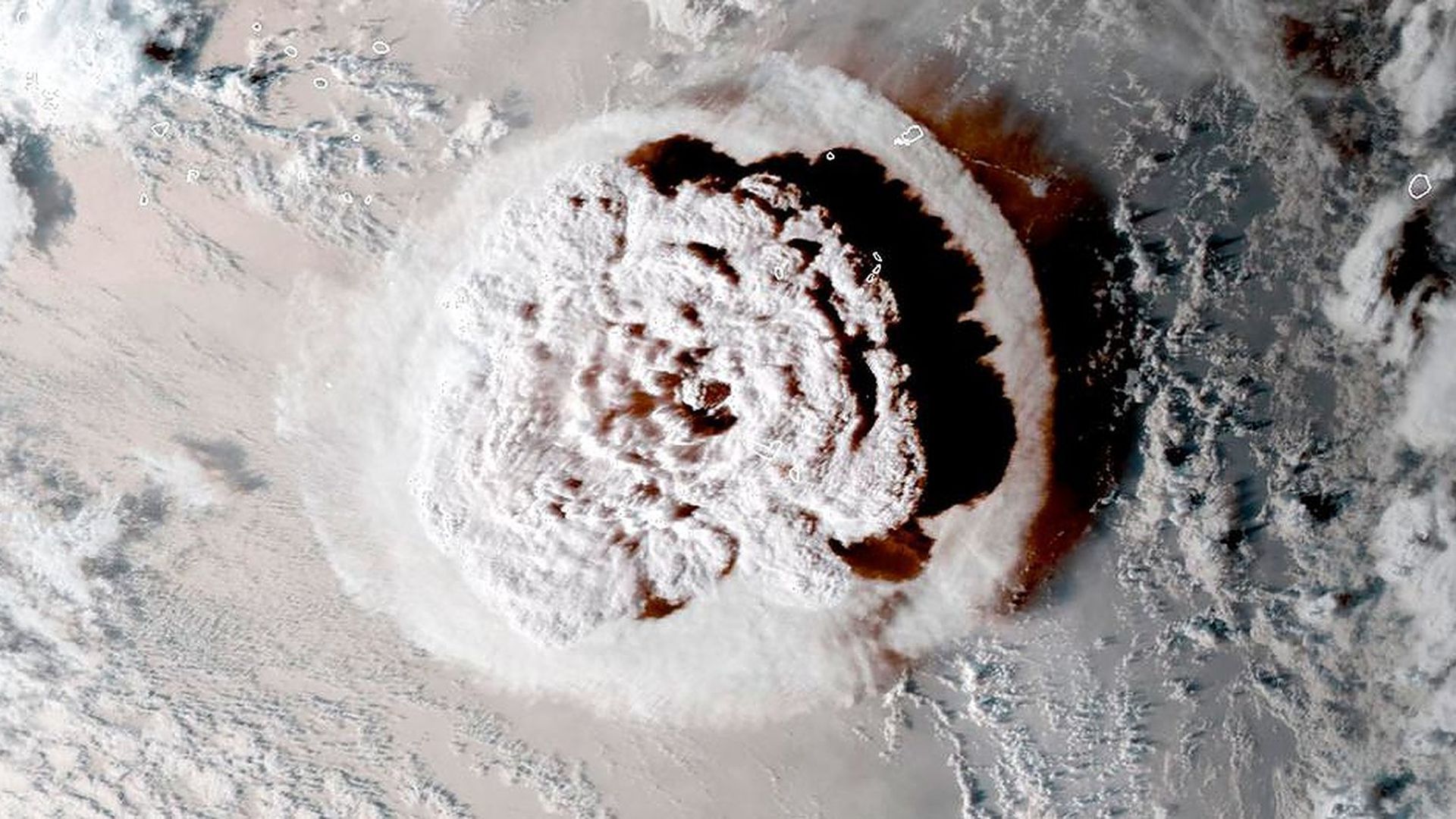 | | | A satellite image of the explosive eruption of the Hunga Tonga-Hunga Ha'apai volcano on Saturday. Photo: UNICEF/NOAA | | | | Tonga volcano eruption created puzzling ripples in Earth's atmosphere (David Adam — Nature) U.S. sees science role as collaborative hub as China rivalry grows (Paul Basken — Times Higher Education) All charges against China Initiative defendant Gang Chen have been dismissed (Eileen Guo — MIT Tech Review) Brain surgeries are opening windows for neuroscientists, but ethical questions abound (Kelly Servick — Science) | | | | | | | | 5. Something wondrous | 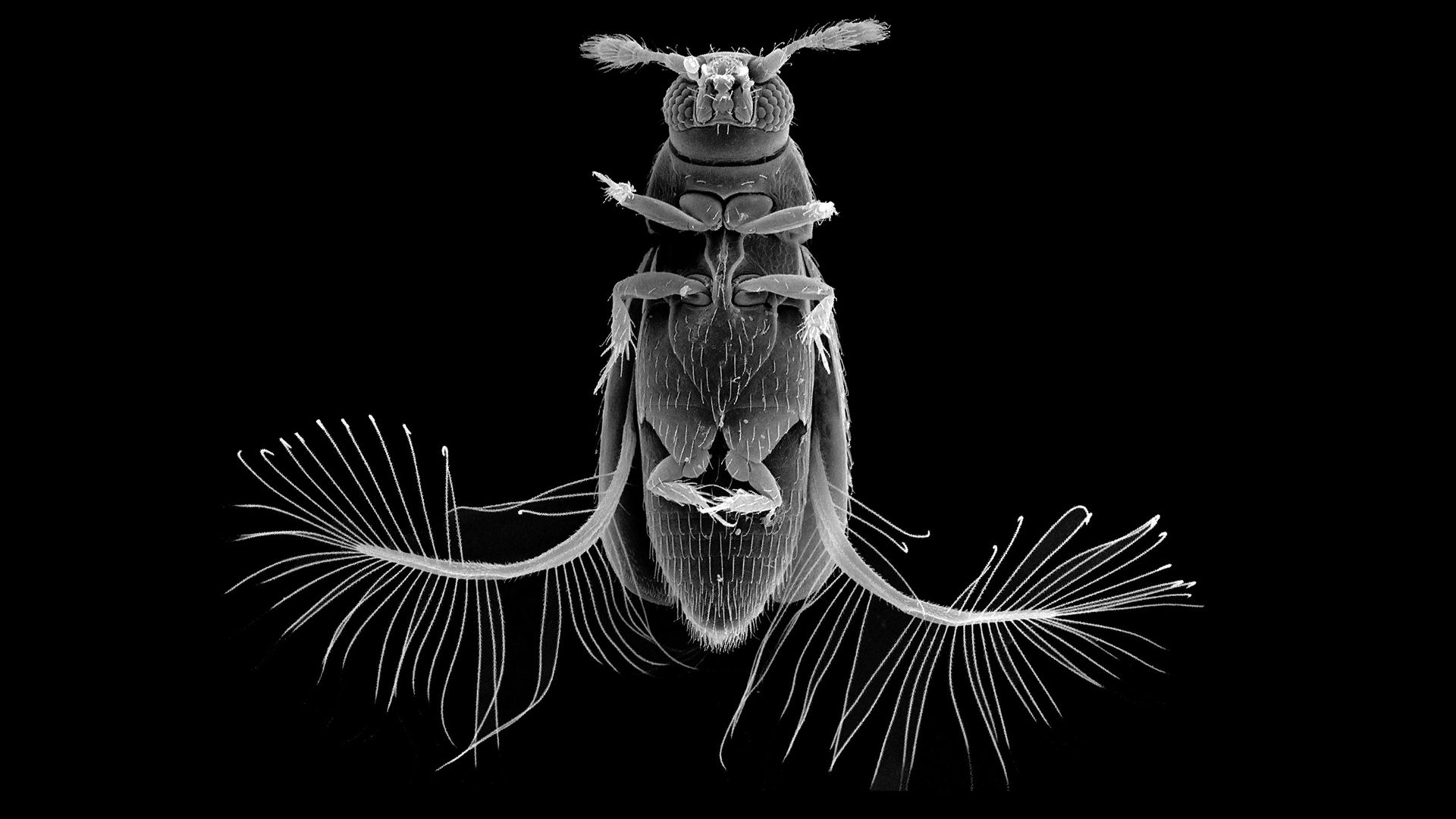 | | | Featherwing beetle (Paratuposa placentis). Image: Farisenkov et al. Nature (2022) | | | | Tiny flying beetles use bristled wings and a unique motion to fly as fast as insects three times their size, according to a new study. The big picture: Small species of insects typically fly slower than larger ones because air friction around small wings challenges an insect's ability to fly. - Featherwing beetles "evolved feather-like wings and a novel flight style that would not have been efficient in their larger ancestors but works very well for them, allowing them to remain extremely good flyers," says study co-author entomologist Alexey Polilov from Lomonosov Moscow State University in Russia.
What they found: Polilov and his colleagues used high-speed video, reconstructions of the beetles' wings, and simulations of air dynamics to determine how a species of featherwing beetle (Paratuposa placentis) moves through the air. - Less than half a millimeter long — about the size of an amoeba, the beetle moves its bristled hindwings in a wide figure-eight-shaped movement not seen before, the researchers report in Nature this week.
- The wing weighs less than similarly sized membranous wings of other insects, so it's easier for the beetle to move, Polilov says. And the bristled wings can still trap air — like a feather.
- The combination of the bristled wings and their unique movement gives the extremely small beetle the ability to generate enough power to fly and accelerate like larger insects.
What's next: The scientists want to compare the flight of these beetles with other tiny flying insects to see how their movements differ and to understand how miniaturization in insects led to new ways to fly. | | | | | | | | A message from Axios | | Your 2022 daily news habit | | | | | | | | Get the news that matters in your inbox every morning and afternoon with Axios AM and PM. Delivered daily by Mike Allen, the world's most wired reporter. Subscribe for free | | | | Thanks to Shoshana Gordon on the Axios Visuals team for her help this week and Sheryl Miller for editing this edition. |  | Bring the strength of Smart Brevity® to your team — more effective communications, powered by Axios HQ. | | | | | | Axios thanks our partners for supporting our newsletters. If you're interested in advertising, learn more here.
Sponsorship has no influence on editorial content. Axios, 3100 Clarendon Blvd, Suite 1300, Arlington VA 22201 | | | You received this email because you signed up for newsletters from Axios.
Change your preferences or unsubscribe here. | | | Was this email forwarded to you?
Sign up now to get Axios in your inbox. | | | | Follow Axios on social media:    | | | | | |


No comments