| |
| |
| |
| Presented By HCA Healthcare |
| |
| Axios Vitals |
| By Tina Reed ·Jan 20, 2022 |
| Good morning, Vitals readers. Today's newsletter is 942 words or a 4-minute read. Situational awareness: NIAID director Anthony Fauci said the FDA could authorize Pfizer's COVID vaccine for kids under 5 in the next month, CNBC reports. |
| |
| |
| 1 big thing: When you're charged a copay you shouldn't owe |
 |
|
| Peter Sacco fought with his health plan to clear a copay he should have never been charged. Photo: Peter Sacco |
| |
| Patients who take pre-exposure prophylaxis (PrEP), a medication that prevents HIV, shouldn't be paying anything out of pocket. The big picture: The federal government specifically reminded health insurers last year to make sure those types of ancillary services for PrEP were free. Zoom in: Peter Sacco, 28, of Washington, D.C., has a prescription for generic Truvada, a PrEP medication. - Sacco buys health insurance from CareFirst, a Blue Cross Blue Shield plan, on D.C.'s Affordable Care Act marketplace.
- Sacco pays nothing out of pocket for his PrEP prescription, but last year he was charged copays for clinic visits and lab work associated with monitoring his health for the prescription.
The bill: $130 — two $60 copays for doctor visits in May and November of 2021 and a combined copay worth $10 for lab work for both visits. - "There's a lot of people who don't know about it and are just paying these copays," Sacco said. "The cost burden for me is not as bad, but it could be more for others."
The other side: Maria Tildon, a marketing and lobbying executive at CareFirst, wouldn't comment on Sacco's case. But Tildon said the broader problem stemmed from doctors not coding PrEP visits as "preventive," even though insurers ultimately have the responsibility to ensure there's no cost-sharing. The resolution: After Axios asked CareFirst about Sacco's case, and as Sacco filed an appeal with the D.C. Office of Health Care Ombudsman, CareFirst told Sacco all copays would be refunded. - Tildon added CareFirst is conducting a retrospective review to see if other members who take PrEP have paid for related services and are owed refunds: "We want our members to be billed appropriately."
This is part of Axios' series, "Billed and Confused." Have you been hit with an unexpected medical bill? Maybe the overall medical billing experience left you feeling puzzled or upset? Email bob@axios.com, so we can dig into what's happening. |
    |
| |
| |
| 2. Omicron moves COVID deaths toward 2,000 a day |
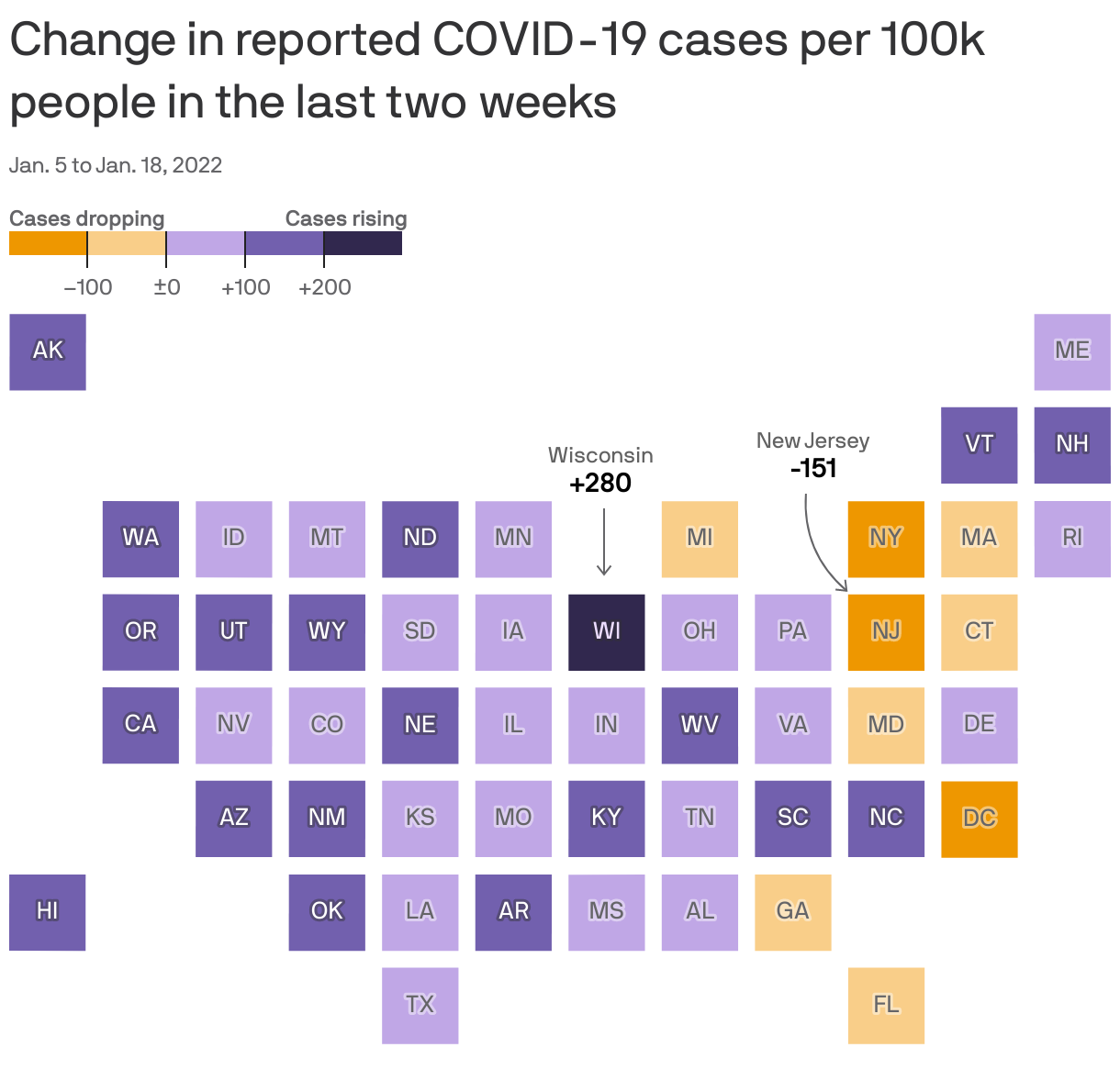 Data: N.Y. Times; Cartogram: Kavya Beheraj/Axios The U.S. Omicron wave may be peaking, but now COVID deaths are climbing as cases continue to soar in most of the country, Axios' Sam Baker and Kavya Beheraj report. By the numbers: The U.S. is now averaging just under 1,900 deaths per day — a 42% increase over the past two weeks. - The Omicron wave is already receding in the places where it first took hold: New cases are slowing down significantly in and around Boston, New York and Washington, D.C.
- But it hasn't yet run its course in the rest of the country. While cases are declining on the East Coast, they've continued to climb just about everywhere else.
- Nationwide, the U.S. is averaging almost 760,000 new cases per day — up 30% over the past two weeks.
Go deeper. |
| |
| |
| |
| 3. 1 big number: UnitedHealth's profits |
 Data: UnitedHealth SEC filings; Chart: Jacque Schrag/Axios The second year of the pandemic did not dampen UnitedHealth Group's finances, and the company actually surpassed its initial 2021 revenue and profit projections, Bob writes. The big picture: UnitedHealth's revenue has tripled from 2010 to 2021, and profit has almost quadrupled. The company continues to make more of its money from owning doctor groups and controlling pharmacy benefits instead of relying on health insurance. |
| |
| |
| |
| A message from HCA Healthcare |
| HCA Healthcare's $10 million commitment to advancing diversity |
| |
 |
| |
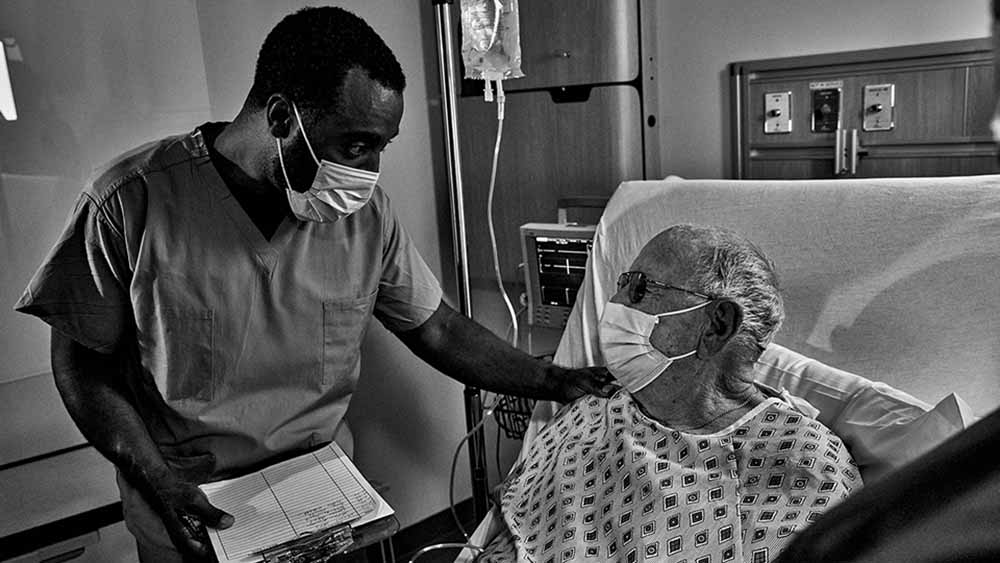
| In 2021, HCA Healthcare announced it will give $10 million to Historically Black Colleges and Universities and Hispanic-Serving Institutions. This investment will help advance diversity in healthcare by creating a more diverse talent pipeline reflective of HCA Healthcare's communities. |
| |
| |
| 4. The prescription drug pricing paradox |
 |
|
| Illustration: Annelise Capossela/Axios |
| |
| Net prices of brand-name drugs have increased significantly over the last decade. But savings from generics have driven average prescription prices down in Medicare and Medicaid, Axios' Caitlin Owens writes about a new analysis by the Congressional Budget Office. Why it matters: The analysis reiterates that the generic market is largely working as it's intended to. By the numbers: The average net price of a prescription fell from $57 in 2009 to $50 in 2018 in Medicare Part D, and from $63 to $48 in Medicaid. - The drop is largely attributable to the growing use of generics, which jumped from 75% to 90% of all prescriptions nationally during that time frame. The average price for a generic prescription also fell in both programs.
- But the average net brand-name prescription price more than doubled in Part D and increased by 50% in Medicaid, per the analysis. These increases were driven by higher launch prices for new drugs and price increases for drugs already on the market.
|
| |
| |
| |
| 5. Study finds racial bias in EHRs |
 |
|
| Illustration: Sarah Grillo/Axios |
| |
| Black patients were more than two-and-a-half times as likely as white patients to have negative descriptors about them in their electronic health record, according to a study published Wednesday in Health Affairs. Why it matters: The study is further evidence of bias in the U.S. health care system, which can ultimately result in worse care and disparately poor outcomes. Details: University of Chicago researchers used machine learning to analyze more than 40,000 notes in the EHRs of more than 18,000 patients at an urban academic medical center. - The study looked for sentences that included negative descriptors such as "resistant," "challenging" or "noncompliant."
- Even when controlling for individuals' sociodemographic and health characteristics, Black patients were 2.54 times as likely to have a negative descriptor than white patients.
What they're saying: "Negative descriptors written in the admission history and physical [notes] may be likely to be copied into subsequent notes, recommunicating and amplifying potential biases," the authors wrote. - "This practice underscores the responsibility of providers who document the initial patient encounter to do so in an aware and sensitive manner," they wrote.
|
| |
| |
| |
| 6. Catch up quick |
 |
|
| South African President Cyril Ramaphosa (L) and NantWorks founder Patrick Soon-Shiong (R) tour the new NantSA vaccine manufacturing campus in Cape Town Wednesday. Photo: Gianluigi Guercia/Pool/AFP via Getty Images |
| |
- Billionaire Peter Soon-Shiong launched a new COVID-19 vaccine manufacturing plant in South Africa on Wednesday. (Bloomberg)
- Men's tennis star Novak Djokovic, who was denied entry into Australia for refusing to get COVID-19 vaccines, apparently has some skin in the COVID treatment game. (Forbes)
- During the Delta wave, prior infection provided protection against COVID, but being vaccinated was still found to be better, CDC officials said. (Newsweek)
|
| |
| |
| |
| A message from HCA Healthcare |
| HCA Healthcare strategically partners with leading tech companies |
| |
 |
| |
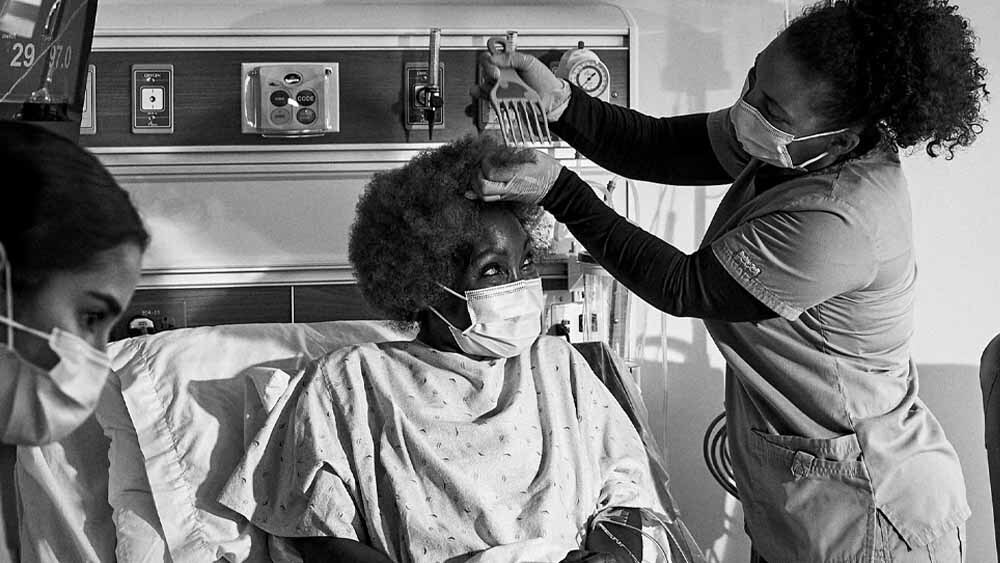
| HCA Healthcare, a leading provider of healthcare services with over 32 million annual patient encounters, has partnered with General Electric, Google and other technology companies. These partnerships help build innovative solutions to advance care delivery in and outside of its hospitals. |
| |
 | Bring the strength of Smart Brevity® to your team — more effective communications, powered by Axios HQ. | | |


No comments