| | | | | | | Presented By PhRMA | | | | Axios Vitals | | By Tina Reed ·Jan 13, 2022 | | Good morning, Vitals readers. Today's newsletter is 947 words, or a 4-minute read. | | | | | | 1 big thing: America reconsiders its COVID goal |  | | | Illustration: Aïda Amer/Axios | | | | Americans' views of life with COVID, and the ultimate goal we're trying to achieve, appear to be evolving quickly at this point in the pandemic. The big picture: In the beginning, efforts were aimed at reducing the overall spread of COVID. Over time, the focus has shifted to preventing the worst outcomes — hospitalizations and deaths. Driving the news: Top Biden officials acknowledged in a Senate hearing this week that most Americans will get Omicron at some point. - "What we need to do is make sure the hospitals can still function, transportation, other essential services are not disrupted while this happens," acting FDA commissioner Janet Woodcock said, according to U.S. News & World Report.
Preventing serious disease and death have been the most important goals since the very beginning, said Megan Ranney, academic dean at the Brown University School of Public Health, but the vaccines' early success against infection may have inflated expectations. "We are starting to see a shift among the folks who take COVID seriously and I think it's an uncomfortable shift for many," she told Axios. - A combination of vaccines, testing and higher-quality masks are helping low-risk Americans safely engage with the world around them.
- Parents have grappled with the safety of daycare or in-person school, weighed against the pitfalls of online learning.
- The approval of antivirals for the treatment of COVID in high-risk individuals is also a factor, as individuals consider risk under the latest variant.
"Where I hope we're going is a recognition that these surges will happen, we're going to do what we can to protect ourselves and our families ... with an acceptance that in some shape or form, COVID is going to be part of our lives and we have to have strategies to deal with it," Ranney said. Read the rest. |     | | | | | | 2. COVID deaths are climbing as cases skyrocket | 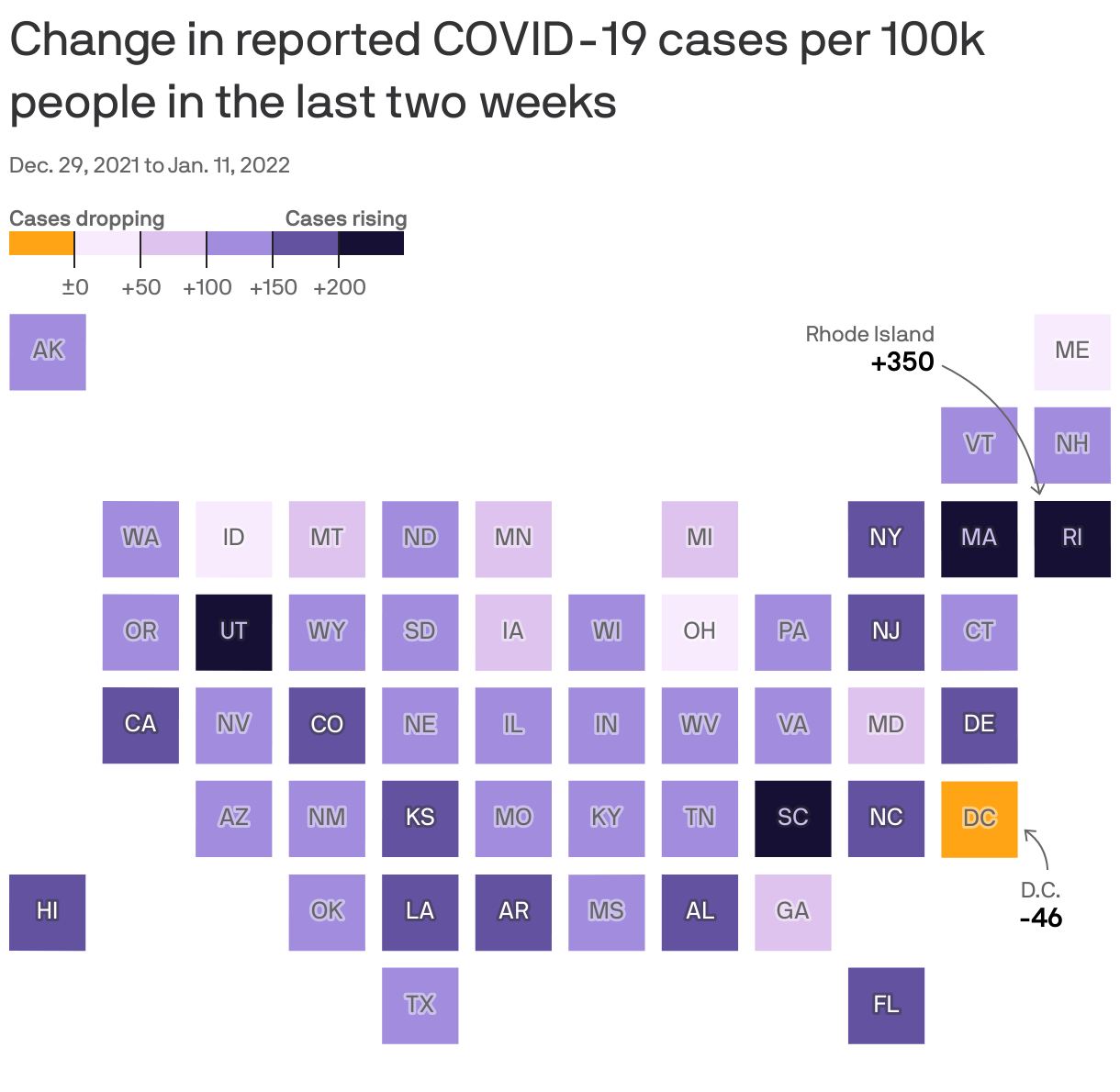 Data: N.Y. Times; Cartogram: Kavya Beheraj/Axios Daily COVID infections have more than doubled over the past two weeks, reaching an average of more than 760,000 new infections per day in the U.S., Axios' Sam Baker and Kavya Beheraj report. By the numbers: COVID deaths are also on the rise, up from about 1,200 per day two weeks ago to an average of over 1,700 per day now. The toll is a reminder that while Omicron is not as deadly as past variants, it's still a serious threat for vulnerable people. Details: Relative to its population, Rhode Island has the country's biggest COVID outbreak, with an average of more than 500 cases per 100,000 residents. Massachusetts, New Jersey and New York each have more than 350 cases per 100,000 people. - If Washington, D.C., was a state, it would be the only state where new infections are slowing down. All 50 of the actual states saw new cases increase over the past two weeks, and most of those increases were large.
- Only three states — Idaho, Maine and Montana — are averaging fewer than 100 cases per 100,000 people.
Share this map. | | | | | | | | 3. Califf confirmation could be a "nail-biter" |  | | | Photo: Sarah Silbiger/Bloomberg via Getty Images | | | | Robert Califf, President Biden's nominee to lead the FDA, is facing a surprisingly tight confirmation vote in the Senate, Axios' Caitlin Owens reports. Between the lines: A handful of Democrats have already announced their opposition to him over concerns about his drug industry ties or the FDA's record on the opioid epidemic, and several others may be on the fence. - But abortion politics — not to mention the opportunity to sink a Biden nominee — are complicating efforts to make up for these defectors with Republican votes.
Driving the news: The Senate Health, Education, Labor and Pensions Committee is scheduled to vote on his nomination today, and it's likely to have the votes to pass. - But whether his nomination has the votes to pass on the Senate floor is a stickier question, even though he was previously confirmed by an 89-4 vote to lead the agency during the last year of the Obama administration.
- Pro-life groups have urged members to vote against Califf's nomination, a wrinkle that certainly makes it a tougher decision for Republicans who may have otherwise been inclined to vote for him.
- "It's going to be a nail-biter until the end," said a senior HELP committee aide.
Go deeper. | | | | | | | | A message from PhRMA | | New study showcases where brand medicine spending goes | | |  | | | | More than half of every dollar spent on brand medicines went to the supply chain, middlemen and other stakeholders in 2020. Key number: The share of total spending for brand medicines received by the supply chain and other stakeholders increased from 33% in 2013 to nearly 51% in 2020. Learn more. | | | | | | 4. The cost of testing | 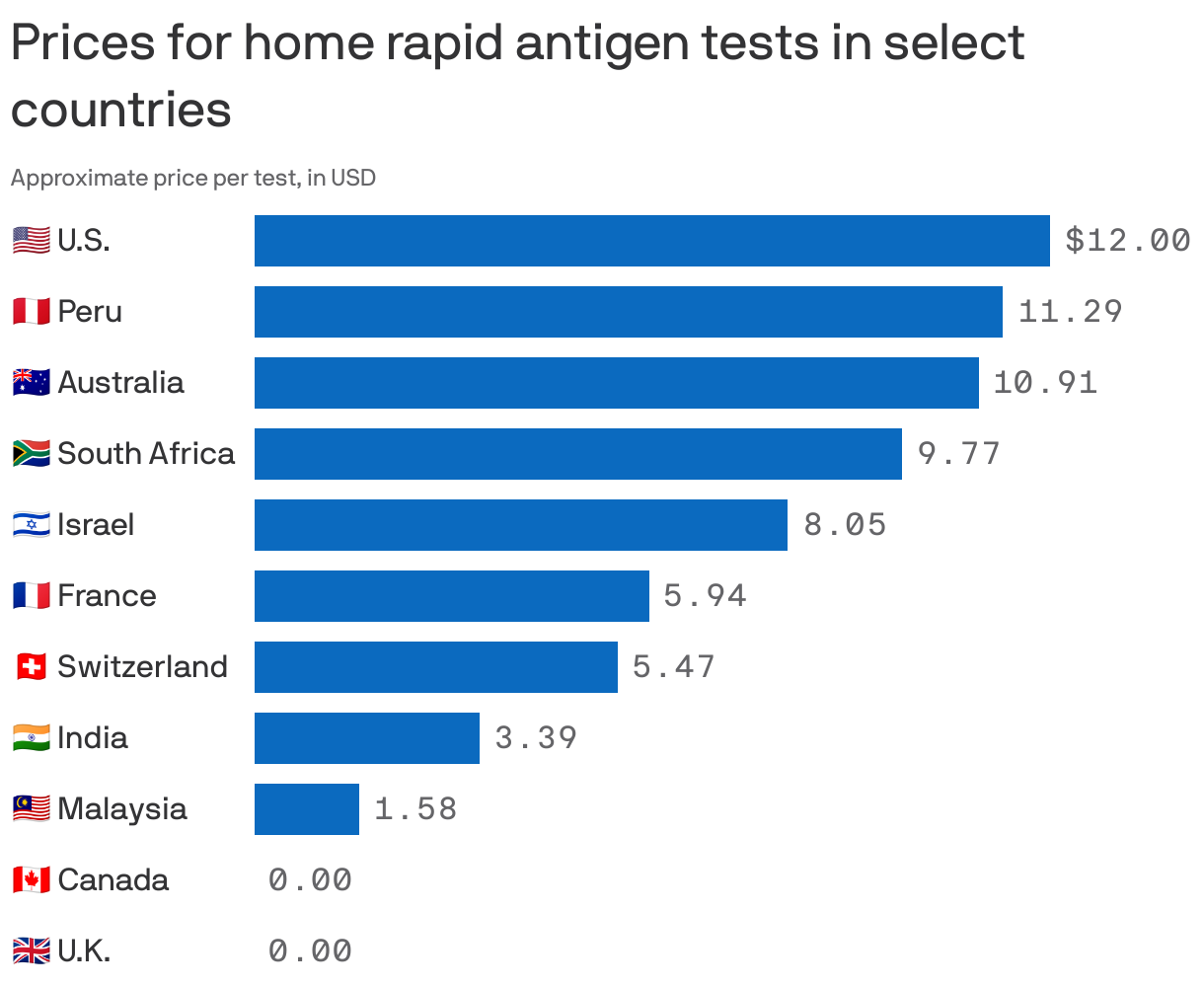 Note: Prices vary within countries. France and Malaysia prices reflect legal price caps. Data: Axios research; Chart: Axios Visuals The average cost of a single at-home rapid COVID test is about $12 in the U.S., more than twice the cost of a test in France and more than three times as much as in India, according to research by Axios' visuals team. - Meanwhile, places like Canada and the U.K. make tests available for free.
- However, health insurers in the U.S. will be required to reimburse costs for up to eight over-the-counter tests per covered person per month over-the-counter COVID tests starting this Saturday.
| | | | | | | | 5. Business notes |  | | | Photo: Kimberly White/Getty Images for TechCrunch | | | | | | | | | | | | 6. 1 interesting thing: Fido's new trick | | Man's best friend may be able to sniff out cases of long COVID, according to a new preprint study. - The study, led by the National Veterinarian School of Alfort in France, supports earlier evidence that dogs may be able to detect long COVID when presented with sweat samples.
Yes, but: This study was small — it involved 45 long COVID samples, as well as samples from COVID-negative, asymptomatic people — and has not yet been peer-reviewed. But it suggests the presence of persistent viral infection in some long COVID patients, as well as the possibility of a "highly sensitive, non-invasive test," authors say. - And this Vitals writer is taking this as yet another reason she thinks dogs are the best...
| | | | | | | | A message from PhRMA | | Middlemen should share the savings with patients | | | | | | | | New study finds that PBMs, hospitals, the government, insurers and others received a larger share of total spending on brand medicines than biopharmaceutical companies. To help lower patient costs on medicines, let's accurately diagnose the problems that exist across the supply chain. | | | | 📫 Did someone forward this email to you? Here's how to subscribe. |  | Bring the strength of Smart Brevity® to your team — more effective communications, powered by Axios HQ. | | | | | | Axios thanks our partners for supporting our newsletters. If you're interested in advertising, learn more here.
Sponsorship has no influence on editorial content. Axios, 3100 Clarendon Blvd, Suite 1300, Arlington VA 22201 | | | You received this email because you signed up for newsletters from Axios.
Change your preferences or unsubscribe here. | | | Was this email forwarded to you?
Sign up now to get Axios in your inbox. | | | | Follow Axios on social media:    | | | | | |


No comments