Key Takeaways and Syntegra's Core Thesis.
Synthetic data is much more flexible than real patient data for product development and research purposes. Synthetic data solves for the traditional complexities associated with the use of healthcare data while minimizing privacy concerns.
To meet the growing demand, Syntegra is leading the way in the synthetic data space to make patient-level data rapid, flexible, and accessible to digital health firms, life sciences companies, health systems and payors alike.
Syntegra functions as an infrastructure SaaS layer to meet data needs for clients of all sizes and maintains a sustainable economic moat which will allow it to differentiate its product offerings and remain a leader in the synthetic data space.
While I'm excited about synthetic data's future, challenges to synthetic data adoption still remain.
Synthetic Data in Healthcare.
In the same way that a fighter pilot trains in a simulated environment, healthcare organizations can harness synthetic data to validate and iterate clinical workflows or set baselines for drug development in clinical trials (or even discover what treatments are working better than others).
The Syntegra team helped me outline a few specific use-cases:
Digital Health and Interoperability: A digital health company building interoperability infrastructure is leveraging Syntegra synthetic data for building and testing its offerings first in a non-HIPAA environment. The use of synthetic data here reduces development costs and risks associated with working with real data to build products.
Life Sciences, Real-World Evidence and Clinical Trial Design: A global pharma company engaged Syntegra to access EU partner datasets to improve and accelerate real-world evidence (RWE) research and health economics outcomes research. In addition to RWE research, there are also several use cases for synthetic data in clinical trial design, particularly looking at how to design trial eligibility and intervention / control arms.
- Beyond clinical trial design, there's an appetite to use synthetic patient-level data for commercial use cases, such as post-launch market surveillance for label expansion and diagnostic / risk stratification algorithms to identify under-treated patients. As we all know from those annoying cookie notifications in browsers, GDPR is notoriously strict. Consequently, synthetic data becomes even more valuable in EU nations.
Academic Medical Centers and Research and Education: A top academic university created a synthetic version of its EHR dataset to enable more secure research and mitigate privacy risks with less IRB oversight. The data is also being used in the academic setting to teach machine learning classes.
- As synthetic data adoption continues to grow and organizations understand its value in saving time and money, Syntegra is well-positioned to respond to and capture increasing demand as the first mover into the space. Based on internal estimates, the synthetic data market is estimated at $30 billion, just a 15% slice of the large and rapidly expanding healthcare data market.
But who is Syntegra?
Syntegra's Origins.
Surprise surprise - Dr. Michael Lesh founded Syntegra after running into data privacy pain points while working at UCSF.
At the time, Dr. Lesh was an established clinician who had led the cardiac electrophysiology at UCSF in addition to founding and running several successful medical device companies. Prior to Syntegra, he found a position as UCSF's Executive Director of Health Technology Innovation and facilitated a project in collaboration with Google and UCSF.
The project sought to develop machine learning software that predicted patient outcomes using existing medical records data. But because the team couldn't clear data privacy and de-identifying issues with legal, the project fell through.
After initial frustration, Dr. Lesh understood that current data privacy standards created serious, debilitating limitations for organizations working on life-saving issues across healthcare.
Determined to solve this unmet need, Dr. Lesh founded his next company, Syntegra . He and co-founder Ofer Mendelevitch recognized how effectively attention-based transformer models could pick up on longitudinal relationships in natural language processing tasks, and realized that they could apply the same principle to healthcare data.
By learning the "language" of health and disease, the models could pick up on the meaningful cause & effect relationships that govern the world of healthcare.
Syntegra outlined an ambitious mission: "Democratize data access to accelerate innovation for improved patient care and outcomes" and is aiming to solve one of the biggest pain points in healthcare outlined above - access to high-fidelity data.
By unleashing synthetic data to the world, Syntegra changes the healthcare innovation game. Innovation in care delivery and drug development can increase at an exponential rate as companies iterate processes over months instead of years.
If the Syntegra mission is successful, it's a game-changer in healthcare. An unsexy, data-driven one, but a game-changer nonetheless.
How the Syntegra Model Works.
Syntegra acts as an infrastructure layer for healthcare organizations who want to access synthetic data. I want to be clear here since this tripped me up just a hair - Syntegra is the data provider and is use-case agnostic - the firm leaves actual use of data up to its clients.
Syntegra offers the following services to healthcare organizations:
Data Licensing. For clients who need data but don't already have it (think: early stage health tech startup), Syntegra licenses its own data (which has been trained on and is representative of 6M+ patient records) on a monthly basis via its API, or via a direct data delivery.
Custom Generation. When engaging with a client that has its own data or wants to work with partner data (like a health system or pharma company), Syntegra generates synthetic datasets from those patient records. This is typically an annual license that includes regular updates to the synthetic data, but can also take the form of a monthly license with the custom synthetic data Syntegra generates delivered via Syntegra's API.
Augmentation. As a supplement to both Data Licensing and Custom Generation Licensing listed above, Syntegra also offers highly customized datasets for specific use cases, a process called augmentation, and charges a flat rate for the service. Augmentation can include expanding population size (such as for rare cohorts) or balancing populations to address bias.
In addition to the above offerings, Syntegra is building and developing new products, like its latest launch of its Synthetic Data API, which is a pioneering offering not only in allowing quick and easy access to patient-level data, but also its ability for users to build patient cohorts to fit a variety of needs.
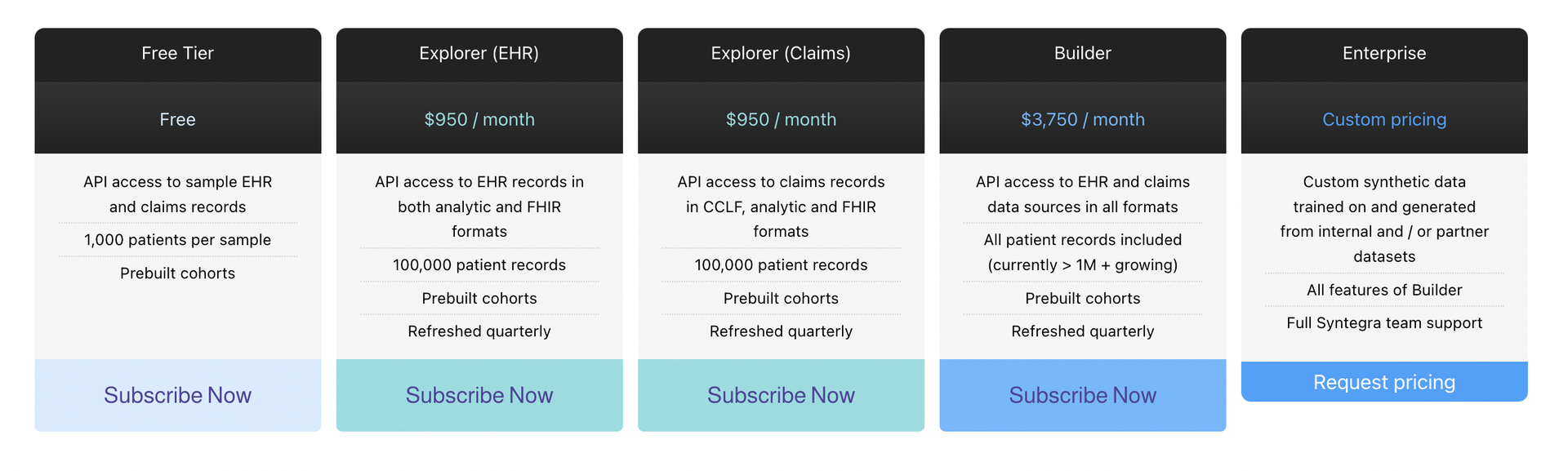
Syntegra's current pricing strategy reflects flexible pricing as a SaaS player.
The firm offers varying ranges of annual (and month-to-month) licenses for access to its API:





No comments