| |
| |
| |
| |
| |
| Axios Vitals |
| By Tina Reed · Nov 22, 2022 |
| Good morning, Vitals readers. Today's newsletter is 815 words or a 3.5-minute read. Join Axios' Tina Reed and Caitlin Owens in Washington, D.C. at 8:00am ET on Wednesday, Dec. 7, for an event with Sen. John Hickenlooper (D-Colo.) on the top priorities, issues and challenges shaping the post-midterm health care policy landscape. - Register here to attend in person or virtually. More speakers are to be announced.
|
| |
| |
| 1 big thing: America shrugs off its twindemic |
 |
|
| Illustration: Gabriella Turrisi/Axios |
| |
| The much-feared twindemic — or even tripledemic — of respiratory viruses is here, but Americans are too COVID-fatigued to care, Axios' Adriel Bettelheim writes. The big picture: Flu in the southeast and RSV infections in multiple regions are filling up hospital wards and causing some facilities to cancel elective surgeries and bring back triage tents. - Though less lethal than COVID-19, the viruses pose a major threat to children and immunocompromised adults. And we're just in November, with the threat of new COVID variants still looming as people plan indoor gatherings and firm up holiday travel.
Yes, but: Americans are good at normalizing risk and have been less and less willing to change their personal behavior since the pandemic's Delta wave. - The creeping threat of another viral outbreak has also been pushed aside by elections, the economy, war and natural disasters.
- "If you don't have children and are a young healthy adult, it's going to be hard to convince you to mask up to protect the population at large," said Yale infectious diseases specialist Scott Roberts.
Driving the news: Much of the current focus is on RSV, or respiratory syncytial virus, which is affecting high numbers of children and has been straining hospitals for weeks. Meanwhile, seasonal flu has been surging through the southeast, hospitalizing thousands and stressing some emergency departments and urgent care centers. The intrigue: COVID is actually the least worrisome piece of the triple threat right now. Cases are down, the new variants seem no deadlier than Omicron, and there are plentiful treatments and vaccines. Read the rest. |
    |
| |
| |
| 2. Work requirements go into effect in Georgia |
 |
|
| Georgia Governor Brian Kemp. Photo: Kevin C. Cox/Getty Images |
| |
| Georgia could begin imposing work requirements on Medicaid recipients following Republican Gov. Brian Kemp's reelection win, Kaiser Health News reported Monday. Why it matters: The Biden administration revoked federal approval for work requirements last year, but decided not to appeal after a federal judge ruled the administration couldn't overrule Georgia's plan, Axios' Maya Goldman writes. - Kemp's plan would expand Medicaid eligibility in Georgia to adults with earnings below the federal poverty line who report at least 80 hours a month of work, volunteering, education or a handful of other activities.
- People with earnings above half of the poverty line would also need to pay a small monthly premium.
Zoom out: Georgia is one of 13 states that got approval from the Trump administration to require that Medicaid recipients work or volunteer in order to be eligible for the benefits. What we're watching: The Biden administration could still challenge Georgia's plan down the road. - Officials may have opted not to appeal in the belief a loss at an appellate court would create an even stronger precedent for Medicaid work requirements, a research professor stipulated in the KHN article.
Flashback: Medicaid work requirements aren't boosting work in Arkansas |
| |
| |
| |
| 3. Twitter flight by major drug advertisers |
 |
|
| Illustration: Natalie Peeples/Axios |
| |
| Among the advertisers fleeing Twitter in recent days are some of the biggest drug companies, Endpoints News reported. Driving the news: A dozen of the top 18 pharmaceutical company advertisers — including Merck, AstraZeneca, Eli Lilly, Novartis and Pfizer — completely cut their spending from Twitter the week of Nov. 14, per a report from Pathmatics, which tracks advertising spending. - The remaining six companies drastically reduced their spending, Endpoints writes.
Between the lines: This comes after a Twitter verification flap that rippled throughout the industry after a user paid an $8 verification fee and impersonated Eli Lilly, saying "Insulin is now free." The news isn't all bad: As STAT reported, Eli Lilly chief David Ricks acknowledged amid the Twitter brouhaha that the company probably could do more to lower the cost of insulin. 🗣 We want to hear from you: Are you sticking with Twitter to share and catch up on health information? If not, what platform are you switching to? Reply to this email and your answers may appear in a future edition of Vitals. |
| |
| |
| |
| A message from Axios |
| Be the one to know before anyone else. |
| |
 |
| |
| Stay informed and ahead of the latest pressing issues taking place in health care policy. Use code POLICYLAUNCH at checkout to get $200 off your subscription. |
| |
| |
| 4. Data du jour: Cervical cancer incidence |
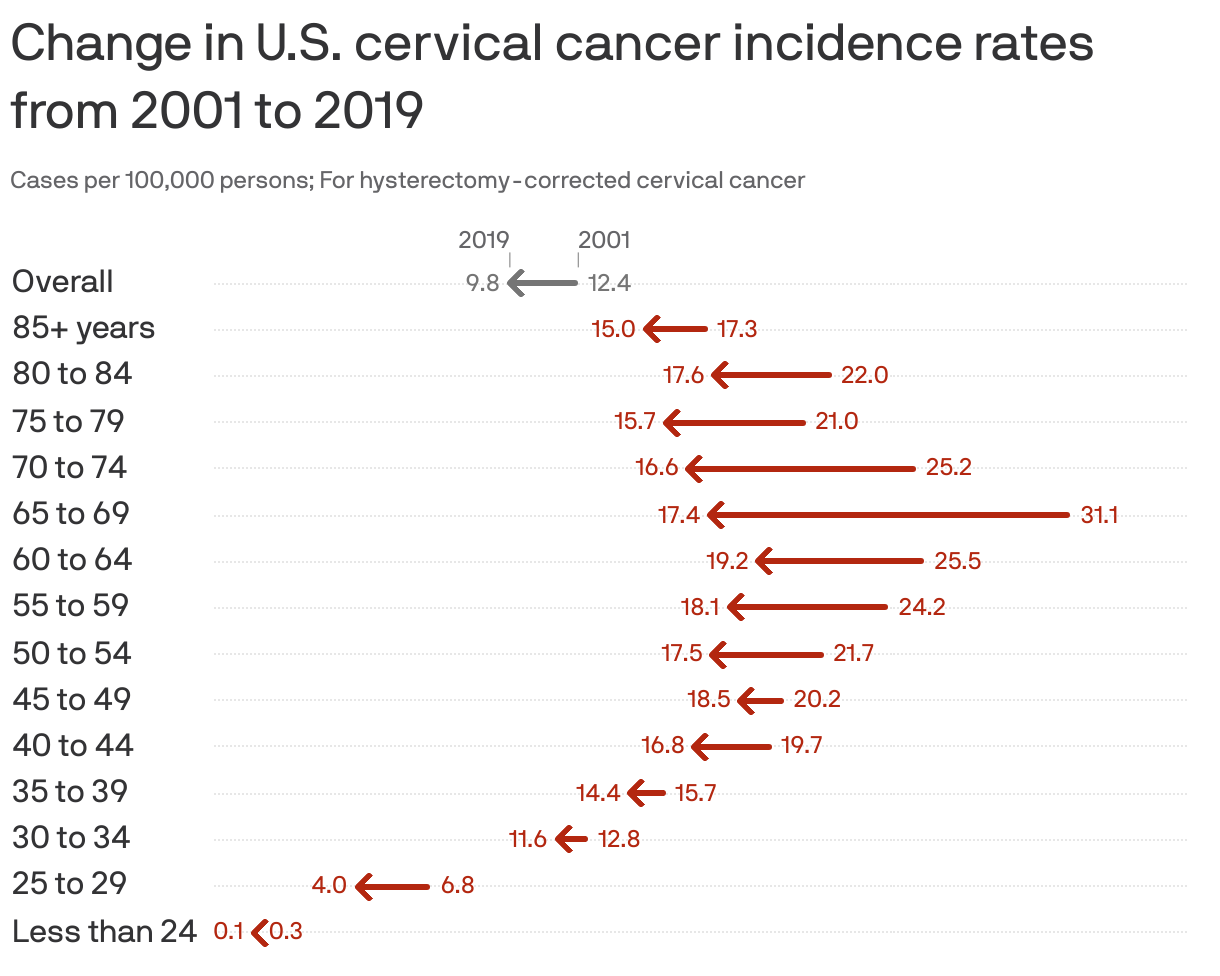 Data: Shahmoradi, et al., 2022, " Cervical Cancer Incidence Among US Women, 2001-2019"; Chart: Simran Parwani/Axios The incidence of cervical cancer in American women has dropped or remained largely stable over the last two decades, a study published Monday in the Journal of the American Medical Association shows. Yes, but: Researchers say the positive trends have plateaued since 2012 across all age groups and, for women in the 30- to 34-year-old age group, incidence increased 2.5% per year after 2012. - The thinking is a significant reduction in cervical cancer screening, particularly among women aged 21 to 29 years, is largely to blame.
|
| |
| |
| |
| 5. Catch up quick |
| 👀 After election win, California's Attorney General turns to investigating hospital algorithms for racial bias. (KHN) 👉 Visually impaired people less likely to access health care, the CDC said. (Washington Post) 🤧 Why the US doesnt have at home flu tests. (STAT) 💰 A look at where the $26 billion in state opioid settlement funding is going. (KHN) |
| |
| |
| |
| A message from Axios |
| Be the one to know before anyone else. |
| |
| |
| |
| Stay informed and ahead of the latest pressing issues taking place in health care policy. Use code POLICYLAUNCH at checkout to get $200 off your subscription. |
| |
| Thanks for reading, and thanks to senior editor Adriel Bettelheim and copy editor Nick Aspinwall for the edits. Did someone forward this email to you? Here's how to sign up. |
 | | Your personal policy analyst is here. | | |


No comments