| | | | | | | | | | | Axios Space | | By Miriam Kramer · Jan 24, 2023 | | Thanks for reading Axios Space. At 1,246 words, this newsletter is about a 5-minute read. - Please send your tips, questions and dark sky areas to miriam.kramer@axios.com, or if you received this as an email, just hit reply.
| | | | | | 1 big thing: The looming threat of light pollution | 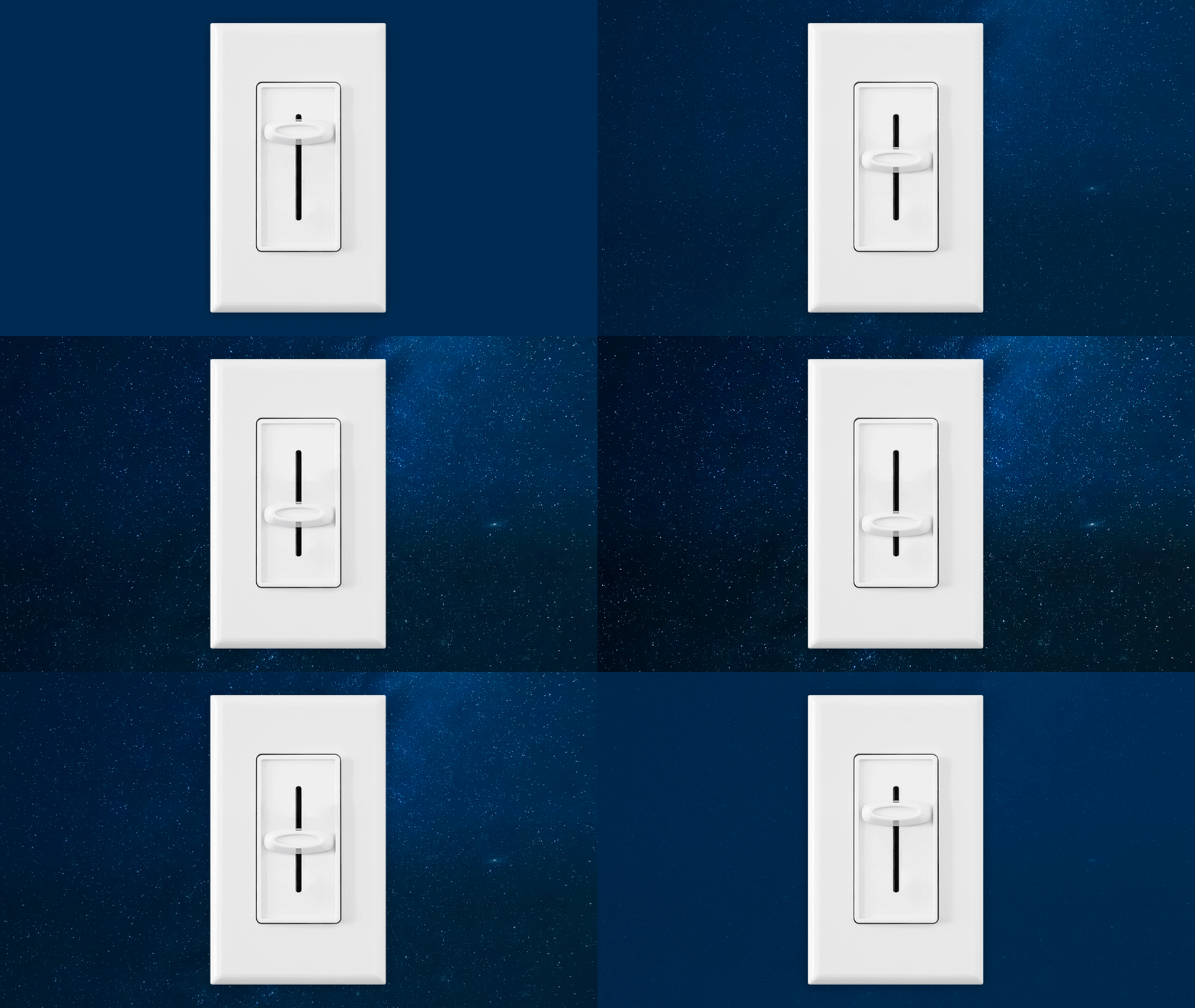 | | | Illustration: Natalie Peeples/Axios | | | | The night sky is getting dramatically brighter due to light pollution spreading across the globe — and it poses an existential crisis for our ability to study space. Why it matters: Information about distant galaxies and star systems gathered through telescopes and other tools is vital for humanity's understanding of our place in the universe. Driving the news: A new study published in Science last week found through 51,351 citizen scientists' observations from 2011 to 2022 that light pollution increased the brightness of the night sky by 7%–10% per year. - That increase is far more than estimates made through satellite measurements that previously suggested an increase of about 2% per year.
- Another study published at the end of 2022 found 21 of 28 "major astronomical observatory sites" are under skies that have a level of light pollution that is able to seriously affect their observations.
The intrigue: Scientists have found light pollution affects animal migration patterns and sleep-wake cycles, and it harms insect populations that birds and other animals depend on for food. - "We are cutting territory with walls of light," Fabio Falchi, a light pollution researcher who was uninvolved in the new study, tells Axios.
- "A bridge over a river is not a wall for some species, but during the night when it is lighted, this light is cutting the river in half for some species. So we are fragmenting the environment where animals live."
- According to Christopher Kyba of the GFZ German Research Centre for Geosciences and one of the authors of the new study, a good rule of thumb is to only light what needs to be lit — like a sign — when it needs to be lit and only the amount of light that you need for it to be seen.
Between the lines: The increase in light pollution each year is likely, in part, caused by growing cities and wasteful lighting techniques, Kyba said. - "When you see that the sky keeps getting brighter, year after year, it means we're just doing a bad job of lighting our cities," Kyba said, adding that taxpayers are paying for much of that lighting. "We're also using a lot of fossil fuels to produce all of that light."
The big picture: Light pollution from the ground isn't the only threat to astronomy. Scientists are still concerned about how constellations of satellites could impede their views of distant cosmic objects from the ground. - Astronomers worry that as the sky fills up with satellites — like SpaceX's Starlink constellation — it will become more difficult to see the stars behind the swarms of moving spacecraft.
- The National Science Foundation and SpaceX, however, are coordinating to mitigate the impacts of the Starlink constellation on observatories on Earth, including adjustments to the satellites themselves to make them look darker.
What's next: Scientists stress that more research is needed in order to figure out exactly why night skies appear to be increasing in brightness each year. - If participation by citizen scientists in the study increases enough, Kyba said, the research team may be able to get more granular with their data, looking at individual states or cities instead of continents.
- Once researchers have that data, they will be able to say what regions are doing better or worse when combatting light pollution and maybe translate that into broader solutions.
|     | | | | | | 2. Cosmic ices revealed |  | | | The molecular cloud of gas seen by the JWST. Photo: NASA/ESA/CSA | | | | NASA's James Webb Space Telescope has parsed out the ices — including methane and carbon dioxide — that make up a distant molecular cloud. Why it matters: Different kinds of ice are key components of habitable planets, and by studying them, the JWST might be able to piece together how complex molecules and even life may evolve in the universe. What's happening: Scientists focused the JWST on part of the molecular cloud Chamaeleon I — which is currently forming new stars —about 500 light-years from Earth. - The team found water, ammonia, methanol — an organic, complex molecule — and other types of ice, according to the study.
- "Our results provide insights into the initial, dark chemistry stage of the formation of ice on the interstellar dust grains that will grow into the centimeter-sized pebbles from which planets form in disks," Leiden Observatory astronomer Melissa McClure, lead author of the new study in Nature Astronomy, said in a statement.
- Scientists also found evidence for other complex organic molecules forming in the cloud, meaning planets and stars born from this cloud "will inherit molecules in a fairly advanced chemical state," Leiden Observatory astronomer Will Rocha, another author of the study, added.
How it works: The JWST's extreme sensitivity allowed the research team to peer into and investigate the molecular cloud. - The telescope was able to see how the light emitted by stars far from the cloud was absorbed by the molecules within it.
- That allows scientists to see the chemical signatures of the various types of ice in the cloud.
| | | | | | | | 3. Space investment takes a hit |  | | | Illustration: Shoshana Gordon/Axios | | | | Investment in the space economy plummeted by 58% in 2022, according to a new report from Space Capital. Why it matters: The space industry isn't immune from the whims of broader markets, and last year's economic headwinds blunted investment in the sector significantly. What's happening: Investment in the space industry peaked in 2021, with $47.4 billion invested. In 2022, it was $20.1 billion. - Emerging space industries were hit hard by this dip in investment, with 63% less invested in this category — which includes speculative markets like the Moon and private space stations — compared to 2021.
- "Tight capital markets have put a premium on sound business models and revenue, including government contracts," the report says.
Yes, but: SpaceX still made it out of 2022 well. The company raised $2 billion last year, despite rough economic waters. - "SpaceX is largely responsible for creating the space economy as we know it today and it clearly dominates the launch industry," Space Capital's Chad Anderson tells SpaceNews. "We can't talk about infrastructure without considering SpaceX and this is not going to change anytime soon."
- Despite economic upset, the overall global space economy also grew last year, according to a report from Euroconsult, and reached $424 billion.
What to watch: The drop in investment could indicate 2023 will be another hard year for space startups. - But experts stress the space economy that emerges on the other side of these hurdles could be tougher, more streamlined and better than before.
- "We believe that less speculation will result in fewer competitors, and a larger talent pool that will make the next two years an attractive time to start and invest in space tech companies," the report says.
| | | | | | | | A message from Axios | | Daily news worthy of your time | | |  | | | | Stay up to speed on the topics shaping our lives in politics, tech, business, media, science and the world. Delivered every morning, afternoon and evening from Mike Allen, Jim VandeHei and Erica Pandey. Subscribe for free | | | | | | 4. Out of this world reading list |  | | | Illustration: Victoria Ellis/Axios | | | | 👽 The search for extraterrestrial life as we don't know it (Sarah Scoles, Scientific American) ❄️ There's snow on Mars (Marina Koren, The Atlantic) 🚀 SpaceX prepares for a breakout year with Elon Musk focused on Twitter (Loren Grush, Bloomberg) ⛅️ NASA suspends efforts to fully deploy Lucy solar array (Jeff Foust, SpaceNews) | | | | | | | | 5. Weekly dose of awe: Starship awaits |  | | | Photo: SpaceX | | | | A fully stacked SpaceX Starship looks skyward in this photo taken on Monday in Texas. - SpaceX loaded the rocket with propellant for a wet dress rehearsal yesterday ahead of its expected first launch to orbit this year.
- The company now plans to unstack the ship from its booster to test fire the ship's engines.
The big picture: NASA is planning to rely on Starship — which will be used as a lunar lander — to bring astronauts back to the Moon as part of the space agency's Artemis program. - That landing could happen as soon as 2025.
| | | | | | | | A message from Axios | | Daily news worthy of your time | | | | | | | | Stay up to speed on the topics shaping our lives in politics, tech, business, media, science and the world. Delivered every morning, afternoon and evening from Mike Allen, Jim VandeHei and Erica Pandey. Subscribe for free | | | | ✨ Big thanks to Alison Snyder for editing, Sheryl Miller for copy editing, and the Axios visuals team for the illustrations. If this newsletter was forwarded to you, subscribe. |  | | Are you a fan of this email format? Your essential communications — to staff, clients and other stakeholders — can have the same style. Axios HQ, a powerful platform, will help you do it. | | | | | | Axios thanks our partners for supporting our newsletters.
Sponsorship has no influence on editorial content. Axios, 3100 Clarendon Blvd, Arlington VA 22201 | | | You received this email because you signed up for newsletters from Axios.
To stop receiving this newsletter, unsubscribe or manage your email preferences. | | | Was this email forwarded to you?
Sign up now to get Axios in your inbox. | | | | Follow Axios on social media:    | | | | | |


No comments