| | | | | | | Presented By Brilliant | | | | Axios Space | | By Miriam Kramer · Apr 11, 2023 | | Thanks for reading Axios Space. At 1,295 words, this newsletter is a 5-minute read. - Please send your tips, questions and National Space Symposium pitches to miriam.kramer@axios.com, or if you received this as an email, just hit reply.
| | | | | | 1 big thing: Creating rules of the road in orbit |  | | | Illustration: Allie Carl/Axios | | | | The space above Earth is becoming increasingly crowded with satellites and junk, and space companies are coming together to update and establish new rules of the cosmic road in orbit. Why it matters: Thousands of satellites are active in orbit today. All that traffic in orbit means that satellites — speeding at more than 17,000 mph — can have close calls with one another, forcing operators to expend precious fuel to maneuver away and keep their expensive spacecraft safe. - Between 2017 and 2021, the number of close passes — defined as spacecraft passing within 1 kilometer of each other — doubled from about 2,000 to 4,000 in low-Earth orbit, according to a 2021 preprint study.
Driving the news: The Space Safety Coalition, an ad hoc group of companies and organizations with a vested interest in space safety, released an updated document last week outlining what it sees as the best practices for operators in orbit. - Those best practices include establishing right-of-way guidance that says spacecraft with greater maneuverability should change course if they are headed for a close encounter with a less-advanced satellite.
- The document also suggests that operators work to protect their satellites from potential cyber interference.
- As of Tuesday, 31 companies and organizations, including Planet, Intelsat and Iridium, have endorsed the document.
Yes, but: SpaceX, which operates the largest constellation of satellites in orbit, hasn't signed on to the best practices document. - "I do think SpaceX should be part of these conversations, and they should be part of these written documents," Victoria Samson, of the Secure World Foundation, one of the signatories of the rules of the road document, tells Axios.
- For its part, SpaceX has previously crafted a document with OneWeb and Iridium outlining best practices that are "complementary" to these rules of the road, Dan Oltrogge, administrator of the Space Safety Coalition, tells Axios.
The big picture: Governments have been considering establishing specific rules of the road for commercial operators in orbit, and documents like these — created with specific input by satellite operators in the trenches — can help create consensus. - "There's been a lot of push for rules of the road, primarily from governments," Oltrogge said.
- While governments have a vested interest in keeping Earth orbit clear and safe, commercial companies are largely responsible for the day-to-day operations of most of the functional satellites in space. That's likely pushing operators to be more proactive.
- By collaborating on these kinds of documents, companies operating satellites today are, in part, probably "trying to get out ahead of governments making regulations for them," Samson said. "If you think people are gonna make the rules for you, you want to get input in ahead of time."
What to watch: The Space Safety Coalition expects that more operators and organizations will sign on to the document, according to Oltrogge. - But the document itself isn't binding, so it will be interesting to see whether the rules of the road established within it are followed when satellites operated by two of the signatories have a close call with one another, Samson said.
|     | | | | | | 2. Inspecting satellites with True Anomaly |  | | | Earth from the International Space Station. Photo: NASA | | | | The private space company True Anomaly is working on developing new satellites to help the U.S. Space Force understand the space environment and keep U.S. assets in orbit safe. Why it matters: Satellites are essential to war efforts for nations around the world, allowing forces to map difficult terrain on the battlefield and communicate across far distances. - These satellites, because of their importance, could be enticing targets for enemy forces.
- The Space Force has also been tracking Russian and Chinese satellites that they say have flown near and taken a close look at U.S. satellites in space.
Driving the news: True Anomaly, founded in 2022, plans to create a constellation of satellites that are able to keep an eye on other objects in orbit and can be used in training operations for the U.S. Space Force. - The company's Jackal Autonomous Orbital Vehicle is designed to fly relatively close to other satellites and "inspect" them, gathering data about what they're doing and how they move.
- True Anomaly plans to launch its first two satellites on a SpaceX rocket this October.
The big picture: These kinds of operations can help nations learn more about what enemy satellites are up to and potentially even help operators on the ground understand what's going on with a malfunctioning satellite of their own. The intrigue: Operations like these could also help experts learn more about how satellites and other objects move in orbit. - "We want to collect as much information as possible, turn this into a big data problem, and then use really smart algorithms to understand more about how to reduce that error and then make really good decisions when it comes to collision avoidance," CEO of True Anomaly Even Rogers tells Axios.
- Rogers also said that the company hopes the Space Force will use its services to help train operators in how to best track satellites using radars and telescopes, flying satellites themselves and even using the company's Jackal for war games.
- Eventually, the company hopes to make some of its services applicable to commercial companies as well.
| | | | | | | | 3. JUICE launching this week | 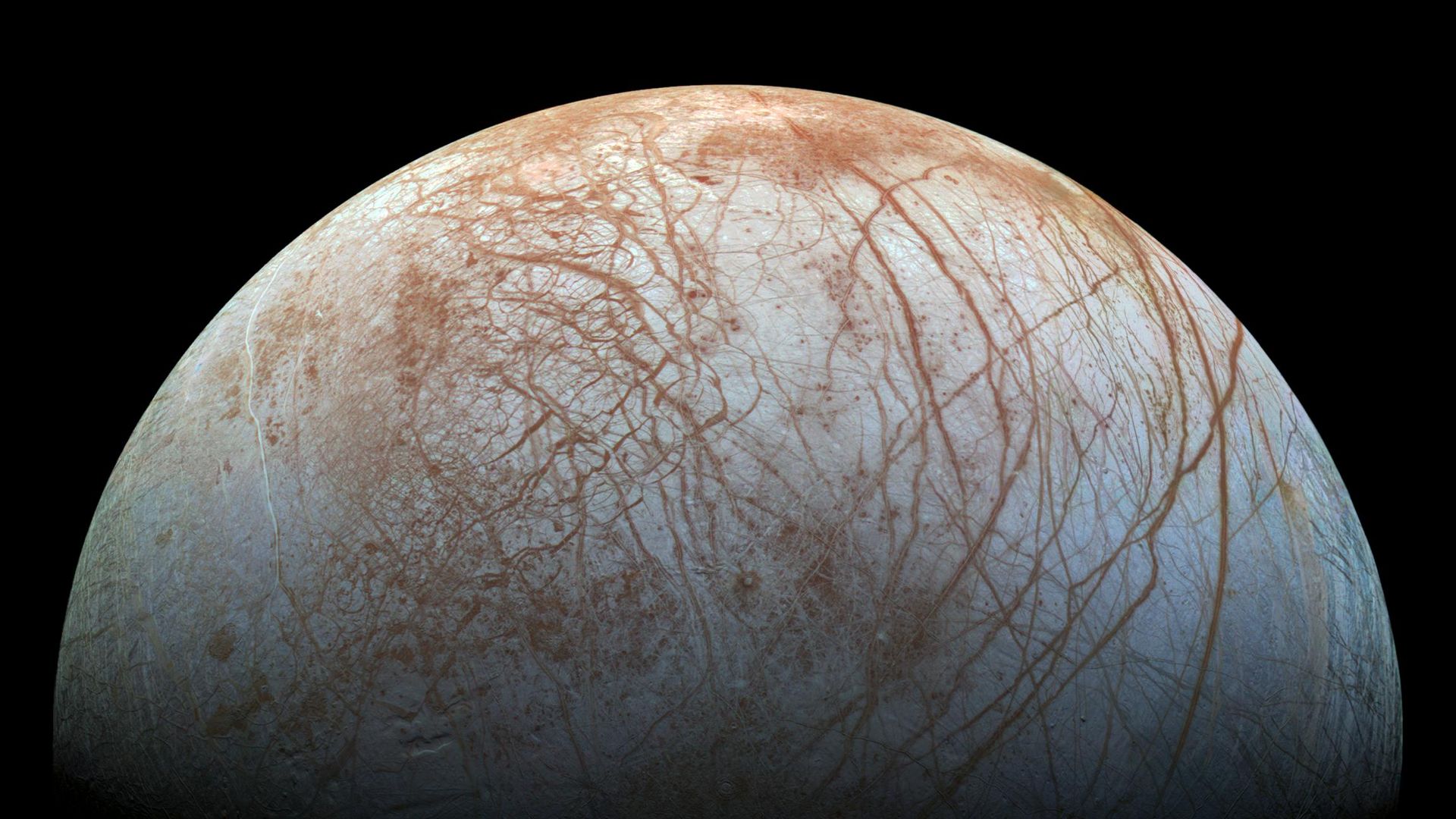 | | | Europa seen by Galileo in the 1990s. Photo: NASA/JPL-Caltech/SETI Institute | | | | A European spacecraft designed to study Jupiter and three of its most intriguing moons is set for launch Thursday. Why it matters: The JUICE mission will focus on studying the moons Callisto, Europa and Ganymede, all of which might be good places to search for life in the solar system. It will also mark the first time a human-made spacecraft has orbited a moon other than our own. What's happening: The mission is due to launch atop an Ariane 5 rocket from French Guiana on Thursday at 8:15am ET. - You can watch the launch live via YouTube.
Between the lines: Europa, Callisto and Ganymede are each thought to have a subsurface ocean beneath their icy shells, potentially making them a habitable environment for microbes or other organisms. - "Together, these moons could hold a colossal amount of water – as much as six times the water contained in Earth's oceans," the European Space Agency wrote.
- The spacecraft will map the moons, investigate Europa's chemistry and potential for supporting life, and learn more about how Jupiter's magnetosphere interacts with its moons.
What to watch: Once launched, it will take JUICE about eight years to get to Jupiter. | | | | | | | | A message from Brilliant | | AI won't take your job, but someone using AI will | | |  | | | | Future-proof your skill set with Brilliant and learn the concepts behind tech like AI, neural networks and more. Here's how: Brilliant's bite-sized interactive lessons let busy people grow their skills in minutes a day. Join 10M+ people learning on Brilliant — try it for free, then get 20% off. | | | | | | 4. Out of this world reading list |  | | | Uranus as seen by the JWST. Photo: NASA/ESA/CSA/STScI/Joseph DePasquale | | | | 🔭 How the JWST just changed our concept of Uranus forever (Elisha Sauers, Mashable) 💥 New photo reveals extent of Centaur V anomaly explosion (Eric Berger, Ars Technica) 💸 Virgin Orbit seeking expedited bankruptcy sale (Jeff Foust, SpaceNews) 🌌 How to see the cosmic phenomenon known as STEVE (Kelly Tyko, Axios) | | | | | | | | 5. Weekly dose of awe: A rogue black hole |  | | | Image: NASA/ESA/Pieter van Dokkum (Yale)/Joseph DePasquale (STScI) | | | | The Hubble Space Telescope appears to have spotted a rogue supermassive black hole leaving a trail of stars in its wake. - The black hole is 20 million times as massive as the Sun. As it speeds through the universe, it's sparking new star formation, creating a trail 200,000 light-years long.
- "We think we're seeing a wake behind the black hole where the gas cools and is able to form stars. So, we're looking at star formation trailing the black hole," Yale University's Pieter van Dokkum said in a statement.
- The black hole is traveling so quickly that it could traverse the distance between the Earth and the Moon in just 14 minutes, according to NASA.
How it works: Scientists think this runaway black hole ended up on its strange, speedy course due to interactions between merging galaxies. - Experts think that two galaxies combined about 50 million years ago, causing their supermassive black holes to orbit one another. Eventually, a third came in, throwing their dynamics out of whack and forcing one black hole off in one direction and the other two in the other.
| | | | | | | | A message from Brilliant | | Sharpen your math, CS and data skills in a few minutes a day | | |  | | | | For professionals and lifelong learners alike, Brilliant is one of the best ways to learn. The deets: Bite-sized interactive lessons make it easy to level up in everything from math and data science to AI and beyond. Join 10+ million people building skills every day. Start with a free 30-day trial. | | | | 🛰 Big thanks to Laurin-Whitney Gottbrath for editing, Sheryl Miller for copy editing, and the Axios visuals team. If this newsletter was forwarded to you, subscribe. |  | | Are you a fan of this email format? Your essential communications — to staff, clients and other stakeholders — can have the same style. Axios HQ, a powerful platform, will help you do it. | | | | | | Axios thanks our partners for supporting our newsletters.
Sponsorship has no influence on editorial content. Axios, 3100 Clarendon Blvd, Arlington VA 22201 | | | You received this email because you signed up for newsletters from Axios.
To stop receiving this newsletter, unsubscribe or manage your email preferences. | | | Was this email forwarded to you?
Sign up now to get Axios in your inbox. | | | | Follow Axios on social media:    | | | | | |


No comments