| | | | | | | | | | | Axios Vitals | | By Tina Reed · Apr 18, 2023 | | Good morning, Vitals readers. Today's newsletter is 911 words or a 3½-minute read. 🍦 Don't stop believin': The Atlantic brings us the curious case of a study that found ice cream is good for you. (This Vitals author is very skeptical, but here's to hoping...) | | | | | | 1 big thing: SCOTUS prepares to examine false claims enforcement | 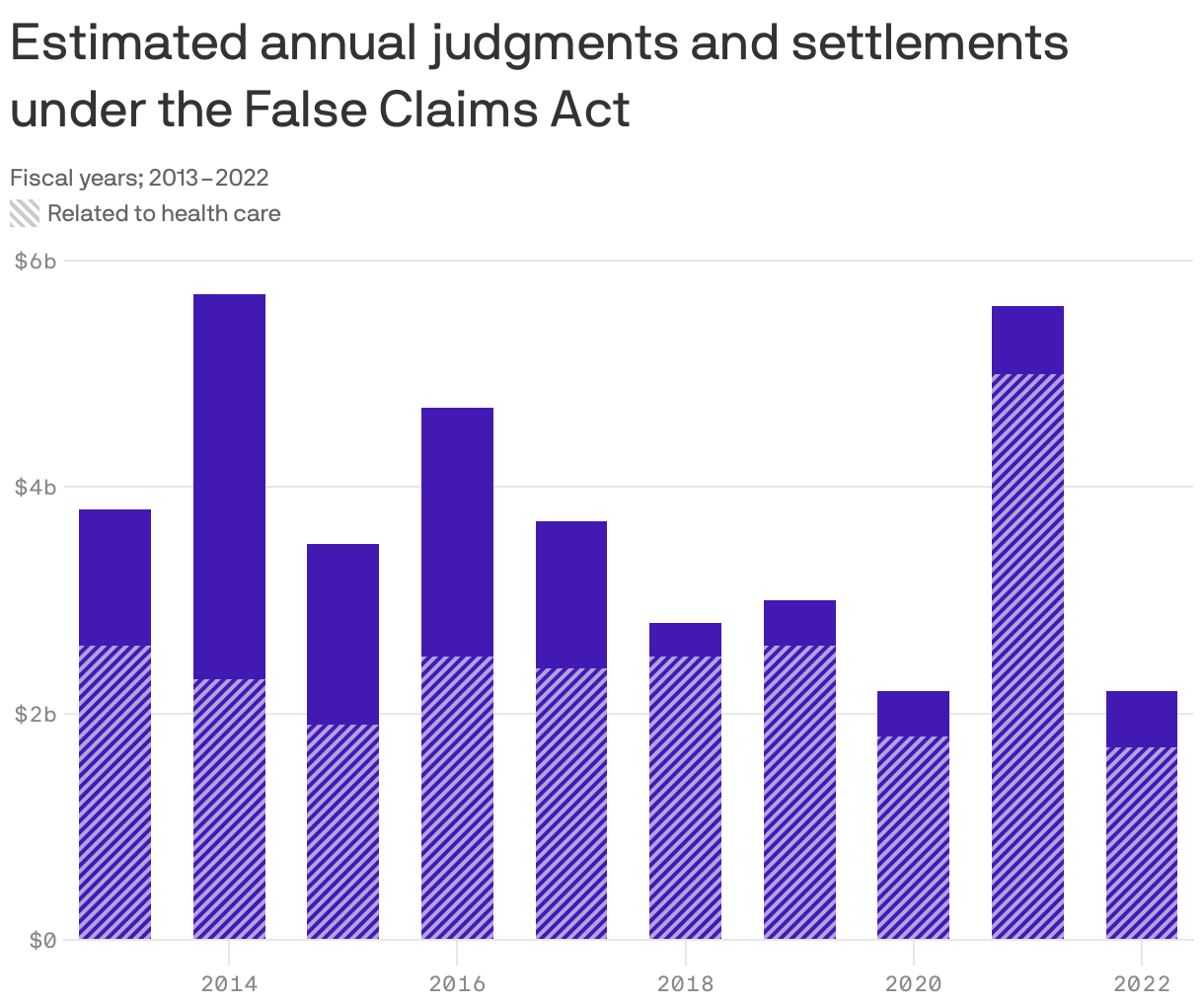 Data: Department of Justice; Chart: Axios Visuals The Supreme Court today will examine whether national pharmacies run by Safeway and SuperValu violated the government's flagship anti-fraud law — or whether the law's requirements are too unclear to hold the chains accountable. Why it matters: Billions of dollars are at stake in the case centered around the False Claims Act, which penalizes those who knowingly defraud the U.S. government. The law has driven scores of whistleblower complaints against health care companies for overcharging Medicare and other alleged misconduct. But challenges have brought into question how to establish if companies knowingly intended to bilk the government. Catch up quick: The potentially "game-changing case" started in 2006, when Walmart began offering deep discounts on commonly used drugs, according to NPR. - In an effort to compete, SuperValu and Safeway extended price-match discounts for cash-paying customers, but charged Medicare and Medicaid the customary prices for the medicines.
- Whistleblowers in both instances alleged the chains knowingly cheated Medicare and Medicaid out of $200 million, Bloomberg Law reported.
The big picture: The case is being closely watched in health business circles and provided common ground for traditional adversaries like the American Hospital Association and health insurer group AHIP. - Last month, they filed a joint amicus brief, saying the government's argument against the pharmacies would "impose criminal or civil FCA liability even though it admits that it cannot 'feasibly address in advance every potential ambiguity' in its thousands of statutes of regulations."
Yes, but: Legal experts say the case could "cripple [the government's] ability to prosecute and deter fraud." - "If the Supreme Court affirms the Seventh Circuit's decision, the Act's intimidating penalties and extremely effective qui tam suits will be diluted beyond judicial repair," per Kohn, Kohn & Colapinto.
Go deeper. |     | | | | | | 2. New docs avoid states with abortion bans | 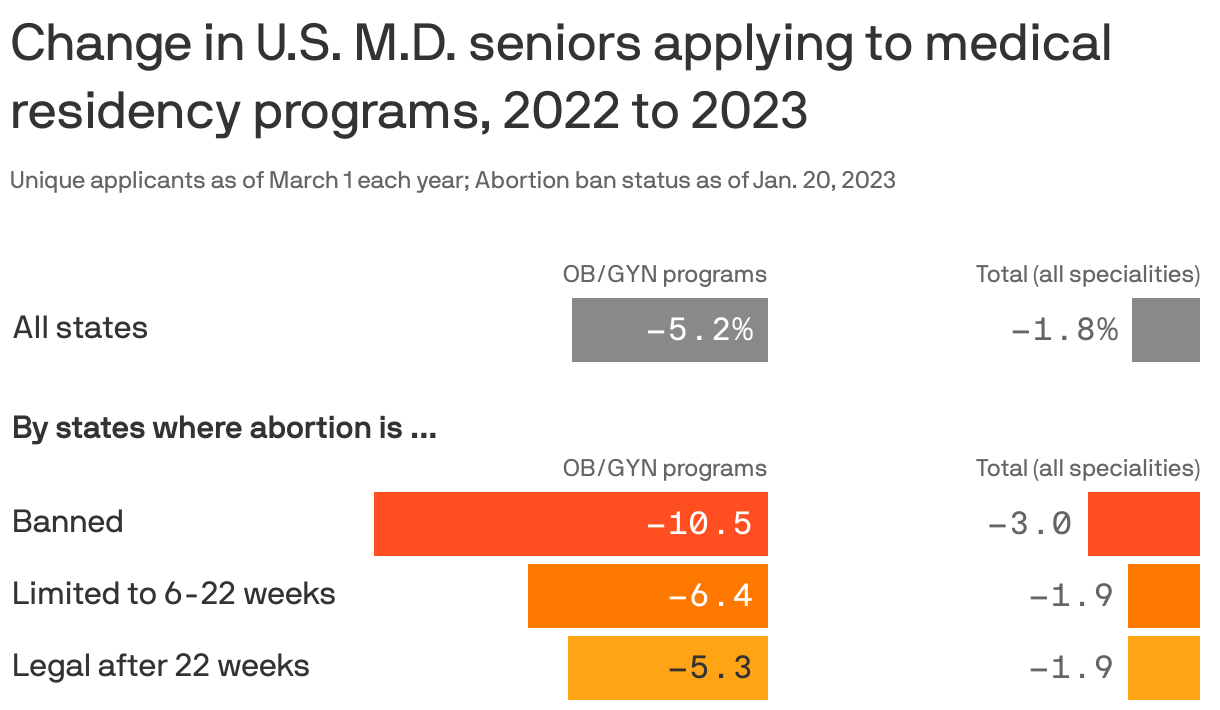 Data: AAMC analysis of ERAS data and KFF abortion ban status; Note: No OB/GYN residency programs in Alaska, Idaho, Montana, North Dakota, South Dakota and Wyoming. States with enforceable abortion bans are Alabama, Arkansas, Idaho, Kentucky, Louisiana, Mississippi, Missouri, Oklahoma, South Dakota, Tennessee, Texas, West Virginia and Wisconsin. States with gestational limits (6 weeks - 22 weeks) are Arizona, Florida, Georgia, Indiana, Iowa, Kansas, Nebraska, North Carolina, North Dakota, Ohio, South Carolina and Utah; Chart: Simran Parwani/Axios New doctors applying to medical residency programs were likelier to avoid practicing in states with the most stringent abortion restrictions, an analysis from the Association of American Medical Colleges found, Axios' Arielle Dreher and Oriana González write. Why it matters: The drop in applications, particularly for OB-GYN residencies, could exacerbate the lack of maternal health care in those states, which already have the highest maternal mortality rates in the U.S. - AAMC found that states with near-total abortion bans saw a 10.5% decrease in OB-GYN applicants who were M.D. seniors this year.
The big picture: Doctors tend to wind up practicing in the locations they train in, and health experts say that it is unlikely that OB-GYNs will relocate to red states, fearing they could run afoul of a rash of new reproductive care restrictions. - Nearly half of programs to train students in obstetrics and gynecology are in states with abortion restrictions or proposed bans in place.
Go deeper: Abortion training set to change after Dobbs decision | | | | | | | | 3. Report: No net benefit for Alzheimer's drug | | Eisai and Biogen's new Alzheimer's drug lecanemab doesn't show a net health benefit over current treatment options and, at its current price, represents low long-term value for the money, the Institute for Clinical and Economic Review said in a report on Monday, Axios' Adriel Bettelheim writes. Why it matters: The findings cast doubts on the first treatment shown to delay cognitive decline from Alzheimer's — which affects over 6 million people in the U.S. - ICER's recommended price based on the drug's clinical effectiveness compared to other treatments was between $8,900 and $21,500 — requiring up to a 66% discount from lecanemab's wholesale cost of $26,500 a year.
What they found: ICER chief medical officer David Rind said current evidence strongly suggests that lecanemab mildly slows the loss of cognition in patients with early Alzheimer's disease. - But factoring risks of brain swelling and bleeding, particularly when the drug is used outside of clinical trials, the report concluded there were significant uncertainties about whether its benefits exceed the risks.
- Beyond direct health effects, ICER said insurers weighing coverage have to consider such factors as the need for treatment based on patients' short-term risk of death or progression to permanent disability.
| | | | | | | | A message from Axios | | Our radical new approach to policy reporting | | |  | | | | Axios Pro: Policy only sends you updates when news breaks, not every day on an artificial cadence. That's news essentialism, designed to save you time. - It's what you need, when you need it, as soon as we know it.
Experience it for yourself. | | | | | | 4. Quote du jour: Senate COVID origins report |  | | | Illustration: Brendan Lynch/Axios | | | | "I think there is a really reasonable logic to what the Chinese might be doing with regard to SARS coronavirus vaccines because they saw the impact SARS had on their country ... They had more than enough reason — as we did post 9/11 — to try to do things to protect ourselves." — Robert Kadlec, lead author of a Senate report on COVID's origins, to Axios' Caitlin Owens. That's Kadlec, a former HHS assistant secretary for preparedness and response during the Trump administration, on the historical context that explains China's motivation to do high-risk coronavirus research that a Senate GOP report concludes most likely caused the pandemic. | | | | | | | | ⚡️ 5. Business lightning round | | ⬆️ Health care mergers and acquisitions reached $12.4 billion in the first quarter of 2023, a big boost over the same quarter a year earlier, according to Kaufman Hall. 💰 Digital health funding was also up in the first quarter, with $1 billion raised, according to a report from Digital Health New York. It's a "surprising bright spot" in the wake of the collapse of Silicon Valley Bank, Axios' Aaron Weitzman writes. 👀 Although "further from [Amazon's] core businesses," Amazon CEO Andy Jassy wrote in his annual shareholder letter that the company's health care efforts have the potential to pay off in the same way AWS has, Axios' Erin Brodwin writes. 🔻 Clover Health is cutting 10% of its workforce as it outsources its health plan operations to improve its bottom line, Insider writes. | | | | | | | | A message from Axios | | Our radical new approach to policy reporting | | | | | | | | Axios Pro: Policy only sends you updates when news breaks, not every day on an artificial cadence. That's news essentialism, designed to save you time. - It's what you need, when you need it, as soon as we know it.
Experience it for yourself. | | | | 👋 Are you at HIMSS23? Tell me what your biggest health tech takeaways are from Chicago and we'll share the best with readers later this week. Thanks for reading, and thanks to senior health care editor Adriel Bettelheim and senior copy editor Bryan McBournie for the edits. |  | | Dive deeper into the future of health care | | | | | | Axios thanks our partners for supporting our newsletters.
Sponsorship has no influence on editorial content. Axios, 3100 Clarendon Blvd, Arlington VA 22201 | | | You received this email because you signed up for newsletters from Axios.
To stop receiving this newsletter, unsubscribe or manage your email preferences. | | | Was this email forwarded to you?
Sign up now to get Axios in your inbox. | | | | Follow Axios on social media:    | | | | | |


No comments