Digital therapeuticsPear dreamt of huge revenues and never got close 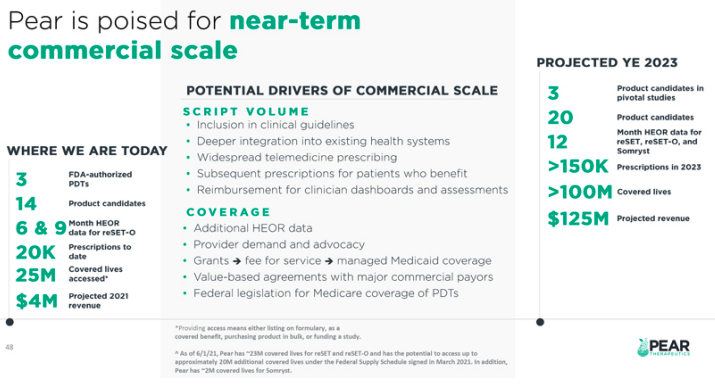
When Pear Therapeutics filed for bankruptcy last week, I was reminded of the slide above from the investor presentation the company gave after announcing it intended to go public via a SPAC merger in 2021. In retrospect, that $125 million revenue projection on the right seems awfully aggressive.
But 2021 was a very different time in digital health. Companies were raising huge rounds and investors afraid of missing out would give money to anything that would absorb it. For Pear specifically, there was a real feeling that the momentum behind health technology created by the pandemic would speed up its path to reliable insurance coverage. Though the company made progress on its business, the "commercial scale" described in the slide above never materialized. Critics say that the company underestimated just how hard it would be to create a business behind its prescription apps.
With boom times venture investment gone, Pear fell on its face trying to raise more money to keep going. Now its
FDA-cleared apps and the rest of its assets will be sold to the highest bidder.
Read my whole story on Pear's demise here.
Artificial Intelligence Google will let health systems test its generative AI tool
Google is releasing a version of its generative language model to health care customers who will begin testing its ability to perform specific tasks in medical settings, STAT has learned. The tool, known as Med-Palm 2, will be distributed to a select group of Google's cloud computing customers over the next several months, with the goal of testing whether it can accurately and safely sift through and summarize vast stores of patient data.
The move will intensify Google's rivalry with GPT-4, the model built by OpenAI that has triggered a flood of speculation about how generative AI tools might change medicine. Yesterday, Microsoft — a major investor in OpenAI — unveiled plans to embed generative AI tools into its own health care computing services. It also underscores the need for researchers to study not just the potential of the tools, but the problems they might create.
"We need lots of people kicking the tires on these models to understand when they're safe to use, when they work well and when they don't work well," Harvard's Andrew Beam told STAT's Casey Ross. Read more here.
Devices Pacemakers without wires may work in kids
The vast majority of medical devices are not tested in children. This includes pacemakers, which traditionally have wires connecting it to the heart. These wires do not mesh well with a small person that's scrambling up trees or hanging from monkey bars. Even routine growth can make the device more likely to fail. But pacemakers are the most reliable treatment for children who have irregular, slow heart rates.
Researchers at the Children's Hospital of Philadelphia and several other institutions suspected that wireless pacemakers, which are implanted directly in the heart via catheter, might fare better in children's bodies than the more traditional, wired devices. On Tuesday, they released the results in Circulation: Arrhythmia and Electrophysiology, a journal from the American Heart Association. They found that wireless pacemakers may work in children just as well as they do in adults, at least in the short term. But until device makers create catheters that fit children's veins, they can't be widely used.
"Everything's easier in a bigger person," said Anne Dubin, head of the pediatric cardiology division at Stanford Medicine Children's Health. "Once you get to smaller, more fragile blood vessels and tissues, your risks go up." Read more here.












No comments