Closer Look
A medical student and artist from Nigeria changes the world of medical illustration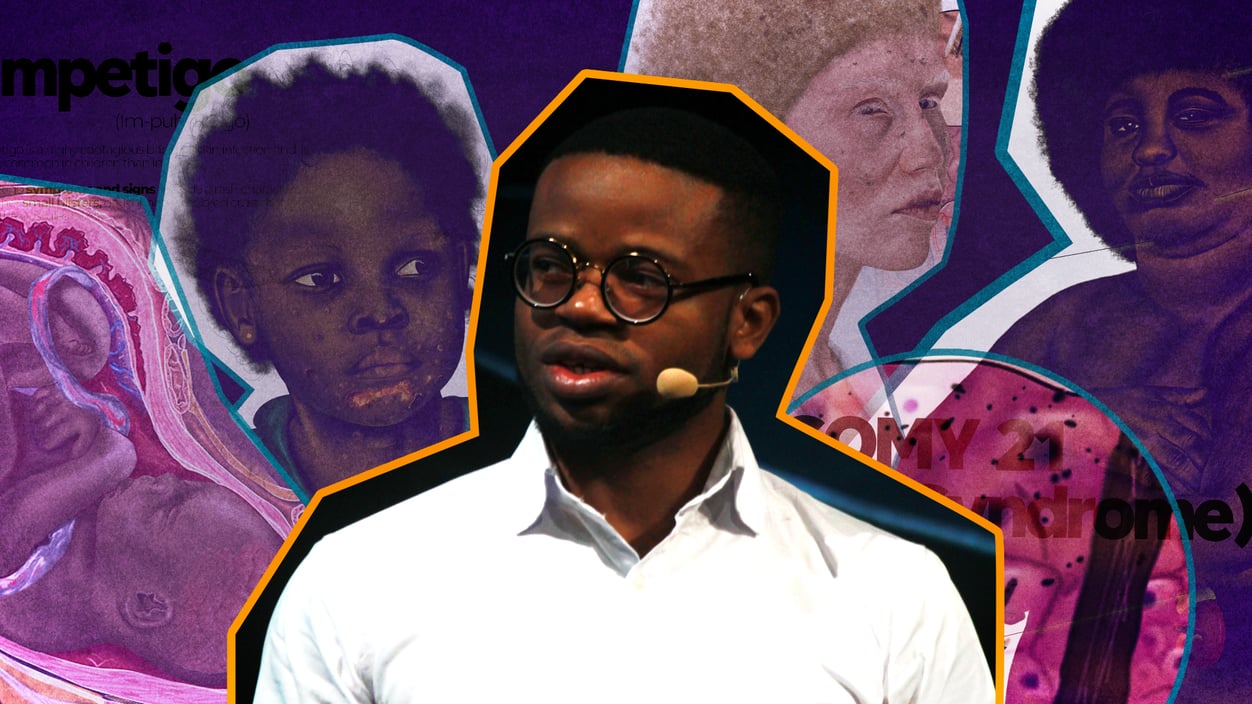
Illustration: Hyacinth Empinado/STAT; Photos: Courtesy Chidiebere Ibe
The medical illustration of a pregnant Black woman and her fetus shouldn't have been groundbreaking when it went viral in 2021, but it was. That's because only 4.5% of the images in medical textbooks feature darker skin tones, which can be dangerous if it leads to misdiagnosis. The image was by Chidiebere Ibe (above), a Nigerian medical student and self-taught medical illustrator. He talked recently with STAT's Annalisa Merelli:
When you started doing medical illustrations, did you intend to add diversity?
No. It's through the process of learning that I realized they didn't represent people of color or Black people.
Do future African doctors learn medical symptoms from images of white people?
I took a course in pathology and realized that all the slides used in lecturing were skin diseases on white people. And I keep asking myself: How does [the same disease] look on Black people?
Read the full interview.
Health equity
How the first Native Hawaiian psychiatrist inspired diversity in medicine
When Benjamin Young started his residency at the John A. Burns School of Medicine University of Hawaii in 1972, he was surprised to learn he was one of fewer than 10 Native Hawaiian trained physicians. Then the dean asked Young, who became the first Native Hawaiian psychiatrist, to launch the novel Imi Ho'ola program. Since then, it's helped raise that number of doctors to hundreds in Hawaii and hundreds more from other underrepresented groups throughout the country.
While the eyes of the world are now trained on Maui and its devastating fires, there is a documentary in the works about the Imi Ho'ola program. STAT's Ambar Castillo asked Young, who turns 85 this week, about encouraging students to believe they could be doctors. "That's the story of Hawaii. You have the children of the plantation, descendants of immigrants, people who were in poverty, those who thought they could never do it." Read how he — and those he inspired — did it.
health communication
Most Americans aren't sure what's misinformation
Call it the uncertainty principle. While few people believe examples of widespread misinformation, such as vaccines causing infertility (3%) or armed crossing guards stopping school shootings (18%), more people weren't so sure, a new KFF poll reports. About half to three-quarters of the Americans are uncertain whether each false claim is true — picking "probably true" or "probably false." That hints in two directions: They may be susceptible to false health claims or they may accept truthful claims from trusted sources, like their doctors.
Local TV news, national broadcast network news, and local newspapers are among the most trusted sources. People who rely on Newsmax, OANN, Fox News, or social media are more likely to have heard the false Covid claims tested in the survey. "The public's uncertainty leaves them vulnerable to misinformation but is also the opportunity to combat it," KFF President and CEO Drew Altman said in a statement.










No comments