Breaking News

Why are lung cancer screening rates so low?; how do you define 'embryo'?; & how can a med student live with two autoimmune diseases?

August 18, 2023
Reporter, Morning Rounds Writer
Good morning and happy Friday to those who observe. Today we look at some mysteries: why lung cancer screening rates are lower than for other cancers, how to define "embryo," and what could account for microbiome differences early in life.

health

Screening rates for the deadliest cancer are low. Why?

A 63-year-old Black man from Massachusetts, Michael Young never smoked, but he had almost all the other risk factors for lung cancer. He grew up on Air Force bases where the now-banned insecticide DDT was sprayed. Both his parents smoked, so he had 17 years of secondhand exposure. And in 2018, his mother was diagnosed with lung adenocarcinoma, the same type of cancer he eventually got. Despite all of this, neither was asked by their doctors to get screened.

Their story reflects a lung cancer screening rate of just 5.7%, compared to 70% to 75% for other tests like mammograms, colonoscopies, and Pap smears. It's been USPSTF-recommended only since 2013. Two reasons: insurance requirements and questions about who's eligible, even as lung cancer has increased among never-smokers, as the late Sharon Begley reported in her last story. STAT's Simar Bajaj has more on the issue.


infectious disease

Talks continue to keep ProMed alive

Two weeks ago, striking moderators sounded the alarm about the potential demise of ProMED, the independent online infectious diseases surveillance network whose host plans to put the service behind a paywall. You'll recall it was ProMED that warned the world about both SARS-1 and Covid-19. Both the International Society for Infectious Diseases, its host since 1999, and the striking moderators have been in discussions with academic and scientific bodies to keep the service going in ways that won't narrow its readership.

"We are in serious negotiation with some major universities and a number of major funders," Paul Tambyah, president of ISID's executive board, told STAT's Helen Branswell. The moderators, subject-matter experts in academia and public health, consider their ProMED work "a labor of love," as ProMED fixture Marjorie Pollack puts it. Most get paid only $7,000 a year, stipends now in arrears. Would ISID fire the striking moderators? "I certainly hope not!" Tambyah replied. Read more.


in the lab

Researchers peg the evolving definition of 'embryo' to its potential tomorrow, not today

The definition of "embryo" is a moving target. "Far from being engrained, it's constantly evolving with scientific advances," said Nicolas Rivron of the Austrian Academy of Sciences in Vienna. He and other leaders in the fast-moving field of synthetic embryology — or "stembryology," as it's sometimes called — assert in a Cell perspective that a new definition for the human embryo should be delineate not how it was made, but what it can become.

IVF is mainstream now, labs can create self-orchestrating stem cells that form embryo-like structures, and the potential for crossing the line to a neonate is looming larger. The Cell co-authors propose defining embryos as "a group of human cells supported by elements fulfilling extra-embryonic and uterine functions that, combined, have the potential to form a fetus." That differs from legal definitions in many countries that are both broad and vague. STAT's Megan Molteni explains how scientists are trying to up their ethical games.


Closer Look

'I want to help folks': This medical student is living with two autoimmune diseases

Photo illustration of Brianna CelixPhoto illustration: Casey Shenery for STAT 

Third-year med school student Brianna Celix has the challenge of managing two autoimmune conditions: Hashimoto's thyroiditis and celiac disease. She chatted with STAT's Isabella Cueto about how her chronic conditions led her to study medicine and  how she works with the dietary restrictions required of her celiac disease. 

How did your thyroid disease show up? And celiac?

The first pediatric endocrinologist I met with essentially told me, "You're an unhealthy, fat kid and you need to get it together." It probably took about a month and a half for us to figure out what was really going on.

How did these twin diagnoses affect your career choice?

That's my "why" for medicine. I usually disclose it right away: I've got this and I've got this, and I want to help folks with it and figure it out with them.

Read the full interview.


In the lab

Racial, ethnic differences in the gut microbiome emerge early in life, but not at birth

STAT's Annalisa Merelli brings this report: The gut microbiome differences associated with certain races and ethnicities are likely due to environmental and social exposures, according to a new PLOS Biology study. The study found that such variations are not present at birth and for the first weeks of life, even as this is when mother-to-infant direct microbial transmission (through breastfeeding, for example) is strongest. Instead, the changes begin emerging at three months, suggesting external factors influence it. 

The childhood gut microbiome can affect the immune system and metabolic development later in life, so the factors that shape the microbiome early on could contribute to future ethnic and racial health disparities. Psychosocial stressors, socioeconomic status, environmental pollutants are all tied to health disparities, but further studies are necessary to identify which of these, if any, has an impact on gut microbiome development.


drug pricing

Weight loss drugs cost far more in the U.S.
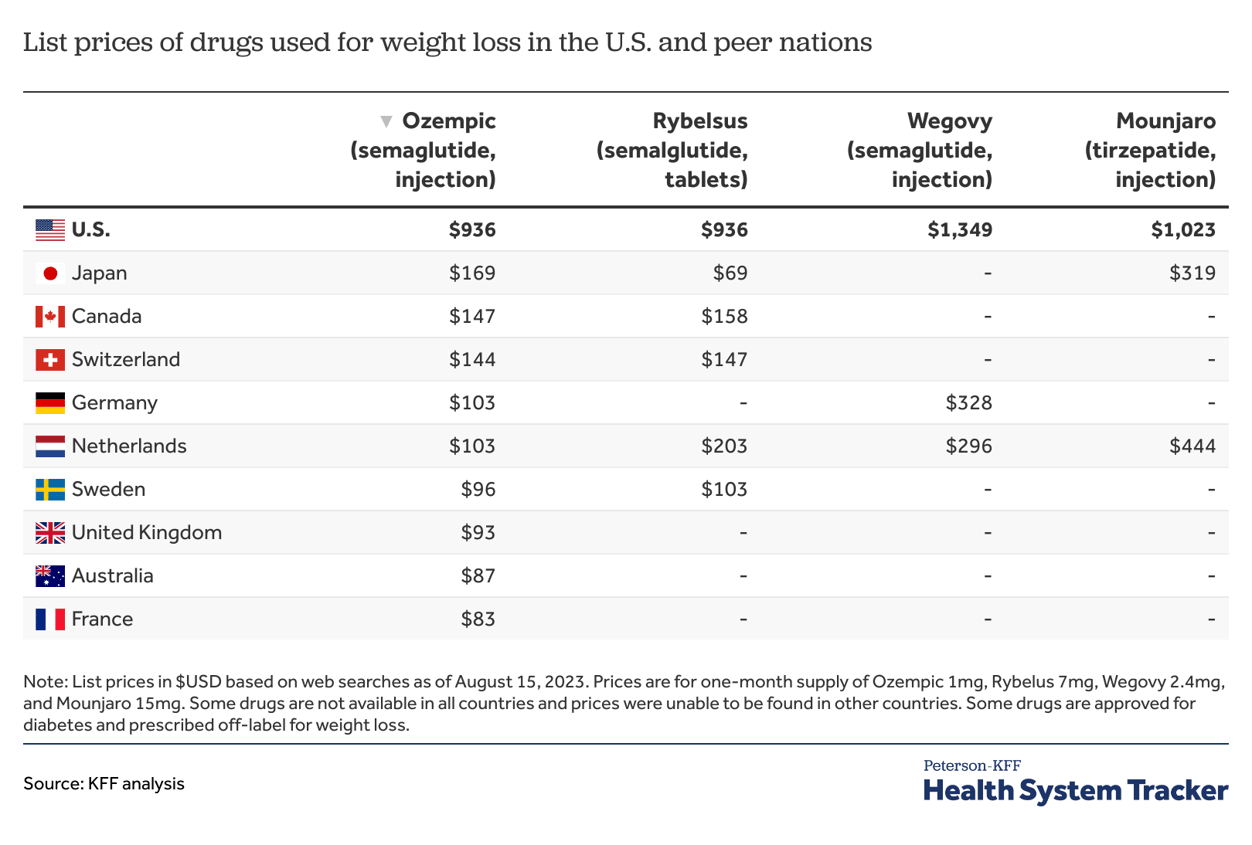
Chart of the list prices of drugs used for weight loss in the U.S. and peer nations

Wildly popular weight loss drugs are hard to find. They're also expensive. A new KFF analysis compares list prices for the drugs in the U.S. to those in similar countries. Prices are much higher here for the drugs, also prescribed for diabetes, even though obesity is more prevalent in the U.S. (33.6%) than in other high-income nations (17.1%). A previous KFF poll found that about half of U.S. adults were interested in taking the drugs until they learned insurance might not pay and the weight might come back. Two price checks:
  • Ozempic, approved in the U.S. for diabetes, is more than five times as expensive in the U.S. ($936) as in the next costliest nation, Japan ($169).
  • Wegovy, approved in the U.S. for weight loss, is four times as expensive in the U.S. ($1,349) as in Germany ($328). 

More around STAT
Check out more exclusive coverage with a STAT+ subscription
Read premium in-depth biotech, pharma, policy, and life science coverage and analysis with all of our STAT+ articles.

What we're reading

  • America's obsession with weight-loss drugs is affecting the economy of Denmark, Wall Street Journal
  • Life can't get much hotter than this, The Atlantic
  • Blue Shield of California overhauls drug pricing operation — by adding more vendors, STAT
  • The toxic aftermath of the Maui fires could last for years, Washington Post
  • U.S. appeals court strikes down key provisions in Oklahoma law that regulates PBMs, STAT
  • South Africa ordered to disclose contracts with Pfizer, J&J, and other Covid-19 vaccine suppliers, STAT

Thanks for reading! More Monday,


Enjoying Morning Rounds? Tell us about your experience
Continue reading the latest health & science news with the STAT app
Download on the App Store or get it on Google Play
STAT
STAT, 1 Exchange Place, Boston, MA
©2023, All Rights Reserved.

No comments