Investigations
How UnitedHealth used an algorithm to cut off care
Casey Ross and Bob Herman have yet another deep dive into the health insurance industry's troubling reliance on algorithms to determine patients' care. United Health Group — the nation's largest health insurance company — pressured its medical staff to cut off payments for seriously ill patients according to its computer algorithm's predictions for the length of time they'd spend in rehab, their investigation found. While the company has maintained that its prediction algorithm is a guidepost for patients' recovery, managers and medical staff were pressured to follow its calculations precisely so that payment could be cut off by the predicted date. According to internal documents, UnitedHealth subsidiary NaviHealth was aiming to keep Medicare Advantage plan patients' rehab stays within 1% of the days predicted by the algorithm, and former employees said they risked discipline or possible termination if those targets were missed. Read more here.
Primary care
Patients loved Carbon Health's diabetes program, but that wasn't enough to save it
The sheen may be wearing off health tech darling Carbon Health's vision for seamless hybrid in-person and virtual primary and urgent care: the company faced several rounds of layoffs especially when it dialed back Covid-related services, and in September, it said it was winding down the diabetes care business it scooped up when it acquired Steady Health in 2021. The company was building powerful technology that could blend data from continuous glucose monitors into chronic care management apps.
It's not unusual for fast-moving, venture-fueled tech companies to introduce and discontinue products in accordance with demand and market pressures. But what happens when patients rely on those services for life-saving care?
"It takes effort for people to get into their rhythms and to find safety or find consistency in these types of services," Jason, one of Carbon's diabetes patients, told Katie Palmer. "For those to go away is just a bummer, and then you've got to figure it out again." Read more from Katie here.
What Amazon Prime's new One Medical offering says about the future of health care
Amazon Prime members can now pay an additional $9 per month or $99 a year to access One Medical's virtual and in-person appointments — a discount of about half for the Amazon-owned primary care company's services. And it's just one of many consumer-focused options hawked by enterprising tech companies offering primary care that's even slightly more convenient than the alternative: traditional brick-and-mortar clinics with opaque pricing, clinician shortages and long wait times, STAT's Annalisa Merelli writes.
"It is a business predicated on a dysfunctional system," Bitsy Skerry, a regulatory policy associate for Public Citizen, told Annalisa. Put simply: Companies like Amazon and competitors like Carbon have a vested interest in traditional primary care continuing to not improve.
But experts also warn that these companies risk worsening the nation's health by exacerbating health disparities, especially when these services are out of reach for patients who don't have money to spare for out-of-pocket fees. And they could be drawing clinicians away from traditional brick-and-mortar jobs, experts told Annalisa. Read more here.
Big tech
Apple-backed asthma app shows positive impact in ambitious study
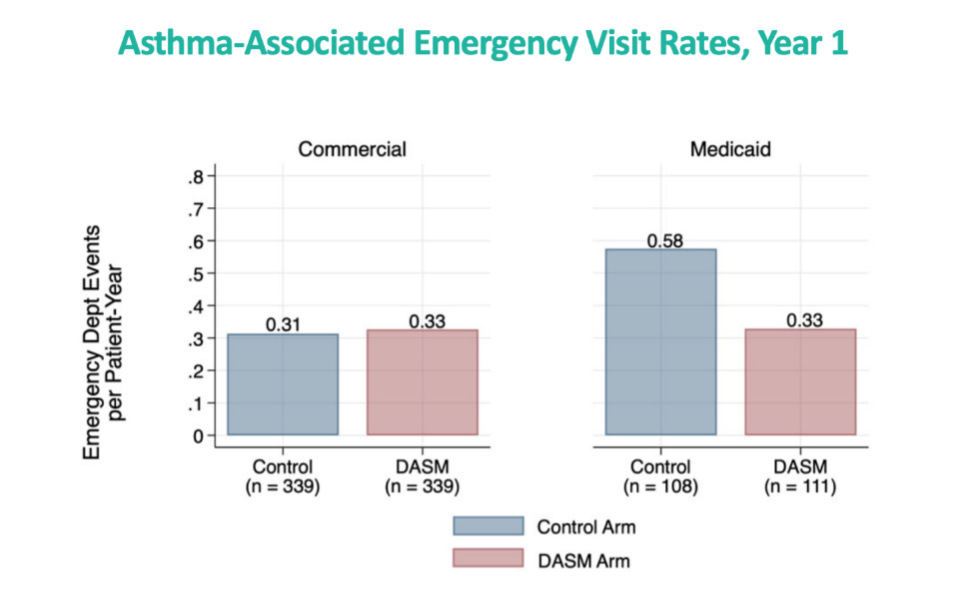
In 2020, Apple and Anthem announced a 900-person randomized study of a digital asthma self-management program meant to help people keep their symptoms under control — one of the most ambitious studies yet to explore how Apple devices could potentially improve a health care outcome.
The program uses an Apple Watch, a sleep tracking mat, and an app that all work together to encourage people to regularly reflect on symptoms and triggers and to equip them to better respond before flare-ups happen. Over time, the hope is that people will grow to deeply understand what contributes to whether their asthma stays under control.
Over the weekend, the researchers behind the asthma program presented the first batch of data showing that people on Medicaid who used the tool were less likely to end up in the emergency department than those who did not. Curiously, participants on commercial insurance did not see an improvement. An analysis of the data looking at health outcomes and cost savings is forthcoming.
The researchers calculate that one emergency department visit is avoided by every four people on Medicaid who received the tool. As my Health Tech co-author Mario Aguilar reports, the study highlights why bias against targeting people on Medicaid with digital interventions can miss populations where there is the most potential impact.
"[It] shows the importance of representation from underserved populations in clinical trials, which is needed to ensure that any benefits of digital health innovation can be realized by all," Jordan Silberman, a co-author of the study, told Mario. Read more here
Lizzy's device digest
NYU radiologists try to make MRI machines cheaper
A small group of radiologists are challenging the assumption that MRI machines, which typically cost between $1 million and $3 million, must be so expensive. And they're looking for ways to build them from scratch.
New York University radiologists Leeor Alon and Tobias Block convened about 50 researchers in New York last month to build a small, low-field MRI, an attempt to increase access to the technology and the scans, which can cost thousands of dollars.
"If we have a low-cost, open source scanner that people can reproduce and build, that can down the road create a lot of new, exciting developments and technology," Block said.
"The kit itself is so complicated that there's so many scientists, electrical engineers, MRI researchers, and clinicians needed to read the scans," Sola Adeleke, an expert in advancing MRI access in Africa, told Lizzy. "All of those things are not in enough supply in low and middle income countries."
Read more.
Covidien is recalling stolen scopes sold illegally
Covidien, a device company owned by Medtronic, is recalling almost 6,000 laryngoscopes: cameras that doctors position in patients' throats to view their vocal chords, Lizzy tells us. According an FDA announcement, someone stole a bunch of these scopes from a scrap pile, meaning they likely have all kinds of defects — and then sold them on Facebook marketplace. People using these devices could be at risk of "inadequate airway support, cardiopulmonary arrest, and death," FDA said.












No comments