politics
Are telehealth flexibilities threatened by partisanship?
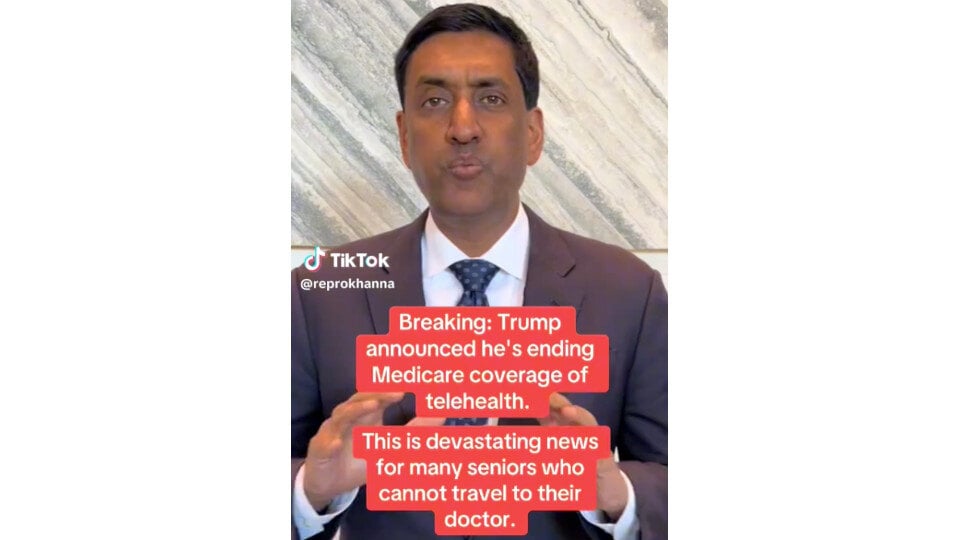
Last Thursday, Rep. Ro Khanna (D-Calif.) posted a video on TikTok informing his 400,000 followers of "breaking news" that "the Trump administration announced that Medicare will stop covering telehealth on April 1st," and calling for opposition to "stand up to these Medicare cuts." Khanna has not previously been vocal on the issue of telehealth, despite his pointing out that he's "the Congressman from Silicon Valley." The TikTok was so random it felt like an calculated move to boost telehealth's profile as a legislative priority, take shots at Donald Trump, or both.
And it took very little time for outrage to build on social media about the assertion that Trump was yanking away the telehealth coverage for seniors. Democratic party operatives ran with it, and behind the scenes, lobbyists who've been working for years to build bipartisan consensus around telehealth, texted each other into the evening and the next morning, trying to figure out what exactly it was that Khanna knew that they didn't.
The answer, in short, is nothing. Medicare coverage for telehealth is indeed ending April 1st as of right now. As savvy Health Tech readers know, this coverage is in a period of limbo. During the pandemic, Congress temporarily expanded the telehealth services covered by Medicare, but the rules were set to expire at the end of last year. A bipartisan push to extend the coverage for two years made it into a large year-end budget compromise that was torpedoed at the eleventh hour in December by Trump and Elon Musk. Congress was forced to pass a stop-gap bill to fund the government through March 15th, and short-term extensions of the Medicare flexibilities rode along with it.
Insiders tell me that another extension is likely with whatever happens with the budget, however, if lawmakers can only agree on another short-term funding deal, the telehealth extensions may only be a few months long. As ever, budget negotiations are dicey, and important provisions can be removed or altered at the last minute.
Despite there not really being any news, by midday Friday, alarm in the digital health community had reached such a level that the American Telemedicine Association was forced to issue a statement to dispel "rumors… mistakenly claiming that telehealth services will not be extended past the March 31 deadline."
The concern raised quietly among advocates is that telehealth might become a partisan issue. The idea of eventually making Medicare telehealth coverage permanent has the support of lawmakers from both parties. For now.
It makes sense that most people do not understand the ins and outs of Medicare telehealth flexibilities and budget negotiations. And as one lobbyist put it to me, the confusion is a good example of how temporary policies that are constantly on the brink can create problems. Despite not mentioning extensions at all in his initial postings, presumably, Khanna was aware of how this all works. But in a statement issued late Friday, he continued his attack, blaming Musk and Trump for blocking the extension legislation last year, adding, "Trump has not done anything to push Republicans to extend [telehealth]." Pushed on Monday as to whether he worried he was making telehealth a partisan issue, he dug in further, saying, "we must clearly make sure Americans know [Trump] and [Trump] alone is responsible for eliminating the telehealth coverage," which again, has not yet been eliminated and seems likely to be extended.
earnings
With semaglutide shortage over, Hims looks ahead
On Friday, the Food and Drug Administration announced the semaglutide shortage is over, making the Hims and Hers full-year 2024 earnings call on Monday something of a reckoning for a company whose stock price has surged thanks to selling compounded versions of the popular obesity drug.
STAT's Katie Palmer tells us that with the shortage over, the company announced it will stop selling "essential copies" of semaglutide in the same doses offered by Novo Nordisk — but that dosages could still be altered to deal with side effects like nausea. In the call, CEO Andrew Dudum leaned into a broader vision for the company built on "hyper-personalized" care leveraging its recent acquisition of an at-home testing company and a peptide facility. How to pull that off at scale? AI, of course! AI to turn those brand-new data streams into algorithmic medication suggestions, and a full stable of AI agents: "AI coaches, therapists, nutritionists and trainers, available for 24-7 on demand support," Dudum mused.
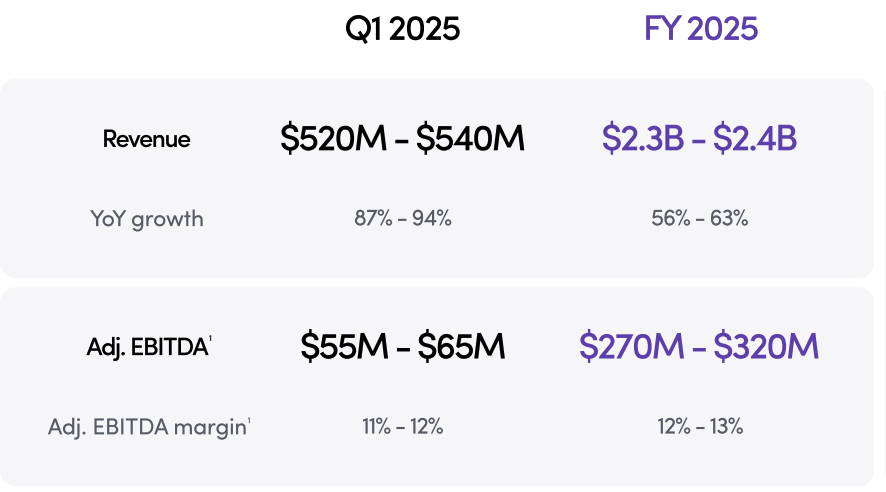
Despite the semaglutide damper, Hims' finanicial performance continues to improve. It reported $1.5 billion in 2024 revenue, up 69% over the year before, and $126 million in net income. Looking ahead, the company projected at least $2.3 billion in revenue in 2025.
Medical records FDA's former digital health leader heads to Oracle
In a climate that's increasingly sensitive to the revolving door between industry and the Food and Drug Administration, Troy Tazbaz, who lead FDA's digital health center for two years, is heading to Oracle to be a senior vice president of data center planning, according to his LinkedIn profile. Tazbaz worked at Oracle for over 10 years before joining FDA. It's unclear if he's going to be working on health care at all at Oracle, but the company has close ties to the Trump administration. Personally, the job title gives me Stargate vibes.
Elsewhere, Patrizia Cavazzoni, who stepped down from her post as the head of drug evaluation at FDA is heading to Pfizer to be an executive vice president and the drugmaker's chief medical officer.












No comments