science
The NIH programs Francis Collins is worried about
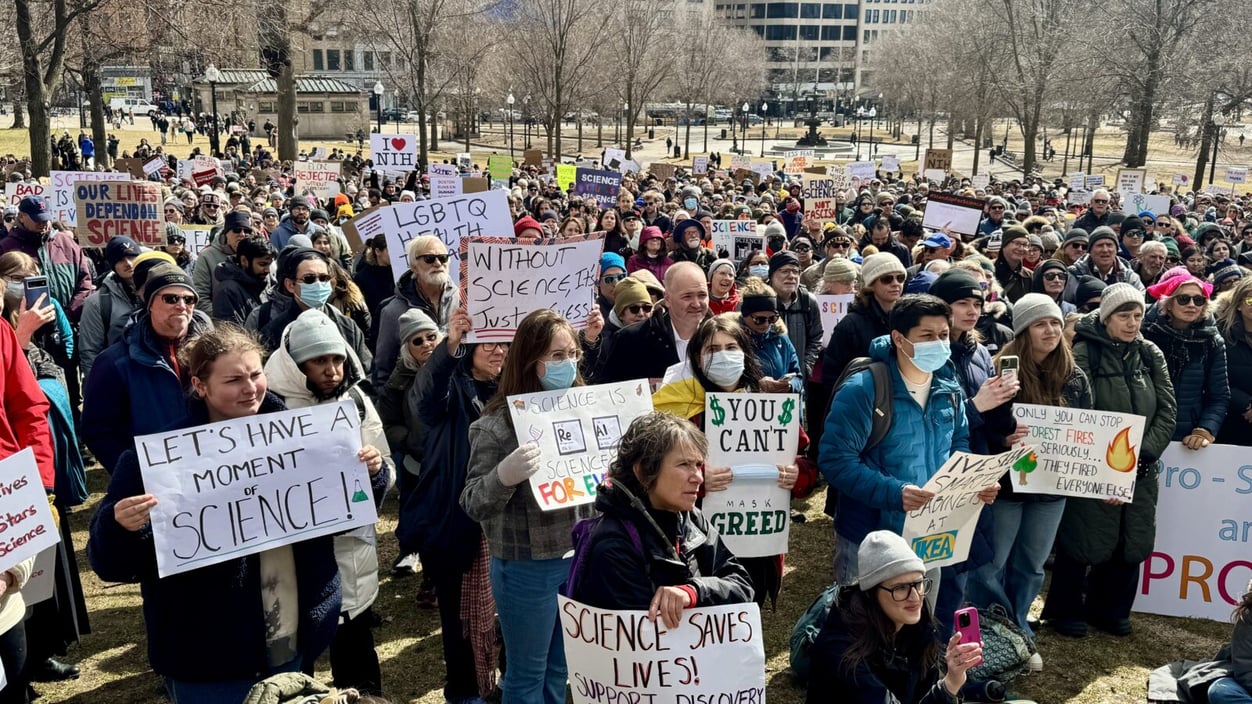
Erin Clark/The Boston Globe
Days after retiring from the NIH, former agency Director Francis Collins warned that two signature programs — the BRAIN, which aims to decipher how the lowercase brain works, and All of Us, a large, diverse genomics database — are threatened by Trump administration actions.
"Both of these groundbreaking projects are now at severe risk because of budget and workforce cuts," Francis Collins said during a speech in D.C., during one of dozens of Stand Up for Science rallies held around the U.S. on Friday. Events took place in 32 cities across the country, with a smattering of affiliated rallies in other towns and university campuses across the globe. Read more from STAT's Anil Oza and Katherine MacPhail about what Collins and other science leaders had to say.
one big number
7%
That's the percentage of U.S. adults who have been present during a mass shooting — in which four people or more are shot — according to a survey of 10,000 people published Friday in JAMA Network Open. For most (76%) of the people who have been through it, the shooting occurred in their local community. Younger people, men, and Black people were more likely than older folks, women, and white or Asian people respectively to be a witness to a mass shooting.
Last summer, former U.S. Surgeon General Vivek Murthy declared gun violence a public health crisis. At the time, he hoped the designation would "firmly take it out of the realm of politics and put it into the realm of public health," as he told former STAT reporter Nalis Merelli. It's unclear how President Trump's pick for the position, Janette Nesheiwat, will or won't address gun violence if confirmed for the role. The New York Times reported in December that Nesheiwat's father died from an accidental gunshot wound when she was a child.
antitrust
Researchers say journal publishers violate antitrust law
Four researchers are suing six of the world's biggest publishers of academic journals, arguing that the system in which they operate is exploitative and overly expensive, and that it relies on illegal and anticompetitive practices.
The scientists allege that these publishers — Elsevier, John Wiley & Sons, Sage Publications, Springer Nature, Taylor & Francis, and Wolters Kluwer — collude not to pay researchers for peer-reviewing manuscripts, prevent them from submitting papers to more than one journal at a time, and block authors from publicly discussing or sharing work once they've submitted it to a journal. Read more from STAT's Jonathan Wosen about the sweeping implications the case could have on the research community.












No comments