special report
NIH cuts threaten the next generation of scientists
Lexey Swall for STAT
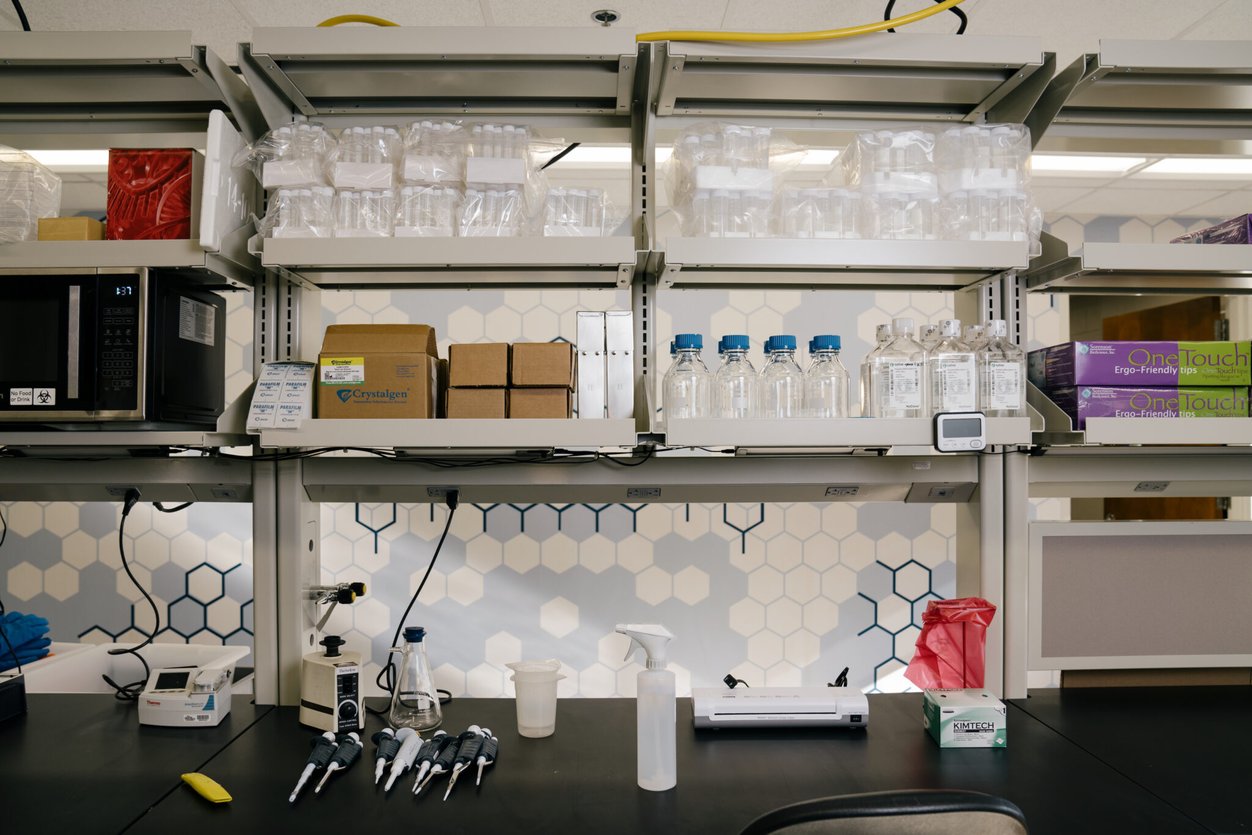
Luis Rodriguez, a 44-year-old molecular biologist, was counting on his MOSAIC grant funding from the NIH as he started his lab at George Washington University this year. The school provided a small startup fund, but it was the federal dollars that would jumpstart his research on the cellular processes underlying lung disease. But most of that money never arrived. (His lab, pictured above, is mostly empty.)
Over the first several months of the Trump administration, the MOSAIC program, which supported scholars as they transitioned from post-doctoral work to leading their own labs, was terminated because of its focus on diversifying NIH grant recipients. While Trump and others say that DEI programming is discriminatory in and of itself, MOSAIC used a broad definition of diverse, including people who grew up in rural areas, those who had parents who did not complete bachelor's degrees, those who were in the foster care system, or those who were recipients of various federal aid programs.
"I've had to trim back a lot of my hiring, and I've also had to trim back a lot of the overarching goals," Rodriguez said to STAT's Anil Oza. "I think everyone has their own horror story." Read more from Anil on what this drop-off in support for early-career researchers means for the scientific workforce. It's the fifth installment of our American Science, Shattered series.
reproductive health
EMTALA violations increase in Texas
Ever since the constitutional right to abortion was struck down by the Supreme Court in 2022, experts have worried about how abortion bans might affect people's ability to get emergency, lifesaving obstetric care in situations where an abortion is medically necessary. A new study shows there was reason to worry: In Texas, which bans abortion without exceptions for the health of the pregnant person, there was a small but substantial increase between 2018 and 2023 in obstetric-related violations of EMTALA, the federal law that ensures everyone receives emergency medical care regardless of their ability to pay. (The increase came out to about one additional violation per quarter.)
That's according to a study published Friday in JAMA Health Forum, which analyzed all EMTALA violation filings between 2018 and the first quarter of 2023. The five other states with similarly strict bans had smaller, imprecise increases. The numbers are small, but the study authors emphasize that these are only the confirmed violations – in reality, there could be many more that were never formally recognized. And before the bans, these states had less than one EMTALA violation per year. So the quarterly increase may seem small, study author Liana Woskie said in an email to STAT, but "from a relative perspective it's large."
health tech
Is AI ready to interpret chest x-rays without human supervision?
At the annual meeting of the Radiological Society of North America in Chicago last week, this was one of the biggest points of debate among experts. Radiology AI companies and academics are rapidly advancing the technology in the face of an extreme shortage of human radiologists. Some are already using AI to generate draft reports, traditionally written by a radiologist, for human sign-off. Chest X-rays, the most common radiological image in the world, have been the first to be fed to the machine, as STAT's Katie Palmer writes.
Medicine's current response to growing AI capabilities is to keep a human in the loop. But some people want to try another way. "This monkey on the shoulder that AI can become isn't useful," radiologist Saurabh Jha told Katie. "We need to be in the loop … But not in the loop for every single X-ray." AI's capabilities may not be there yet. But read more from Katie on what the future of radiology could look like when it improves.












No comments