special report
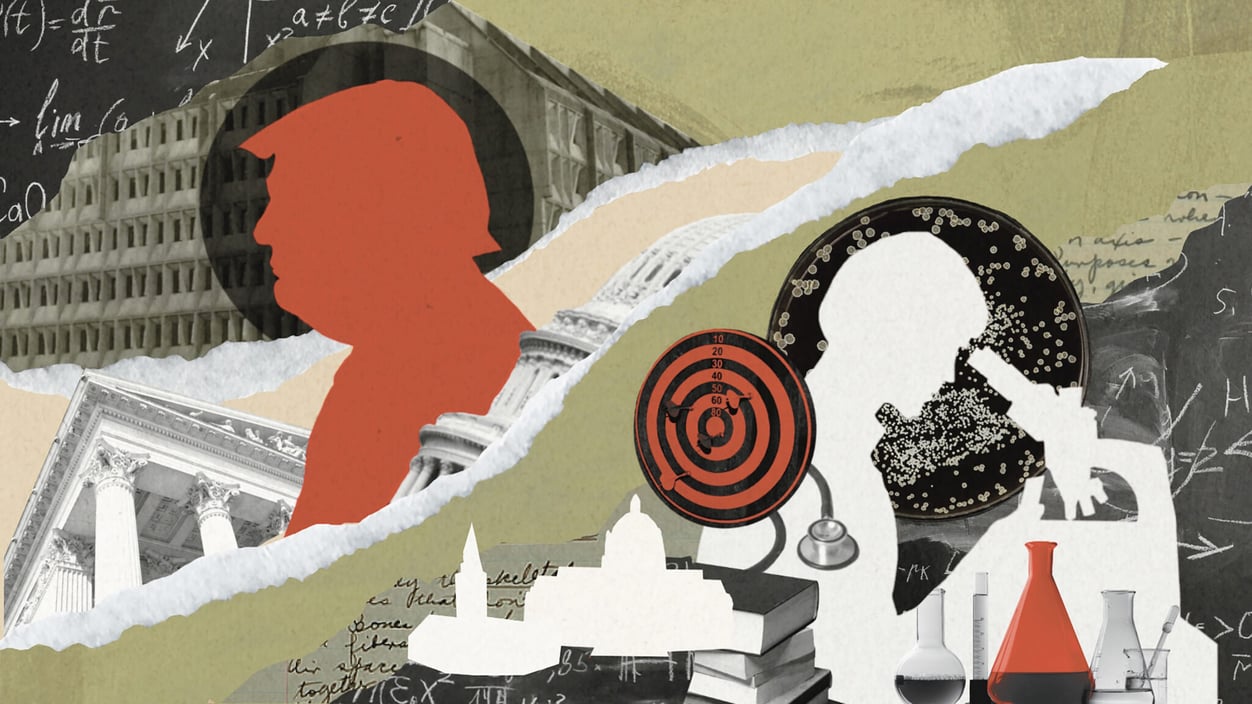
The year that science was shattered
Laura Weiler for STAT
For decades, the entire American research enterprise has been built upon one man's vision for a social contract between government and academia. That framework — wherein federal scientific agencies, staffed by experts, set research priorities and write checks to the nation's universities and medical centers — has never been perfect. For years, it's shown signs of stagnation. But over the last ten months, the Trump administration has completely torn apart that social contract, disrupting labs, upending lives, and delaying discoveries in the process.
To better understand this historic inflection point, STAT's Megan Molteni and Anil Oza interviewed more than two dozen biomedical researchers, science policy experts, historians of science, and current and former federal health officials, including four former NIH directors. The only thing everyone agreed on is that there's no going back.
"That's the most devastating part of all this," one NIH official said. "Why would anyone trust the NIH ever again?" Read the story, which also includes analysis on a decade of NIH grant data by J. Emory Parker. Come to understand how, exactly, American research has been unraveled. Stay to learn which of Trump's executive orders were seen by one scholar as "so Nixonian."
The story is the first installment of a new 10-part series from STAT's science team. In American Science, Shattered, we'll share the stories of scientists, labs, and entire communities whose lives have been altered by the chaos. Two more parts are available for you to read now:
- As a lab technician at a primate research center, Brittney Dockery spent the past four years working closely with dozens of young macaques, studying how anesthesia affected their development with the goal of improving human and animal health. It was a dream job — one in which she referred to the monkeys as her "kids." But Dockery left the role earlier this year amid confusion and concern about the funding for her role. Outside of academia, she has more financial security, but feels like something is missing. "My day-to-day is a lot quieter, and it feels like it has less of a really lasting impact," she told STAT's Jonathan Wosen. Read more about Dockery's love for science and where she's working now.
- Breanna Cutright was in eighth grade when saw vaping explode among her classmates. "Suddenly, all your friends are hanging out in the bathrooms and skipping class," she told STAT's Sarah Todd. "And then you go into the bathroom and it smells like cotton candy." Around the same time, she got involved with Raze, an anti-tobacco program focused on young people across West Virginia. But this spring, federal funding cuts shut the program down. Through Raze, Cutright had gotten scholarship opportunities and met with senators on Capitol Hill to talk about tobacco in schools. She counseled other young people and even helped her grandfather to quit smoking. "Why does no one see how important this is?" she asked. Read more from Sarah on how cuts to federal funding have had sweeping effects on a program that gave teens like Cutright a sense of community and purpose.
See more here about the whole series and future installments.
health tech
Faulty CGMs linked to seven deaths, hundreds of injuries
Two types of continuous glucose monitors made by Abbott Diabetes Care — the FreeStyle Libre 3 and its "plus" version — are incorrectly reading people's glucose levels, providing inaccurately low numbers. An FDA alert issued Tuesday linked seven deaths and 736 serious injuries to the flawed devices. Among those, no deaths and 57 injuries occurred in the U.S., per an Abbott press release.
While health secretary Robert F. Kennedy Jr. and others have pushed for more widespread use of CGMs as a wellness tool, the devices have long been critical survival tools for people with diabetes. The company says it has resolved the manufacturing effort that led to the problem.










No comments