PARTNERED WITH  |
|
|
Hey Hospitalogists, This week's theme is one I keep coming back to: good ideas running headfirst into bad systems. Everyone agrees behavioral health should be integrated into primary care. Everyone agrees value-based care should work better than fee-for-service. And yet, when you talk to operators actually responsible for making this stuff function day to day, you hear the same thing over and over again: the incentives, workflows, and infrastructure just aren't aligned. In this issue, I'm sharing candid takes from the community on where integration breaks down, why VBC needs a reset, and an example of a system doing something different to move past pilots and into something that actually scales. If you're feeling the gap between strategy decks and operational reality, you're not alone. Don't forget to participate in Hospitalogy Member Q&A! |
Was this email forwarded to you? |
|
|
Integrating Behavioral Health with Primary Care |
|
|
What's the biggest challenge your organization is facing today when trying to integrate behavioral health with primary care? |
|
|
THE REAL-TIME DEMAND TAKE |
Anonymous "Meeting real time demands of patients. When behavioral health patients need help, they need it now. They need a resource referral now. Or an appt. now - not in two weeks, not in two months. They need to often review instructions we have already provided, but they are in the portal and they can't get signed in. Everyone is frustrated. Staff, patients, providers. We need walk-in clinics, people that answer phones. We need extra empathy and extra time." |
THE PRIVACY AND INSURANCE TAKE |
Anonymous "1. Privacy. If you go through a tough time and you need some temporary help, is it going to feel weird if you're in the office you'll be visiting every six months for regular care? It's not the same as spending a few weeks with a therapist you'll never see again. 2. Insurance coverage. If the patient has medical coverage but not mental health coverage, does it create a patient satisfaction issue to say to them they can't get that particular support when they're used to thinking of your office as the place they get care? And to overcome that, would the org be better off having a cash pay option so they can still cover existing patients who need it?" |
Blake Madden "The biggest challenge isn't whether integration makes sense—it's that the system still isn't designed to support it operationally or financially. Most organizations want to integrate behavioral health into primary care, but they're running into three hard constraints at once: workforce shortages, misaligned reimbursement, and fragmented data systems. Primary care practices aren't staffed or paid to absorb behavioral health complexity, and behavioral health providers are operating under entirely different economic and regulatory realities. On top of that, the technology and data infrastructure simply hasn't caught up. Behavioral health data is often siloed, restricted, or poorly integrated into EHRs, which makes true team-based care hard to execute in practice—not just in theory. So what we're seeing is a lot of pilots and good intentions, but very few models that are sustainably scaled. Until payment models, workforce strategy, and data-sharing rules are better aligned, integration will continue to be more aspirational than operational. Check out my exclusive overview of Baylor Scott and White's and Geode Health's new partnership as a model that is trying to integrate hybrid mental health services into primary care - primary care physicians are offloading like 10,000 referrals so far to Geode sites. The partnership unlocked: - More primary care capacity
- A place for PCPs to send mental health centric patients quickly
- Telehealth services for quick access to mental health care
- Better recruitment and retention efforts for mental health services"
Hospitalogy members can join this discussion here. Not a member yet? Apply to join here. |
I just released my new report, The Hospitalogy State of Health Systems. One of the things I discuss in the report is how VBC as a whole needs a reset. The model is broken and doesn't work with its current financing mechanisms and structural setup. This reminded me of a question asked and answered in the community back in August. It was before we started the Ask Hospitalogy segment, so where we weren't able to reach someone in time for permission to use their name, I've used anonymous. |
|
|
What's one change you'd make to the current value-based care model to make it more effective for providers? |
|
|
Anonymous "We have been stuck in the proof of concept stage far too long. Administrative burden has been brutal. Provider practices will need tightened prospective attribution with hybrid monthly prospective payments for primary care. The TEFCA-aligned networks providing Medicare claims data in near real time visibility to claims can be leveraged to craft the most impactful strategies." |
Anonymous "Create the same population health approaches across multi payors. Providers or admins should also think broadly about population health lens to all populations (VBC contract agnostic), otherwise the change mgt is not sustainable." |
Patrick Allen - VP of Business Development "When I worked on this topic at Lumeris, we found that the most important element to changing behavior is to get a critical mass of patients on some form of value-based contract. Thus, there is an incentive for the provider to change the way they practice because it becomes easier / necessary. Another, counterintuitive best practice is to reduce clinic time and add some "admin time." This allows the provider to think critically, respond (themselves) to messages, document and code correctly, and coordinate care across the system." |
Jim Brown - VP Value-Based Care Payment/Innovation "As an industry, we have to simplify value based programs to align action to outcome and reimbursement. A program focused on no more than 5 trackable and moveable metrics with timely reporting and payments empowered by rosters and registries will work!!" |
Anonymous "Creating a value-based care framework that doesn't simply incentivize improving risk adjustment coding and focuses on total cost of care reduction." Hospitalogy members can join this discussion here. Not a member yet? Apply to join here. |
|
|
- Read: Following a year of major innovations in healthcare IT, what did IT and digital leaders from some of the biggest health systems in the country say were the technology projects and trends that excited them the most in 2025? Read the full article in Becker's Health IT here.
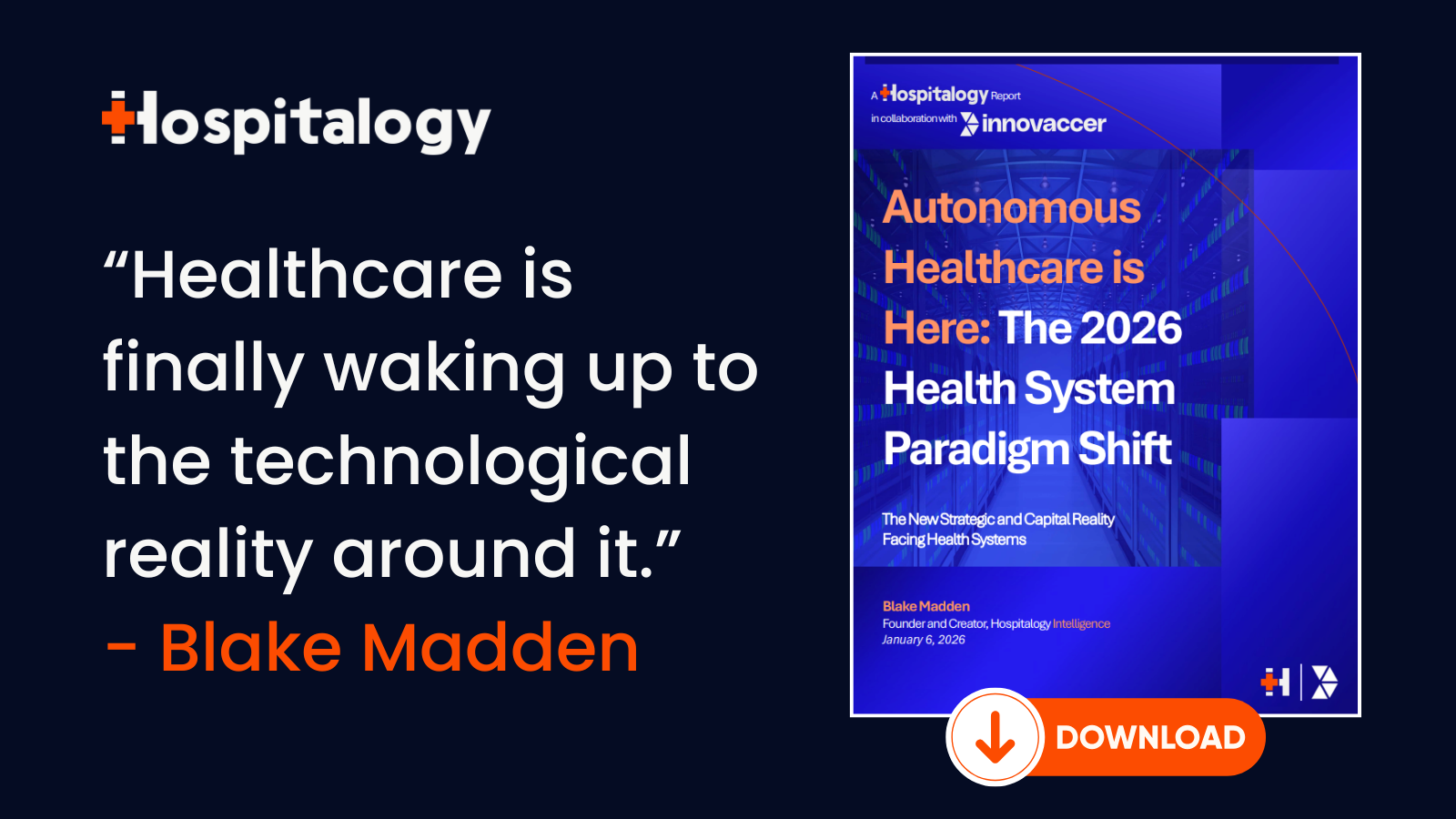
- Resource: Autonomous healthcare is here! What should health systems expect next for AI (hint: real opportunities for hard ROI), finance, strategy, M&A, and more? Read my new report.*
- Roundtable: Register now for the January Roundtable for Plus Members, Friday January 23 at 1pm EST.
* This read is brought to you by one of my brand partners who help make this newsletter possible.
|
|
|
- Judi Health's pharmacy benefit management arm, Capital Rx, has surpassed five million contracted PBM lives, adding over two million new plan members in the past year as demand grows among major employers, unions, and health systems for more transparent, tech-driven benefits administration. The milestone follows the company's $400 million funding round and rebranding from Capital Rx to Judi Health. Read more.
- Mount Sinai's Tisch Cancer Center launched an AI-powered platform called PRISM to expand access to cancer clinical trials across its entire health system. Created by Triomics, the platform is powered by Triomics' OncoLLM, a large language model-based pipeline built especially for cancer care. The system analyzes patient records, diagnoses, and medical histories to match individuals with relevant trials, a process traditionally done manually and prone to delays and gaps. Read more.
- While healthcare buzzes about the promise of a "MedGPT moment," where EHR tools can forecast a patient's mortality or disease progression, Stanford University researchers say we haven't reached it. In a commentary piece in Nature Medicine, researchers wrote, "Generative models trained on electronic health records are viewed as 'zero-shot predictors' for clinical outcomes — but this interpretation is misleading." They say the framing glosses over a subtle but important distinction. "While these models are powerful, they are not actually designed to 'predict' clinical outcomes in the traditional sense. They are simulators." Read the full commentary.
- Chicago-based Rush University System for Health has partnered with Amazon One Medical to expand access to both virtual and in-person specialty care. The three-hospital system began collaborating with the hybrid primary care company on Jan. 1 and by Jan 6. had received more than 20 in-person specialty care referrals from One Medical patients in the Chicago area. Read the full story in Becker's Health IT.
- Just a few days after OpenAI launched ChatGPT Health, Anthropic made a similar announcement introducing Claude for Healthcare, a complementary set of tools and resources that allow healthcare providers, payors, and consumers to use Claude for medical purposes through HIPAA-ready products. Read more.
|
|
|
Thanks for the read - let me know your thoughts!
– Blake
|
|
|
I'm building a community of leaders in strategy, finance, and ops at hospitals and health systems to help us connect, learn, and grow together. |
|
|
Get your brand in front of 50,895+ executives and healthcare decision-makers. |
Workweek Media Inc.
1023 Springdale Road, STE 9E
Austin, TX 78721 Want to ruin my day? Unsubscribe. |
|
|
|




No comments