PARTNERED WITH  |
|
|
Happy Tuesday Hospitalogists, I hope you enjoyed the weekend! Today I'm sharing more AI readiness wisdom from the community, a guest post from Rik Renard that covers one of the first real RCTs testing AI in subspecialty medicine, margin analysis from my end of year report, and some takeaways from recent studies. Also, if you're going to be at ViVE, it's not too late to register for my executive happy hour! We are keeping it purposefully small - to folks who are actively working at hospitals & health systems, ACOs, physician practices, and investors. If you're in one of these groups please apply. If you're not, please reach out separately to me and I would love to connect! |
Was this email forwarded to you? |
|
|
SPONSORED BY AMBIENCE HEALTHCARE When Houston Methodist ran a rigorous, side-by-side evaluation of leading ambient AI technology, they were looking for a solution that could be implemented enterprise-wide across ambulatory, emergency and inpatient settings. They selected Ambience Healthcare's AI, an intelligence platform purpose-built for each specialty and care setting. Ambience supports clinicians with an experience tailored to the distinct clinical reasoning, documentation standards and acuity of their environment. And with full chart awareness, it synthesizes labs, imaging, prior notes, medication history and care plans to ensure every encounter is grounded in complete clinical context. Clinicians at Houston Methodist are leveraging the technology for 80% of patient visits, and they're seeing 40% less documentation time, 33% less pajama time, faster time to close encounters and more voluntary visits per clinician per day.
This story is worth a closer look |
|
|
More AI Readiness Signals |
|
|
A couple of weeks ago, I shared Hospitalogists' answers to this question: What would you rank as the top 2 or 3 signals to know whether your org is ready for AI implementation? Since that time, we've had two additional answers I wanted to include as a follow-up. |
|
|
THE BUSINESS ALIGNMENT TAKE |
Beverly Theodore - Co-founder "1. Clear Definition of the Business Problem: Does the organization know what problem they are trying to solve for? Is AI the best solution to solve this problem, or is there another tech automation solution that can address your issue? Is this problem tied to measurable outcomes? 2. AI Literacy and Alignment: Does everyone on your team know the basic definition of AI and the steps to implement AI? Does leadership have realistic expectations for technical and non-technical roles? 3. Evidence of Experimentation and Data-Driven Decisions: Has the organization used A/B testing, pilots, and/or rule-based automation on a smaller scale before jumping to AI as the solution?" |
THE INFRASTRUCTURE AND OWNERSHIP TAKE |
Anonymous "1. Data Infrastructure: Do you have the analytics capabilities to pull answers to basic operational questions from your data and do it within 24 to 48 hours? For example, can you quickly identify patient flow bottlenecks across your ED and inpatient units or no-show patterns by service line and payor? If getting answers takes weeks of IT requests and manual data wrangling, it's not a good indication of readiness. AI will amplify your data dysfunction, not fix it. 2. Measurable Pain points: You'll probably do better with AI implementation if you are tackling specific, painful problems that executives lose sleep over, not exploratory "innovation initiatives." Examples: - Your CFO can quantify the annual cost of the problem in dollars
- Frontline staff complain about it regularly without prompting
- You've already tried solving it with conventional approaches
3. Operational Ownership: Leadership buy-in matters, but if a COO, CMO, or service line director is willing to stake their operational metrics on the AI implementation, it's probably going to be treated like the operational imperative it should be." Hospitalogy members can join this discussion here. Not a member yet? Apply to join here. |
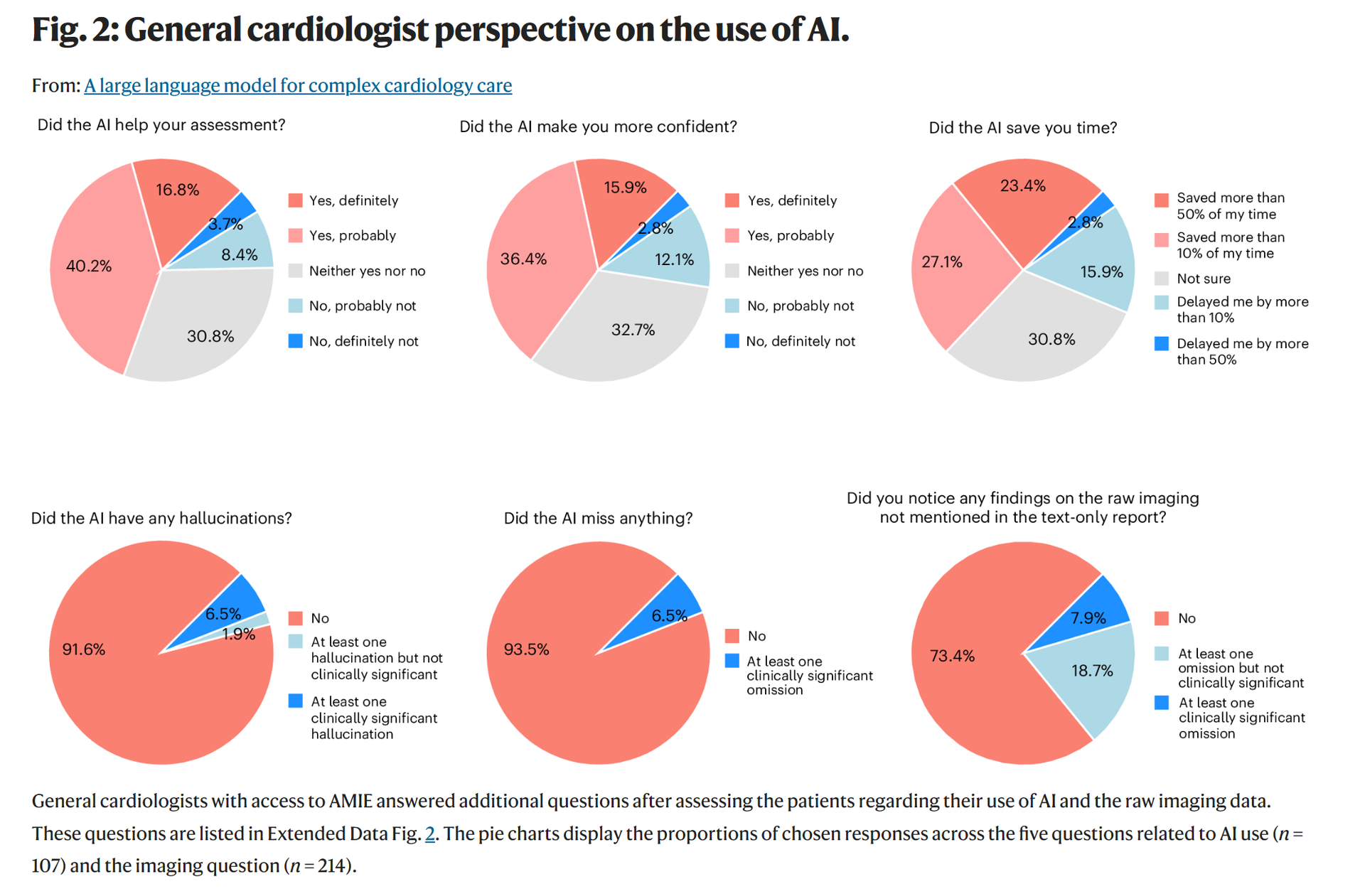
This piece was co-written with Rik Renard, who shares weekly insights on healthcare AI and strategy on LinkedIn. Stanford and Google just published one of the first real RCTs testing AI in subspecialty medicine, and it's showing where the next battle for AI scribes will be fought. Most AI scribes today do one thing: listen, transcribe, maybe code the note. They're getting really good at that. But this study (published in Nature Medicine) shows what happens when you push AI further into clinical decision-making for rare, complex diseases. The setup: 107 real patients with suspected genetic heart disease. Nine general cardiologists assessed them—half with AI assistance (Google's AMIE system), half without. Subspecialists at Stanford then blindly evaluated both assessments. Results: AI-assisted assessments had 11% fewer clinically significant errors and 20% less missing content. Cardiologists said the AI helped in 57% of cases and saved time in half. |
|
|
These weren't routine cases. Hypertrophic cardiomyopathy. Arrhythmogenic cardiomyopathy. Rare diseases most general cardiologists see maybe a few times a year. The kind where you'd normally refer to a subspecialist and wait months. The AI caught nuanced findings across ECGs, echo reports, CMRs, and stress tests that a generalist might miss. It surfaced management considerations that aren't top of mind unless you see these patients daily. This is the shift --> AI moving from documentation to clinical co-pilot. Right now, 60% of HCM patients in the US go undiagnosed because half the states don't have a specialized center. If AI can help generalists perform closer to subspecialist level, that changes access fundamentally. P.S. The AI hallucinated in 6.5% of cases (e.g. inventing details that weren't in the reports), so still needs human oversight. |
Health System Operating Margin Analysis |
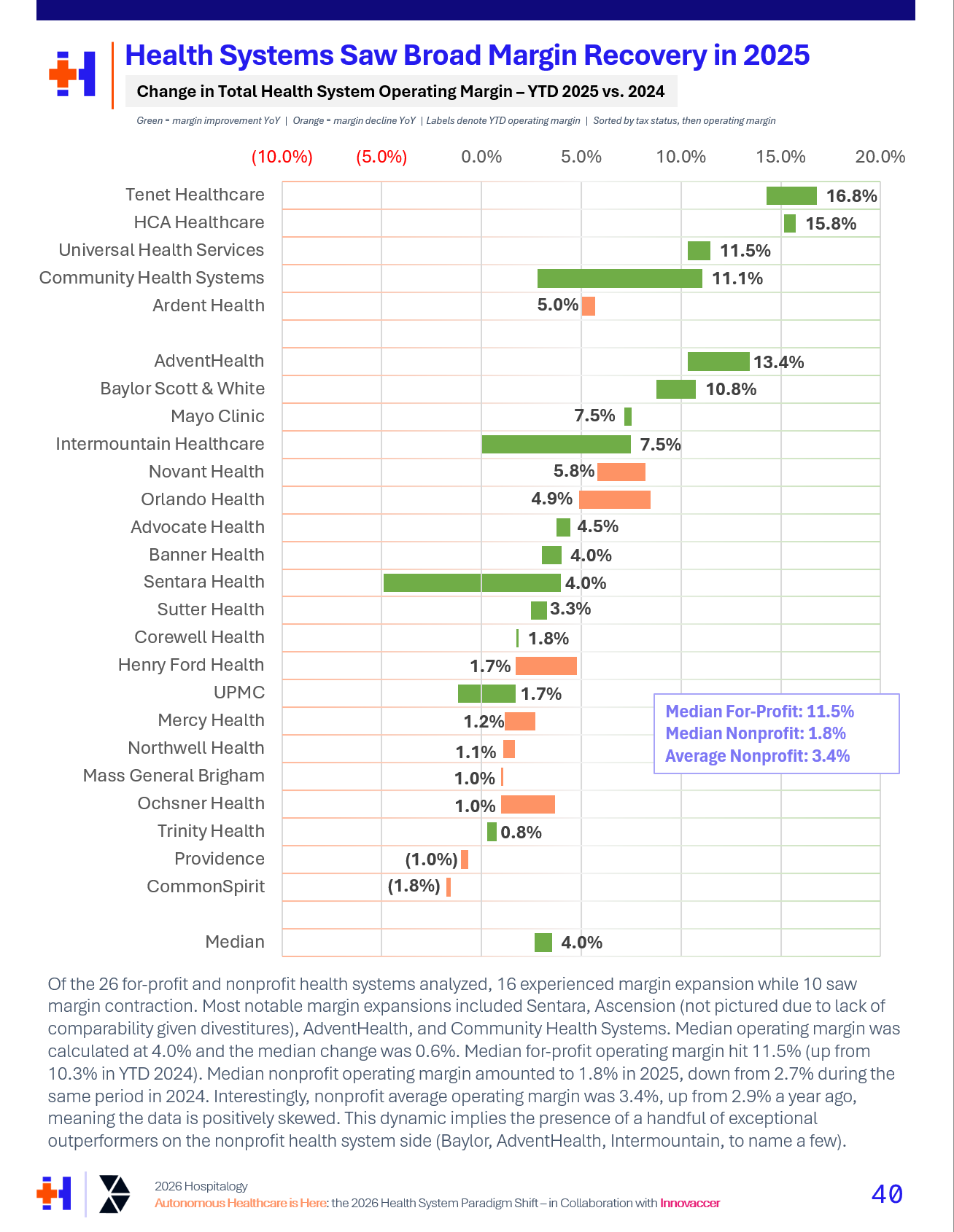
Continuing to tease content from my 2026 state of hospitals and health systems report, I compiled a select 26 of the largest health systems around the country for a review of operating margins. Of the 26 for-profit and nonprofit health systems analyzed, 16 experienced margin expansion while 10 saw margin contraction. Get the full report here! |
E‑Visits: Wide Acceptance and Low Follow‑Up Rates |
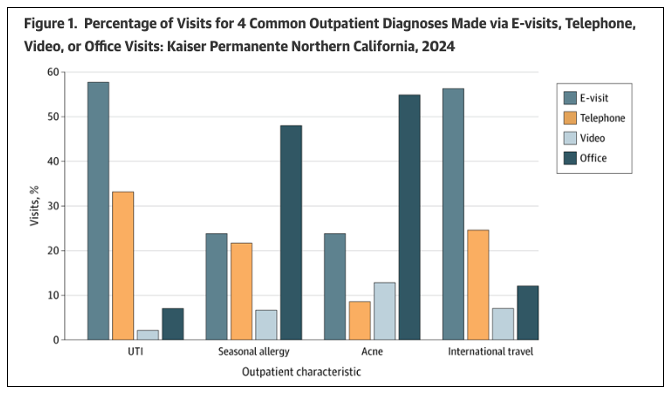
A new study from Kaiser Permanente (KP) found their patients are increasingly opting for structured, asynchronous e-visits (message-based) for resolving straightforward clinical issues, instead of talking to a doctor in-person, by phone, or by video. KP's analysis, which looked at over 73,500 e‑visits through Kaiser Permanente Northern California (KPNC) in 2024, focused on 4 common reasons for outpatient visits: urinary tract infections (UTIs), seasonal allergies, acne, and advice ahead of international travel. Patients opted for e‑visits in 58% of UTI cases, 56% of travel-related cases, and 24% of both acne and allergy visits. |
What was particularly of note was how effective the model appears to be at resolving care on the first touchpoint. Follow-up visits within 7 days were rare (2.5% for UTIs, 2.1% for acne, 6.5% for seasonal allergy, and 0.1% for travel advice requests) and were often equal to or lower than comparable phone, video or in-person visits. Some other interesting tidbits from the study: - For the 4 studied diagnoses, most common age groups for telehealth were 18-29 and 30-39 (41% of total), and 86% of visits were female!! To clarify, these patients selected telehealth when other visit settings were available - a form of consumerism.
- 65+ folks prefer to pick up the telephone.
Read the full study in JAMA Network Open here. |
McKinsey's Take: US Healthcare in 2026 and Beyond |
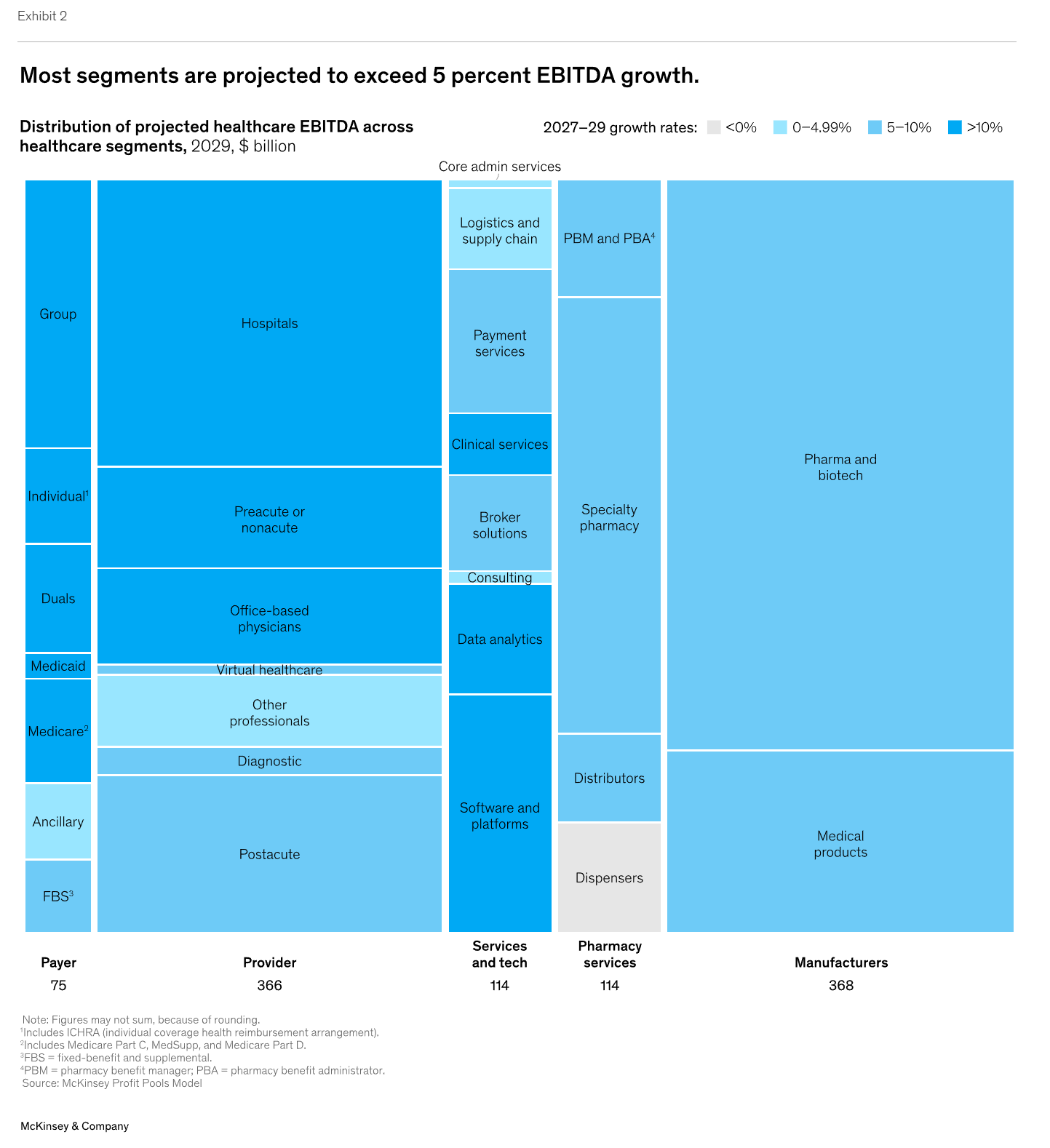
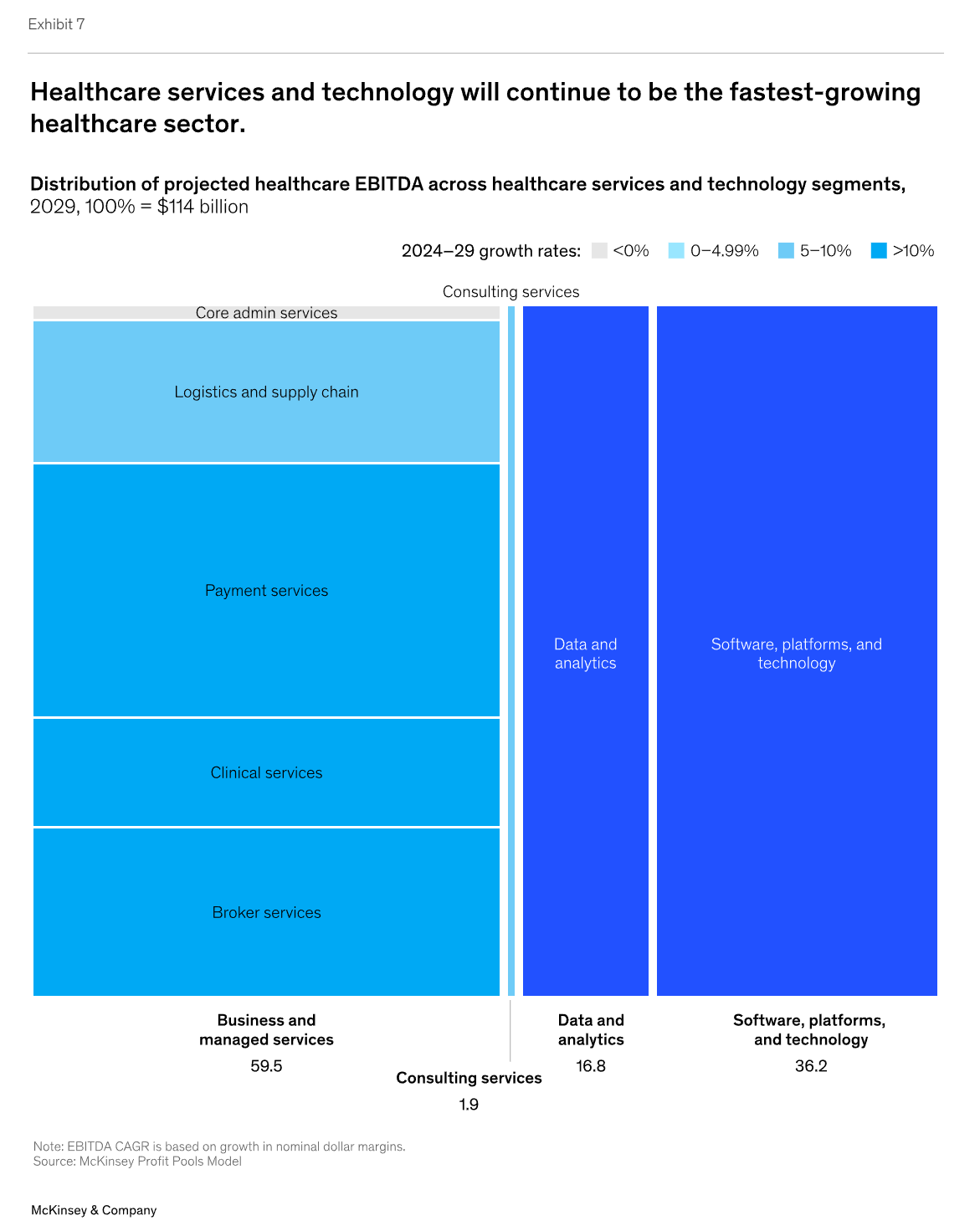
McKinsey & Company's latest outlook finds the healthcare industry under continued financial pressure, but with "pockets of opportunity." The outlook emphasizes that resilience will depend on strategic repositioning, productivity improvement, and targeted investment rather than broad-based recovery. |
Key takeaways: - Industry EBITDA as a share of national health expenditures fell from 11.2% in 2019 to 8.9% in 2024 and is projected to dip slightly further (to 8.7%) by 2027.
- Although margins are compressed, McKinsey projects annual EBITDA growth of ~5% from 2024–27 and ~10% from 2027–29.
- Providers continue to contend with rising labor costs, reimbursement pressure, and uncompensated care, while payors face enrollment shifts and margin pressure (particularly in Medicaid and ACA segments) before potential stabilization later in the decade.
- McKinsey identifies health services and technology (HST), specialty pharmacy, and non-acute care settings (such as ambulatory and home-based care) as the strongest growth areas through 2029, outperforming traditional acute-care segments.
|
Check out the full article for quantitative, segment-level forecasts through 2029, including profit pool growth by subsector and payer mix dynamics. |
|
|
Nearly 100M adults lack access to primary care, just as the physician workforce shrinks and chronic disease rises. The traditional model can't scale. In a new perspective, Dr. David Carmouche explores using generative AI to transform primary care from episodic visits to always-on, proactive, and personalized health support. At the center is Tom™, an agentic care team member with autonomous capabilities to act on "best next actions" under the care team's guidance. See how this AI-enabled vision for primary care can help solve access and workforce challenges, improve outcomes, strengthen care coordination, and drive efficiency. |
|
|
- Read: A recent survey from Monigle explores the reasons patients lose trust in their providers and includes ways to personalize trust to different segments of your patient audience, understand mistrust specifically among Gen Z, and an action plan for restoring trust. Read the full report.
- Breakdown: See how a safety net hospital achieved a 14× increase in behavioral health screening rates and captured $750K additional P4P revenue without disrupting workflows. Read the case study.*
- Resource: Some interesting developments in AI among Health system CIOs noted by Beckers here.
- Roundtable: Don't miss the February Roundtable for Plus Members, February 27 at 1pm ET. Register here.
*This read is brought to you by one of my brand partners who help make this newsletter possible! |
|
|
Let me know your thoughts. I'm all ears. – Blake |
|
| I'm building a community of leaders in strategy, finance, and ops at hospitals and health systems to help us connect, learn, and grow together. |
|
|
Get your brand in front of 66,700+ executives and healthcare decision-makers. |
Workweek Media Inc.
1023 Springdale Road, STE 9E
Austin, TX 78721 Want to ruin my day? Unsubscribe. |
|
|
|





No comments