PARTNERED WITH  |
|
|
Happy Tuesday Hospitalogists! I'm (unfortunately) back in Dallas after a great week discussing the future of healthcare and AI amongst friends and leaders in Santa Monica. Talk about a temperature differential. Wherever you are, I hope you're staying safe and warm (except for the Californians who experience no fluctuation in weather whatsoever). One housekeeping note: The countdown to ViVE is on! If you're planning on attending, but looking to break up the small talk circuit with genuine connections and candid conversations, this is for you. - Rooftop happy hour
- Feb 22
- Curated, vetted group of healthcare leaders in health systems, physician groups, ACOs, and payviders
Hope to see you in person in a few weeks! |
Was this email forwarded to you? |
|
|
SPONSORED BY WEAVER What are the trends, challenges and opportunities that will shape healthcare valuation in 2026? A new report from national accounting and consulting firm Weaver breaks down what actually moved value last year and the impact it will have on healthcare valuation dynamics and transaction activity in 2026 and beyond. Get a clear picture of: If you're making capital, growth, or partnership decisions, Weaver Insights: Health Care Valuation 2025 Year in Review connects macro pressure to transaction reality and explores value drivers you may be overlooking.
|
|
|
The most important news from the week |
Inside Nabla's Accelerate |
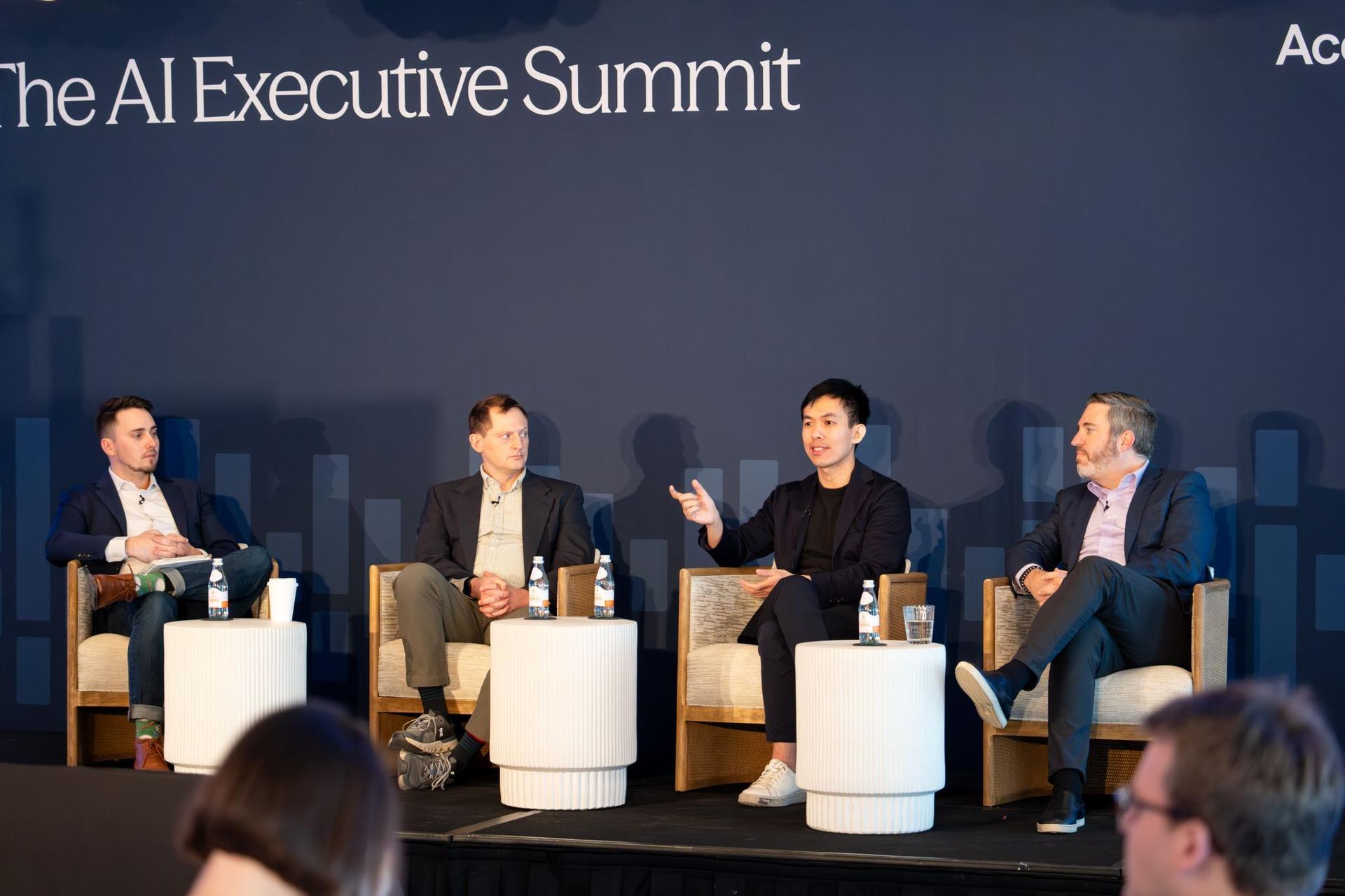
I had a chance to attend Nabla's inaugural event and had the humbling experience of being the dumbest person in the room.
Take, for instance, the keynote on the first night with none other than Yann LeCun, who managed to convince all of us that current LLMs are nearing a functional ceiling - a dead end - and that world models are the future of AI. LeCun left Meta about a month ago to start his own lab, AMI Labs. |
His attempt to dumb down his work enough for me to understand it worked like a charm. AMI Labs' thesis goes something like this (and I realize I'm late to the game here; sue me): - We want AI to reach autonomous levels of general intelligence (AGI). Yann prefers to call it 'human-level AI.'
- Structures of current LLMs are useful, but not reliable enough for full autonomy given over-indexing on text. The real world is more complex than just text-based language. Therefore LLMs will hit a ceiling and will be unable to achieve AGI.
- Conversely, in order to achieve human-level AI, you need to train models on real-world data → sensory data (videos, images, environment) which allows models to understand how systems work, engage in abstract thinking, and be able to predict consequences of action.
- The next revolution of AI will come from systems of intelligence that understand continuous, noisy data, build predictive models based on how their environment is evolving, that can plan and reason at a core level, and that are controllable and safe.
- This next phase is called the physical AI revolution.
As you can imagine, most people in the room hung on Yann's every word with bated breath, trying to reason through the implications of world models and JEPA architecture, rather than generative - true AGI - for healthcare. If Yann is correct (and it seems like most experts are converging on world models as the coming phase of AI), LLMs will still be useful across multitudes of use cases, but world models will understand the…er, world…and therefore, healthcare, better. Yann showed us a demonstration where an individual using Meta glasses and cooking being guided through all of the steps by an AI with the ability to infer when an action was completed. Eggs are done? sweet, now butter the bread. Yann's ultimate vision for JEPA involves an intelligence with an ability to build universal, causal models of any complex system. And might I ask which industry is known for its complexity? Take for instance, general medicinal rules simplified. A1C should be under 7. Maybe not for everyone, though. In theory, world models can fine-tune and vary the metric optimally on a patient-by-patient basis and empirical observation. While business use cases and product development are at least few years away, Nabla announced an under the radar partnership with LeCun's AMI Labs to forge ahead in these world models. At the time, I had no idea what this meant. Now I am, simply put, drinking the Kool Aid straight from the firehose and am excited for what's next. Here's another great recent talk Yann gave which provided similar, more generalized context for what he's researching. Whether you believe this model or architecture is the future or not, it is fascinating to hear an incredibly intelligent individual talk about his craft with an immense, unfathomable level of understanding. Beyond the world model discussion, I had a ton of great conversations with leaders across the healthcare ecosystem to get a sense of how they're thinking about AI and the current state of things. It struck me how so many of the conversations, despite all of the rapid advancements in technology, and the discussion around tactics and how to strategically deploy or vet AI solutions, converged back to the human elements at play. Because, ultimately, healthcare is human. At its core, it is relational. Can I trust you to hear me? To understand me, and provide the best care for me? Despite the talk of world models, the beach alongside the discussion setting, and the phenomenal weather, this north star was not lost. There is a new fierce passion, enabled and boosted by technology, to get back to the blocking and tackling of healthcare with vibrant discussions around the following topics: |
- Ambient was such an easy win across my organization. But what's next? And is my organization ready for that next step? How do I know?
- What happens if I stumble across a use case where AI can eliminate a significant number of jobs at my organization?
- How can I leverage AI and technology to fill in the gaps between visits for my primarily Medicaid population, and engage with polychronic, behaviorally complex individuals?
- What guardrails are we putting in place to mitigate potential disasters?
- Who is liable for when AI makes a mistake? Is this really even the right question, or framing? For instance, does AI in healthcare have a self-driving car problem wherein use of AI is inherently safer, yet mistakes are amplified?
- What regulations should I look out for next? Is the industry leading the charge, or am I about to be hamstrung by the usual state-led fragmented fiasco?
World models or not, there is no doubt in my mind that when we look up in 5-10 years, AI will have made significant inroads in areas like clinical decision support, care navigation, billing and rev cycle (of course), primary care, medical education (and consumer education!) Maybe we'll even have the personalized health record! Kidding…but a guy can dream. Oh, and also, the Vatican is joining CHAI. Who knew? |
|
|
THE WEEKLY EXECUTIVE SUMMARY |
Notable moves, policies, and strategies from around healthcare. |
Stay tuned for upcoming Hospitalogy newsletters. I have a ton of intel, analysis, and news to drop in the coming weeks (hospital earnings season, MA rate advance notice, digital health consolidation) and it's hard to keep up!! For now, here are some quick hits: - Podcast #2 is out! Thanks to everyone for such kind words. I am open to all feedback on these. This one is with Fairview Health's CEO James Hereford - we talked about his random walk through healthcare, how he turned around an organization that had 5 CEOs in 6 years, the messy University of Minnesota relationship, and why specialty pharmacy isn't about 340B arbitrage. Listen to the podcast on Apple here and Spotify here.
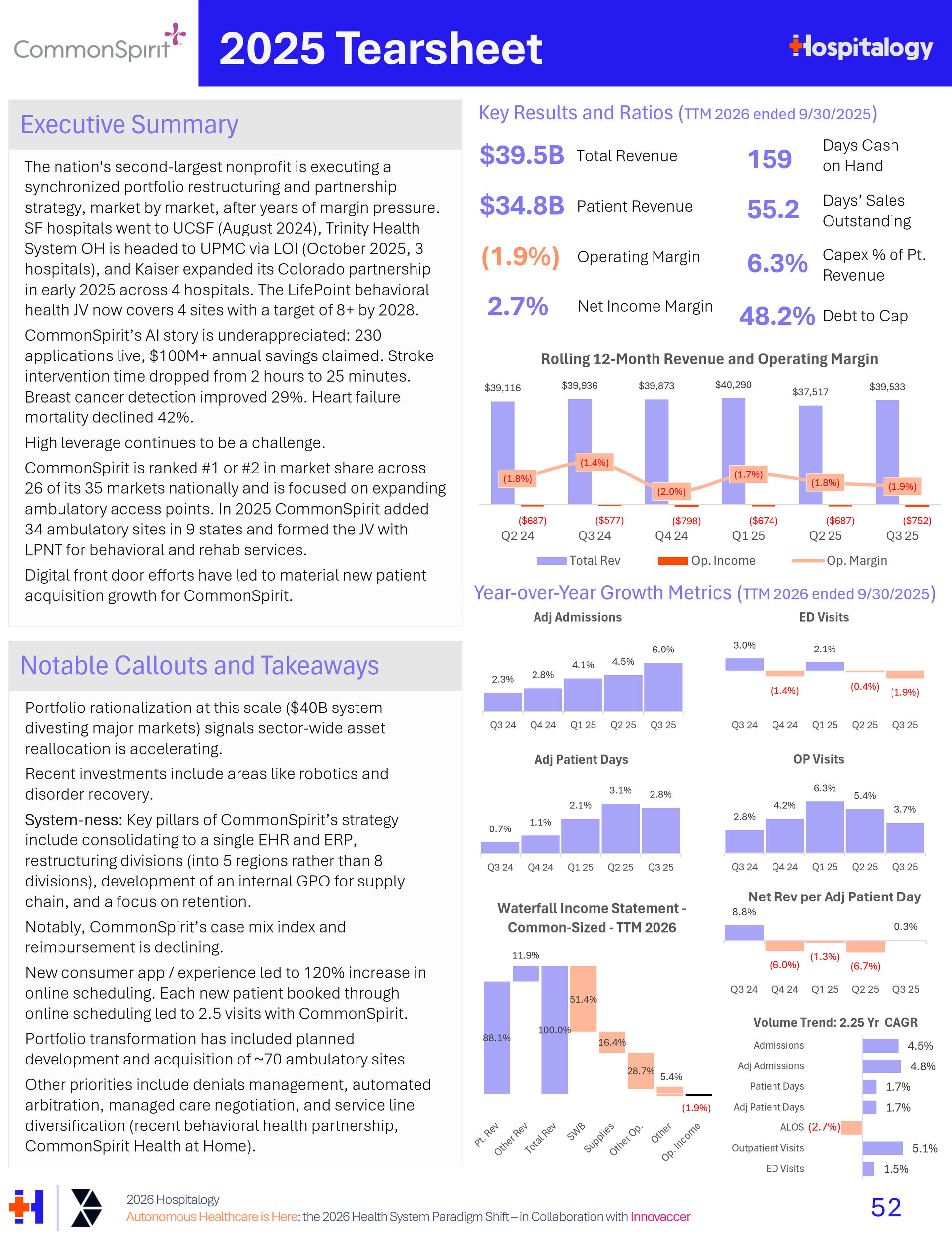
- Tenet completed a $1.9B transaction with CommonSpirit to resume full Conifer (its rev cycle arm) ownership, a few years after trying to spin off Conifer altogether. Leads me to wonder what CommonSpirit is planning to do with its RCM function in the coming years and also the vast potential for AI in the space. More to come, I'm sure. If you have any intel, hit me up!
- Speaking of CommonSpirit, I also highlighted them in my 2026 year end State of Hospitals and Health Systems report as they're in a current state of portfolio transformation alongside the likes of Providence and Ascension. Download the full thing here.
|
- Sword Health acquired Kaia Health for $285M, extending AI MSK platform to 100M people and entering German market.
- Spring Health is buying Alma to combine enterprise mental health platform with 25K+ independent therapist network and payor relationships. Pretty fascinating crossover.
- Premise Health and Crossover Health are merging to create largest employer-focused primary care company with 900 wellness centers serving 400+ organizations.
- UnitedHealth Group expects to lose 1.2-2.8M MA members in 2026 while CMS proposes an essentially flat 2027 MA advance notice (0.09% increase).
- CHS completed two major divestitures: sold 80% of Tennova Healthcare Clarksville (270 beds) to Vanderbilt for $623M, and divested three Pennsylvania hospitals (677 beds total) to Tenor Health Foundation for $33M cash plus $15M promissory note. The portfolio optimization continues.
- ~30,000 Kaiser Permanente workers launch open-ended strike.
- DOL proposed new PBM compensation disclosure requirements for self-insured employer health plans.
- Thoma Bravo is exploring a sale of Imprivata (healthcare digital identity software) at potential $7B+ valuation.
- US Neurology Associates made inaugural investment, affiliating with Texas Institute for Neurological Disorders (35+ physicians, 13 DFW locations). Link
- The FTC is requiring Sevita to divest 128 facilities to resolve antitrust concerns in $835M BrightSpring acquisition.
- Telehealth and hospital-at-home waiver extensions inch forward as House passes spending bill.
- Medical Facilities Corporation sold Oklahoma Spine Hospital (63.95% interest) to SSM Health for $46M.
|
|
|
SPONSORED BY LUMERIS The Rural Health Transformation program gives states both the resources and responsibility to rethink rural care delivery. The biggest challenge is execution, with states facing structural problems like fragmented delivery models, workforce constraints, data gaps, and sustainability questions. The Collaborative for Healthy Rural America is a national coalition purpose-built to help states deploy rapidly, demonstrate progress early, measure results continuously, and turn RHT investments into durable rural care models. Explore the top 10 challenges states must solve to realize the full promise of RHT and how to tackle them. |
|
|
My favorite reads & resources from the week |
- Bessemer Venture Partners: State of Health AI 2026. The annual health AI landscape report. If you're tracking where capital is flowing in health tech, this is required reading.
- This KFF overview of the return of the provider sponsored plan, though likely by force rather than by design given large BUCA pullback in Medicare Advantage. This dynamic is one I'm watching closely and I'm hoping to research and write further about it as the trend develops.
- This video of current CMS and policy proposals, what policymakers are thinking about, from the Paragon Institute (politics aside) is a good listen for anyone trying to stay on top of what's next. I particularly thought the section about letting Medicare Advantage carriers negotiate their own 'market rates' to the 'value' of the market rather than indexed to Medicare was something I had not seen discussed publicly before.
- Read my take on Unlock Health's new 2026 Managed Care Trends Report, which details how the pressures shaping managed care will determine how patients seek care, providers deliver it, and payors control it in 2026.*
- Wheel's comprehensive whitepaper on the state of virtual care, including the expected boom in weight management and GLP-1s but the surprising bastion that is women's health.
*This read is brought to you by one of my brand partners who help make this newsletter possible! |
|
|
Random personal anecdotes and musings from me |
Apart from learning that my job will be obsolete in under 5 years (one of you guys will take me in, right?) wifey and I had a great time in Santa Monica for one of our first true vacations away from our toddler. This isn't a food blog but I'd like to call out the following restaurants for their incredible food and atmosphere: - Elephante where I had some of the best pizza with great views to boot
- Fig Tree with an incredible menu and beachside atmosphere
- Shunji with the feeling of being inside a premier Japanese chef's intimate home setting
- RVR where we had exceptional service
- I'd like to note that despite its high praise on online forums, I had a disappointing experience at Tar & Roses, mostly service driven. Food was great but I felt like they were trying to rush us out of there and wanted us to order quickly. That's not my vibe, fam. I think we went on an off night.
If there's a restaurant I missed, give me a holler for next time! |
|
|
Thanks for the read! Let me know what you thought by replying back to this email. — Blake |
|
|
I'm building a community of leaders in strategy, finance, and ops at hospitals and health systems to help us connect, learn, and grow together. |
|
|
Get your brand in front of 53,000+ executives and healthcare decision-makers. |
Workweek Media Inc.
1023 Springdale Road, STE 9E
Austin, TX 78721 Want to ruin my day? Unsubscribe. |
|
|
|





No comments