big tech
Google's health AI event: Fitbit, CVS Health100 details
At its annual health event, Google announced that Fitbit users will be able to use services like Clear and b.well to connect their health records so the AI coaching feature can offer personalized advice. As I wrote in STAT Health Tech earlier this week, similar features have become common with recent launches from Google's sister company Verily, as well as Microsoft, OpenAI, and others.
What I found most interesting from the event was the walkthrough of the new CVS-backed Health100 patient engagement app (about ~35 minutes into the video). The announcement of the service a couple of weeks ago was quite vague. Like an increasing number of apps tied to health benefits, Health100 hopes to serve as one-stop portal to your health record, insurance and pricing information, appointment scheduling, and connections to digital health services to help with needs like hypertension management. Health100 also features an "AI health partner" that provides guidance, answers questions, and helps users navigate the app. Health100 will launch this year, and the company says it will be available to anyone, not just CVS Health users.
biotech
Biotech turns to Apple Watch for Parkinson's study
Annovis Bio will begin using Apple Watches to monitor patients in a study of its investigational drug buntanetap in Parkinson's disease. Launched earlier this year, the open-label extension study aims to evaluate the long-term effects of the drug on people who enrolled in its phase III study, as well as on people receiving deep brain stimulation. The study, which completed in 2024, did not meet its pre-specified primary endpoint but showed promising effects on cognitive decline in some patients.
Annovis will offer 100 participants NeuroRPM's FDA-cleared platform that uses the Apple Watch to monitor bradykinesia, dyskinesia, and tremor symptoms. Parkinson's disease symptoms are highly variable and are usually only measured in infrequent clinical appointments. There's optimism that a continuous flow of data from digital sources can help paint a more robust picture of the real-world effects of drugs and maybe even one day help secure a drug approval. In the short term, Annovis will use data from NeuroRPM's platform to better understand the effects of its drug and potentially to corroborate exploratory endpoints of symptom management and treatment efficacy. The experience may also help inform the design of future Annovis studies that use digital data as endpoints. As I wrote in an in-depth story several years ago, NeuroRPM is one of several companies that has built Apple Watch-based solutions for tracking Parkinson's for patient support, clinical care, and clinical trials.
Elsewhere in Parkinson's disease tech, Kneu Health, which offers a smartphone-based symptom assessment platform to help health systems manage their patients, released a sliver of data about its work with Cedars-Sinai: During a six-month pilot, 104 people used the platform and clinicians reported that the data "informed earlier intervention" in some patients. I recently wrote about Kneu's $5.6 million fundraise.
artificial intelligence
So how (and how much) do physicians use AI?
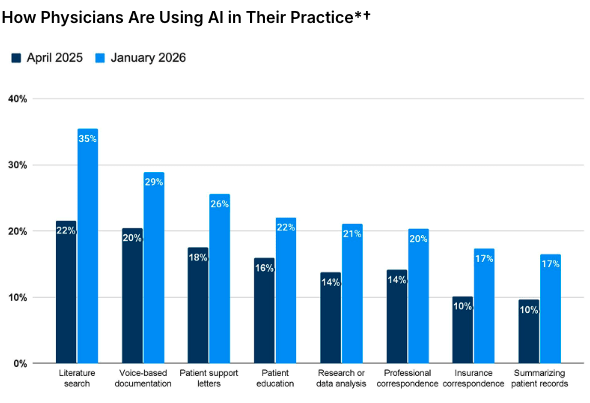
Ideally, this piece should tell you a definitive number that helps you understand the state of AI adoption among physicians, but I'm afraid I cannot deliver this because two surveys completed this year, one from health tech company Doximity and one from the American Medical Association, differ somewhat on the numbers. AMA's survey says 72% of docs use one of 17 AI use cases presented by the organization, up from 48% a year ago. Doximity says 63% of physicians use AI in their practice, compared to 47% in the company's last survey. As you would expect, doctors are using AI, and more than they were before.
The survey numbers were very close on several topics. In both, the top use case is to parse medical literature. The AMA found that 39% of respondents use it to provide summaries of medical research and standards of care, compared to 13% in 2024. Doximity found 35% use AI literature search, compared to 22% in 2025. (Doximity offers a literature search product.) In both surveys, this use case now exceeds the use of AI documentation tools which were used by 28% and 29% of respondents in the AMA and Doximity surveys.












No comments