health inequity
How one nonprofit is expanding LGBTQ+ care while it shrinks elsewhere
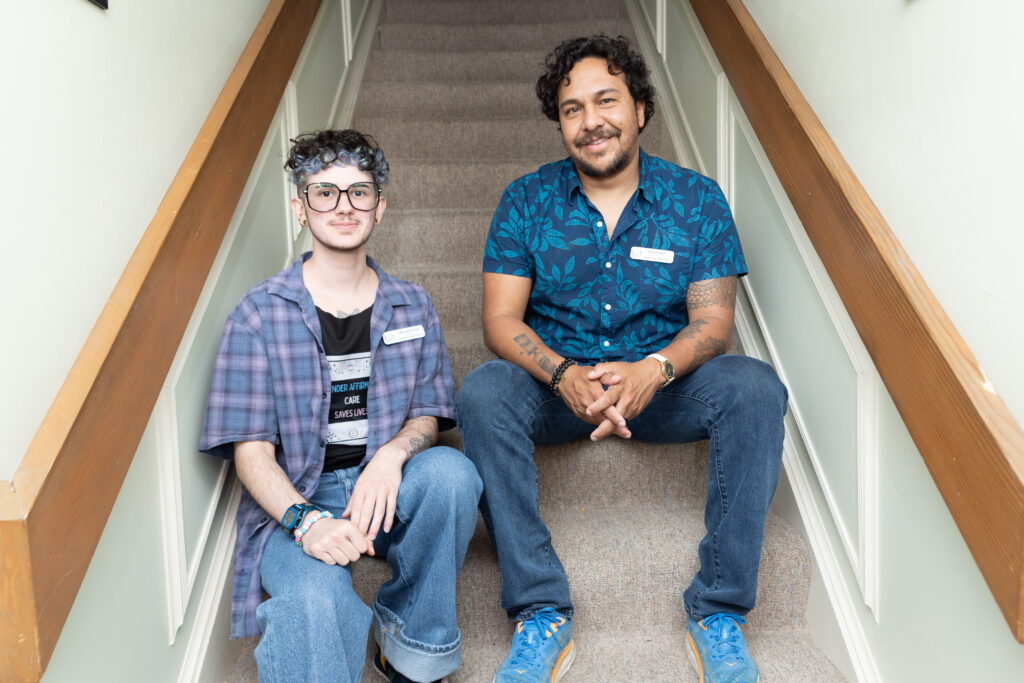
Christopher Lane for STAT
Nikolas Indigo (pictured above with one of his found family fathers, Michael Bell) made appointments with four different surgeons over two years before he was able to get top surgery in September. The first doctor deadnamed him: “I did not like the vibe of that man, zero out of 10,” Indigo told me. The next two were unable to take his insurance. The fourth try was the charm, except he had to travel all the way to Atlanta from his home in Savannah, Ga.
“No matter how hard I tried, I could not do it on my own,” Indigo remembered about seeking doctors for hormones and top surgery. Instead, he turned to the Savannah Pride Center, a nonprofit where he’s now a lead volunteer, to find reliable information on affirming clinicians. I wrote about Indigo, his journey to top surgery, his work at the Pride Center, and his optimism in the face of endless political attacks on trans people. I even got to travel to Savannah, where I attended the center’s second annual health summit and ate some delicious southern food. Read more.
notable quotable
‘We still have 3.6 million births a year, but the problem is teens and young adults.’
That was Marc Siegel, a senior medical analyst at Fox News, framing the declining rate of girls ages 15 to 19 having babies as a “problem.” And he’s not the only person thinking about it this way.
A new First Opinion essay by researcher Riley J. Steiner argues that Siegel’s comments are just the latest example of how politicians and public health experts try to take charge of teenagers' reproductive lives. While Siegel and others seem to want more teen pregnancies, Steiner argues that efforts to reduce teen births are often borne from the same impulse.
“Controlling teen fertility should not be a public health and policy goal,” she writes. Read more on the history of the teen pregnancy prevention era and how it affects today’s public discourse.
cancer
A controversial cancer study abstract comes to AACR
I had to read the headline twice when I saw the press release: "Eating fruits, vegetables and whole grains may increase the chance of early onset lung cancer," according to new research from the USC Norris Comprehensive Cancer Center that will be presented tomorrow at the annual American Association for Cancer Research meeting.
The claim comes from a survey study of 187 patients who were diagnosed with lung cancer by age 50, most of whom had never smoked. The authors speculated that pesticides might be a contributing factor.
But outside experts eviscerated the research methods. Peter Shields, a medical oncologist at Ohio State University, noted in a statement that experts have long known leanness to be a risk factor for lung cancer, which could explain the authors’ findings. “This is only a conference abstract, but the flaws of the study and its conclusions are quite striking,” Baptiste Leurent, a medical statistics professor at University College London said in a comment. “Jumping to the conclusion that [healthier eating] could cause lung cancer is quite a stretch, let alone implicating pesticides.”
There’s a few days of the conference left. For the latest, strongest reporting on what’s going on there, sign up for STAT’s AACR in 30 Seconds newsletter. And don't miss his special report on KRAS inhibitors from yesterday.


 HHS
HHS








No comments