pancreatic cancer
Strong results for Revolution Medicines’ KRAS drug
Last week, researchers working with the biotechnology firm Revolution Medicines presented stunning news: the experimental drug daraxonrasib more than doubled survival in second-line pancreatic cancer compared to chemo – although that only meant increasing median survival in this terrible disease by six months.
The field is now sprinting towards two main areas, moving the drug to frontline therapy and using it in combinations. The hypothesis has been that using the drug earlier in patients who haven’t gone through other treatments, and alongside or in series with chemotherapy, immunotherapy, or other targeted therapies, might yield better results. At AACR on Tuesday, researchers presented some early data supporting that idea in metastatic pancreatic cancer.
In a phase 1/2 trial testing daraxonrasib with standard of care chemotherapy, the overall response rate was 58% at the data cutoff, significantly higher than the current standard of care of chemotherapy alone. In a different trial testing frontline daraxonrasib alone, the response rate was 47% and included one complete response, meaning the drug eliminated detectable tumor in the patient. Overall survival was at 90% at 6 months for daraxonrasib plus chemotherapy.
ORAL CANCER
A little immunotherapy goes a long way
About 5% of people have precancerous lesions in their mouths. And while most don’t progress to full-blown tumors, the standard of care is surgical removal, which often entails cutting out part of the tongue. Lesions tend to recur, meaning many patients endure repeated procedures that can meaningfully affect their ability to speak and eat.
What if checkpoint inhibitors, immunotherapies that have proved to be skeleton-key medicines for a host of cancers, could help?
Physicians at the University of Texas MD Anderson Cancer Center devised a study to find out, enrolling 29 patients with oral lesions and injecting a tiny amount — less than 5% of the standard dose — of Bristol Myers Squibb’s Opdivo directly into the problem areas.
After four shots three weeks apart, the results were clear: 85% of patients saw their lesions shrink. The median lesion reduction was 60%, and 21% of participants saw their lesions disappear entirely. Because the injections are locally administered, the drug didn’t seep into the bloodstream, resulting in no dose-limiting toxicities, said Moran Amit, a surgeon at MD Anderson who led the study.
Among the patients who had a complete response, three quarters were cancer-free after 12 months, meaning they didn’t need to have their lesions surgically removed. “To me, 75% surgery-free survival is unheard of,” Amit said at a news conference.
The pioneering study marks the first time immunotherapy has been used for cancer prevention, he said. MD Anderson is now running a larger, placebo-controlled study in hope of replicating the benefits.
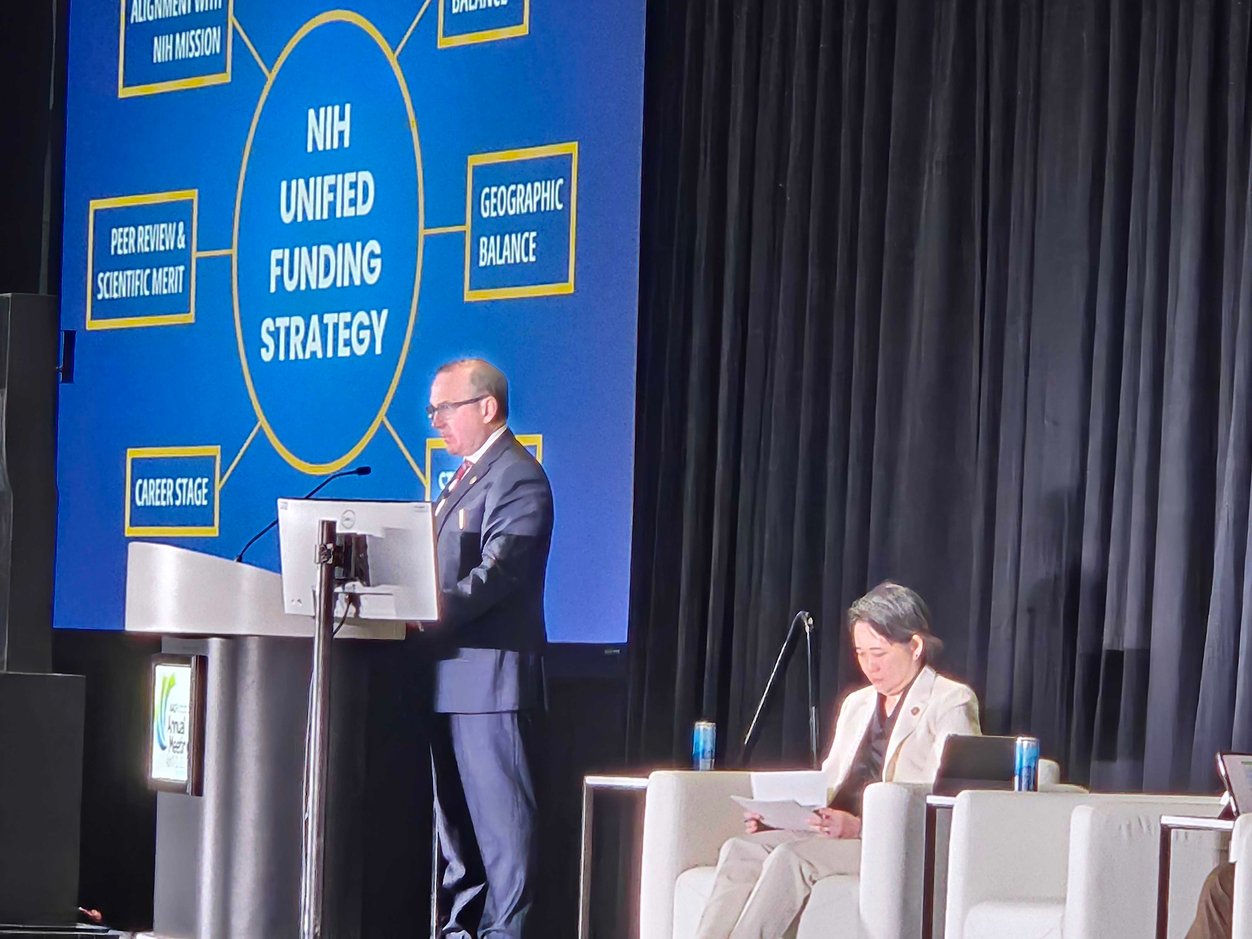
NCI Director Anthony Letai. Angus Chen/STAT
NCI
Anthony Letai on funding, trust in science and more
Anthony Letai has taken on the job of NCI director at one of the most interesting times in the history of the office. Letai’s address at AACR on Monday was a glimpse into how the new director is navigating the various politics and the governmental challenges present for the moment for science.
Researchers are worried about the instability in the federal government under President Trump, and the impact that has had on public funding for science and public trust in science. In his address, Letai tackled some of these questions head on, starting with NCI funding, and said emphatically that the NCI is stable in terms of its mission and funding.
That continues a line of messaging that Letai has held since taking office, though in this address he also acknowledged that multiyear funding requirements “did affect our ability to provide the same number of grants.” Many in the cancer research community have expressed concern that fewer investigators were being funded. However, Letai added that he believed the agency is on track to fund more grants in the coming years.
Towards the end of the hour, Letai took a question from past AACR president Lillian Sui about repairing trust in science with the public. In his answer, he referred indirectly to the pandemic-fueled surge of public interest in the antiparasitic ivermectin.
There is no clinical evidence that ivermectin is effective against cancer, but Letai urged the scientific community to “be more universally respectful if someone brings up an idea about a certain antihelminth,” he said. “We’re probably missing an opportunity to connect with this member of the public that probably needs it most. Understand that the people coming to you with funny ideas, they’re often desperate people that are suffering greatly.”
In an interview, Alice Shaw, the chair of the department of medical oncology at the Dana-Farber Cancer Institute and a program chair for the AACR meeting, said, “I think it’s wonderful to have Dr. Letai at the helm here.” She added: “He is a lab based scientist. He's done incredible work, and he understands the need for translation as well from science to the clinic. He's done exactly that in his career.”







No comments