PARTNERED WITH 
|
|
|
Happy Tuesday, Hospitalogists,
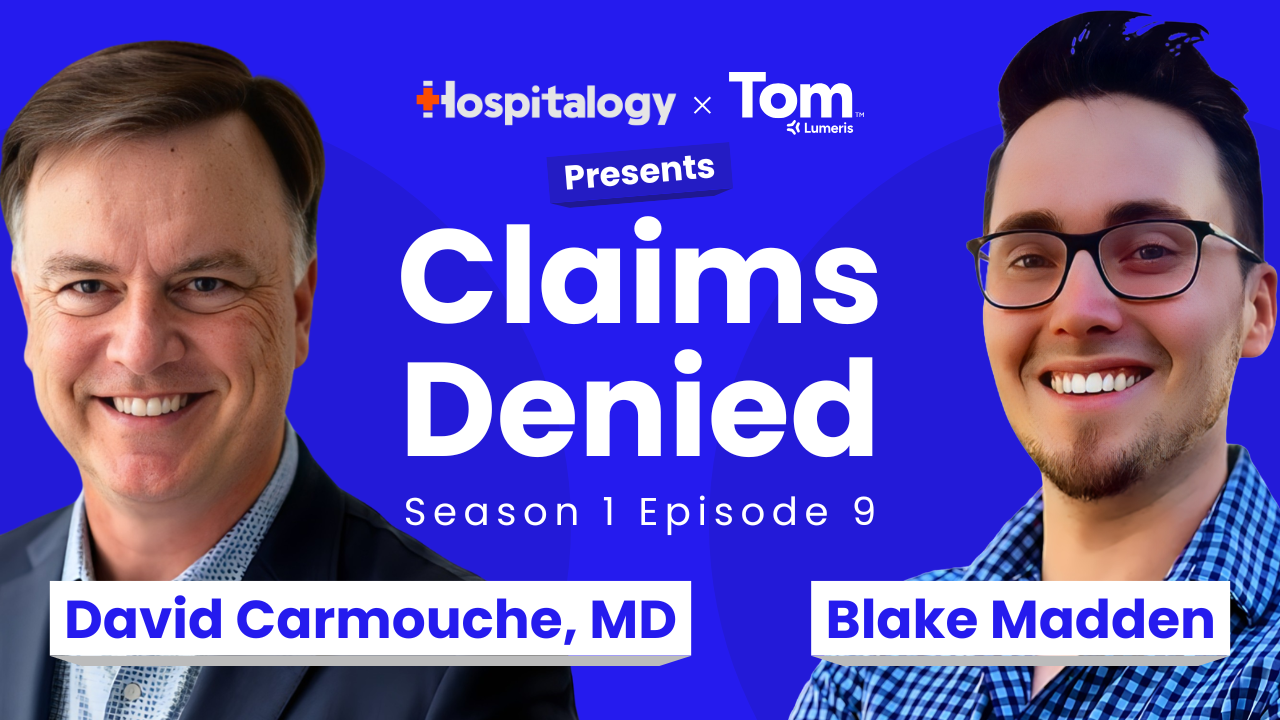
Today, I’m sharing key takeaways from a recent conversation I had with Dr. David Carmouche of Lumeris that reframed how I think about the primary care landscape, raising some interesting questions around the sustainability of the subsidy model within health systems.
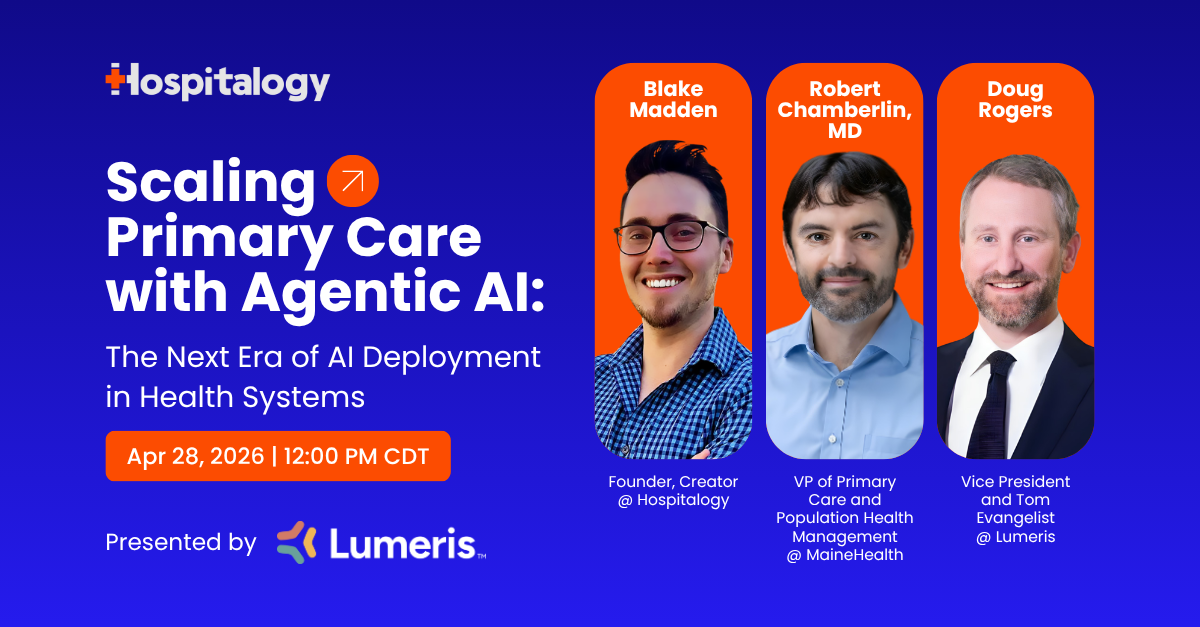
We’re continuing this AI in primary care conversation next Tuesday the 28th, where I’ll chat with Doug Rogers, VP of Lumeris, and Dr. Robert Chamberlin, VP of Primary Care and Population Health Management at MaineHealth.
Specifically diving into how to expand & scale with agentic AI. Register here.
Enjoy!
|
Was this email forwarded to you?
|
|
|
SPONSORED BY SMARTER TECHNOLOGIES
Get to know Smarter Technologies: AI-native technology designed to support the entire revenue cycle. Not another point solution. Maintaining control of your revenue cycle with a modular platform designed to solve specific challenges where and when you need it.
Start with what matters most: SmarterNotes to unlock clinical insight, SmarterUtilization to prevent downstream issues, SmarterPrebill to capture revenue before claims go out the door, or SmarterDenials to recover revenue faster.
Each solution delivers standalone value, and becomes even more powerful when deployed together.
200+ healthcare organizations are already transforming revenue cycle performance, increasing cash flow, and mastering the cost to collect with a smarter, more flexible revenue cycle platform. See why you should join them.
|
|
|
The Primary Care Manifesto: The Doctor Who Wants to Kill the Primary Care Office Visit |
Listen to our discussion here.
Dr. David Carmouche has spent 30 years trying to fix primary care from every possible vantage point in the system. Practicing PCP. Payor CMO. Health system executive. Retail health leader. Now health tech officer building an AI-enabled care delivery platform at Lumeris. When someone with that kind of résumé tells you the traditional primary care model is dead, you should probably listen.
I recently sat down with David on my Claims Denied podcast to talk about his journey to Lumeris, what really killed Walmart Health, the Ochsner deployment of Lumeris's AI care agent "Tom," and his provocative 10-year vision for primary care. Spoiler: there aren't many waiting rooms in that future.
|
From Exam Room to Boardroom (Via a Fake Appointment) |
David's origin story is a long walk through healthcare. He started as a practicing internist who genuinely loved the cognitive work of primary care: longitudinal relationships, figuring out what makes patients tick, guiding them on their health journey. About 15 years in, he hit the wall every PCP eventually hits. Doing the job well was financially punishing.
"To really take good care of patients came at my own personal expense financially," he told me. "Time is not your friend when you're in a fee-for-service environment."
David had a patient who happened to be the CEO of Blue Cross Louisiana. Every time the guy came in for an appointment, David would book a fake appointment in the adjacent slot so he could finish the clinical encounter and then corner the CEO about healthcare payment reform. Picture it: a practicing doc cornering the CEO of the dominant commercial payor in the state, telling him, you control 75% of commercial payment in Louisiana, you're everyone's margin, why don't you do something different with how you invest in healthcare?
These conversations came to a head when the ACA landed and everything changed. Guaranteed issue, exchange competition, no more underwriting your way to profitability. Suddenly that same Blue Cross CEO needed someone who understood care delivery to help reorient the entire company. He invited David to lunch and asked him to leave his practice, come on as CMO, and own the transformation. David wrestled with it for a while, 15 years into the career he'd planned since age 6, until a mentor gave him the most direct career advice I've ever heard: "Healthcare is broken. You can either be part of the problem or part of the solution. You can't be both."
So David went to Blue Cross. Then Ochsner, where he ran primary care and VBC for 7 years. Then Walmart Health. Now Lumeris. Each move driven by what David described as "black swan healthcare events": ACA, COVID, and now AI. Can’t make the timing up, really.
|
What Actually Happened at Walmart Health |
I couldn’t help but ask about Walmart Health. You guys know I wrote about Walmart at the peak hype cycle of retail health, and to see the initiative shut down was a bummer to me.
What I learned was Walmart’s mission was real. Walmart saw that 90% of Americans live within 10 miles of a Walmart store, creating a huge rural health opportunity. Its vision was a flywheel similar to any other retailer at the time: bring primary care into the stores, help customers get healthier, maybe they spend less of their discretionary income on medical conditions and more on retail. The primary care play was supposed to be a standalone business that also happened to reinforce the retail ecosystem.
The problem was the same one that kills every brick-and-mortar primary care play: unit economics. Modern clinical space is way more expensive to build post-COVID than pre-COVID. Reimbursement models for primary care are structurally inadequate. And at a Fortune 1 company, anything subscale struggles from lack of attention and resourcing. Walmart’s path to scale was going to be brutally expensive and long, and Walmart ultimately decided to cut it as non-core to its business given capital demands.
"Had we had some of the technologies that I'm sure we'll talk about today, maybe there would have been a different way for Walmart to get into primary care." David laid out the vision playing out at Lumeris and within health system deployments of Tom today. Essentially, the AI-enabled, capital-light primary care model he's now building at Lumeris is the version of Walmart Health that the technology of 2021 couldn't support. Now that AI has an action layer, scaling primary care efficiently is possible.
|
The Math That Breaks Everything |
Roughly 100M American adults are "undocked" from primary care. They either can't access it or choose not to. The physician pipeline is drying up, with estimates putting the shortage at roughly 90,000 physicians over the next decade. Meanwhile, the population is aging and carrying a bigger chronic disease burden, largely obesity-related.
The traditional answer of "recruit more PCPs, build more clinics" doesn't pencil anymore, and we’re seeing a secular trend play out where traditional primary care is being replaced by urgent care, prevalence of APPs, and now most notably, agentic AI.
Health systems have a decreasing ability to throw more humans at the primary care problem, though.
At Ochsner, this math was explicit: hitting organic growth targets for primary care would have required hiring approximately 162 new PCPs and building clinics for them. Wildly expensive. Also, frankly, there aren't 162 primary care docs available to recruit. The human solution to the primary care crisis does not exist at the scale required.
So what does primary care need to look like? David's white paper (I called it a manifesto and I'm sticking with it) argues that we've artificially crammed primary care into a handful of 15-to-30-minute office visits per year, as if patients know exactly what to do for the other 361 days. Most don't. Some have a doctor friend they can call. Others go to ChatGPT. Most are just left to their own devices.
His thesis is that primary care should be constant, connected, continuous, and proactive - but also virtual first. Not reactive. Not episodic. And the technology to make that real (conversational AI, remote monitoring, wearables, voice-based engagement) is here. This thesis is what created Tom, Lumeris’ answer to scaling primary care and designed to be an agentic layer for longitudinal patient journeys. Primary care for the other 361 days, stated differently.
The vision is expanding a PCP's effective panel from roughly 2,000 patients to potentially 5,000. David was refreshingly honest about how that message lands with physicians: "If I told a burned-out PCP they could see more patients, their eyes roll back in their head, if they're not grabbing for my throat."
But David isn't a 26-year-old in a garage pitching Tom or AI as a silver bullet. He's a PCP who has walked the damn walk, lived the burnout, and who understands that the technology isn't the barrier; but rather, physician adoption / behavior change is. And adoption requires evolution, not revolution. You don't flip a switch from seeing 20 patients a day in-person to orchestrating 120 asynchronous AI-enabled encounters. You build trust incrementally. Let early adopters prove the model (and get ahead while they’re at it).
Doctors are scientists, and healthcare is conservative by nature. So stakeholders want proof. For physicians, many experiences with health IT to date have largely been "more work added to my plate," not "cognitive burden reduced."
Good news is that ambient documentation and clinical decision support tools are starting to shift that perception. Clinicians are seeing that some technologies actually help. But the leap from "this tool transcribes my notes" to "this AI is autonomously engaging my patients between visits" is one that will happen over a longer time horizon. We’re only human after all and not robots (yet).
|
Primary Care as a Strategic Asset, Not a Subsidy |
Most health systems frame their employed physicians in a subsidy model - losing money on primary care to capture downstream economics. Everyone knows this. Obviously primary care physicians create enterprise value for the health system, but the accounting is wrong. Question is why we keep framing and silo-ing primary care in this way when ‘whole house math’ is the real path forward.
David broke this loss leader subsidy dynamic at health systems into 2 buckets: community benefit (mission) and clinical front door economics (margin). The front door argument is the one that should reshape how leadership teams think about AI investment. In reality, primary care your most important asset. It is the acquisition channel for lifetime patient value, including downstream subspecialty care, surgical care, inpatient care, and higher-margin services.
Based on payor mix, network configuration, and percentage of aggregate care captured versus leaked to competitors, there's a calculable dollar value to every incremental primary care patient. When you deploy technology that grows those panels without proportionally growing real estate and physician headcount, you can see why subsidy model is pretty poor framing for an infinitely valuable asset to patients and future viability of a health system.
There's also a defensive play worth flagging: keeping Medicaid and Medicare patients out of the hospital for medical conditions where you lose money on the admission (heart failure, CKD, hypertension emergencies). Avoidance of lower-reimbursed inpatient stays is a legitimate value prop that often gets overlooked in the AI conversation. And…duh…better patient care and experience - what ought to be everyone’s north star in healthcare.
The competitive dynamics at play David described are fascinating. Health systems that figure out AI-enabled primary care first will be the ones capturing market share, offering large employers better access, onboarding new patients through a virtual layer that doesn't require an open appointment slot on some future Tuesday. Growing market share by creating in-person appointment availability is brutally inefficient. An AI-enabled access layer is not.
|
In 10 years, David believes the in-person office visit will be the exception in primary care, maybe 15% of encounters. The rest will be AI-driven, remote monitoring-enabled, and virtual.
For that 15% where you actually need a human with the patient, he envisions mobile vans dispatched to someone's home with a paramedic, virtual care connectivity back to an NP or physician, and the ability to conduct a full guided physical exam remotely (especially on the rural side). Or micro-clinics, 500 square feet, distributed across the geography, where a patient is dispatched at a specific time and meets an MA or NP for a tech-enabled virtual encounter.
Payment model that makes this work include subscription or sub-capitation, and not really fee-for-service which obviously presents challenges in today’s landscape. Primary care finally becomes profitable because you've stripped out the bricks-and-mortar cost structure, scaled the human component with AI, and aligned payment to value creation rather than visit volume.
|
Traditional primary care solutions (recruit more docs, build more clinics) are unsustainable - look at the flight to higher dollar or more efficient primary care adjacent offerings like longevity clinics, med spas, direct primary care, concierge care, urgent care. Health systems that recognize primary care as a strategic growth lever (not a missionary subsidy) and invest in AI infrastructure accordingly are going to separate from the pack.
How long before a major health system loses meaningful market share to a competitor that deployed AI-enabled primary care first? Or to the Whoop’s of the world (who plan to participate in ACCESS, by the way)? Because that's the moment when "wait and see" stops being a strategy and starts being a liability.
|
|
|
- Join me at HFMA! HFMA is a great conference. I'm hosting an intimate, curated happy hour a few steps from the conference center, right on the Potomac. 40+ senior leaders from health systems, physician groups, and health tech. Gourmet drinks and bites. Showstopping views of the river. Good conversation with great people. This is application based, and taking place on June 8. Apply to join us!
- Podcast: In a recent episode of McKinsey On Healthcare, Sam Hazen, CEO of HCA Healthcare, laid out his thesis that ambulatory expansion, rural market investment, and rising inpatient acuity are the 3 forces reshaping the healthcare system, with AI as the throughline tying it all together. Check it out here.
- Read: Amazon is methodically building an integrated health stack: expanding Health AI to all consumers; launching an enterprise-grade AI contact center platform (Amazon Connect Health); growing pharmacy same-day delivery to 4,500 cities by end of 2026; and adding Zepbound to its cash-pay formulary. All this while quietly importing CVS Health payor talent to run its provider network. Read more in this Becker’s article.
- Breakdown: Kaufman Hall's Q1 2026 M&A report shows hospital deal-making hitting its highest Q1 pace in six years — 22 announced transactions totaling $14.5B in transacted revenue — with divestitures representing 68% of activity as health systems aggressively reposition their portfolios ahead of anticipated Medicaid cuts from H.R.1.
- Roundtable: Don’t miss this Friday’s April Hospitalogy Roundtable for Plus Members at 1pm EDT. Save your spot here.
|
|
|
That’s all for this Tuesday. I would love to know your thoughts! Just hit reply to this email.
– Blake
|
|
|
I'm building a community of leaders in strategy, finance, and ops
at hospitals and health systems to help us connect, learn, and grow together.
|
|
|
Get your brand in front of 68,400+ executives and healthcare decision-makers.
|
Workweek Media Inc.
1023 Springdale Road, STE 9E
Austin, TX 78721
Want to ruin my day? Unsubscribe.
|
|
|
|




No comments