telehealth
Hims' weight-loss shift, peptide optimism
Hims is feeling the aftershocks of shifting its weight-loss business from compounded GLP-1 products to branded versions of the drugs. In its first quarter earnings report, the telehealth provider wrote down $33 million in restructuring costs related to investments it made in compounding "that now face risk of obsolescence."
On the earnings call, Hims executives were eager to present this pivot as brilliant strategic opportunity. But, those who have been following along will remember that the company's hand was forced following a lawsuit from Novo Nordisk and increasing regulatory pressure from the Food and Drug Administration.
Since announcing a truce with Novo, Hims reports it has fulfilled 125,000 Wegovy shipments. The branded products, however, cost Hims more and also ship monthly instead of every two months.
Overall, Hims reported $608 million in revenue for the first quarter, 4% over a year before — at the low-end of its guidance but below Wall Street expectations. The company increased the top-end of how much it expects to earn this year to $3 billion, but lowered its margin and EBITDA ranges.
CEO Andrew Dudum told investors the company is gearing up to launch a peptides offering and will be watching FDA for guidance on what's allowable. The agency is convening an advisory committee meeting on the topic in July. Dudum said Hims will need to ensure its supply chain is solid, that it has appropriate clinical guidelines in place, and overall that the future peptide offering is safe.
artificial intelligence
Sepsis algorithm redux
Sepsis algorithms are suddenly back in the spotlight. Bayesian Health today announced its algorithm for predicting a patient might develop the potentially life-threatening infection has been cleared by the FDA. Now, the company must figure out how to get enough health systems to pay for the product to build a business. Standing in its way is Epic, the dominant electronic health record software vendor, which markets a sepsis predictor of its own.
Several years ago, an earlier generation of Epic’s sepsis algorithm turned into a symbol for the dangers of hastily implementing AI. As Katie Palmer reports, even with that troubled history, Epic's technology has a huge advantage in the market because it’s relatively cheap and easy for the company's customers to switch it on.
Epic’s algorithm hasn’t been cleared by FDA, a point of consternation for some competing AI developers who see sepsis software as a qualifying medical device that ought to be reviewed by the agency. We'll see if Bayesian's clearance and claimed technical superiority will do anything for the company's ability to find adopters for its prediction algorithm.
Read more here
research
Sloppy science
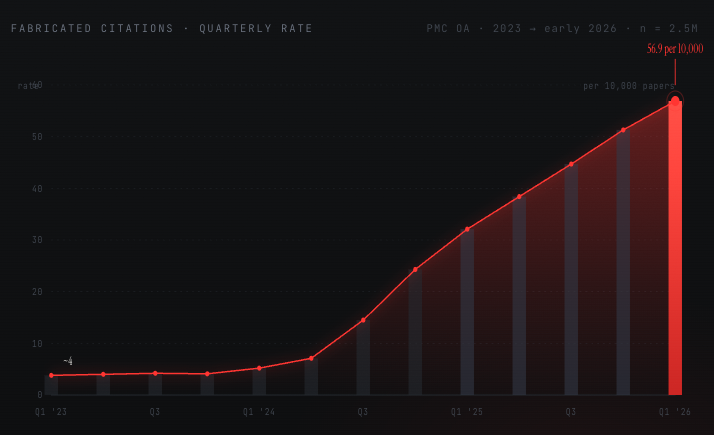
A new study reviewed nearly 2.5 million biomedical papers and identified 2,800 that contained fabricated citations. The work from researchers at Columbia University provides the latest evidence that the growing use of AI that makes it easier to write and edit text may be impacting the quality of academic research.
While the overall numbers are relatively low, the researchers observed a striking increase in fake citations in recent years, Anil Oza reports. In 2023, 1 in 2,828 papers contained a fabricated reference. In 2025, that number was 1 in 458. The chart above showing this trend is taken from a website that highlights the findings. In his story, Anil reached out to prominent publishers to see what they are doing to combat the troubling trend.
Read more here
digital health
Omada’s PBM strategy
Omada Health last week announced it will now be offered as part of OptumRx’s Weight Engage, which helps the PBM’s customers offer different kinds of GLP-1 benefits, including lifestyle change programs like Omada that support weight-loss goals.
Omada now has deals with the three major PBMs — CVS’ Caremark, Cigna’s Evernorth, and OptumRx, which is a subsidiary of health insurer UnitedHealth Group. In a post-earnings interview last week, Omada President Wei-Li Shao told me the PBM deals are important because employers are likely to be having conversations with PBMs about whether and how to cover the GLP-1s. That makes it a natural place to have a conversation about a wraparound program.
The deals are potentially very lucrative. We know that Cigna is one of Omada’s most significant customers, and Omada is offered as part of Evernorth's EncircleRx GLP-1 program, Cigna recently disclosed 12 million people were enrolled in that program, and though just a fraction are Omada members, it gives you a sense of the potential scale.
Last year, Omada announced the deal with CVS, and on the company’s earnings call last week Shao said that “thousands and thousands” of members are now coming to Omada through that relationship.
Besides the OptumRx deal, Omada will also serve as an administrator through Lilly's Employer Connect, which allows employers to offer GLP-1 benefits without necessarily paying for the pricy drugs.
Omada reported $78 million in first quarter revenue, up 42% year over year. The company crossed 1 million members for which it billed in the preceding 12 months.












No comments