

🏥 The $48B payor nobody contracts with
 |
|||||||
|
|||||||
|
|
|||||||
The $48B Payor Nobody Contracts WithFellow Hospitalogists, Buried in HCA's Q1 commentary this year was a quick note honing in on a huge emerging pressure point for health systems: $150M of unfavorable adjusted EBITDA impact tied in to increases in uninsured populations from ACA and Medicaid disenrollments. AKA, the ability (or, increasing INABILITY, rather) of patients to pay copays and deductibles, with this marked mix shift. HCA also flagged it's watching whether the ~40% of exchange patients who auto-enrolled can sustain premium payments past their grace periods, because historically Q2 is when the coverage attrition shows up. Fast forward to today, and ACA enrollment is already down over 3 million, with premiums spiking another 14% on average in 2027. And between work requirements and other OBBBA provisions, Medicaid disenrollment will continue, affecting everything from supplemental payments to bad debt. America's largest, best-run, efficient hospital operator, with sophisticated centralized revenue cycle operations, told Wall Street that whether patients can pay their share is now a material swing factor in quarterly EBITDA. So if it's significant enough to make HCA's adjusted EBITDA bridge, I promise it's doing worse damage to the 2% margin nonprofit system that doesn't have HCA's scale and capabilities. Which brings me to Cedar, a company that has spent a decade building for exactly this moment, and to a thesis I've been circling all year: the patient is now functionally a top-three payor for most health systems, and almost nobody runs their revenue cycle like that's true. Let's dive in. Executive Summary
While You Were Fighting the 800 Pound Managed Care Gorilla, a New Payor Walked InEvery hospital CFO can recite their payor mix from memory: Medicare, Medicaid, commercial, self-pay. Seth Cohen, Cedar's president, made the case to me that this taxonomy is now archaic, and I think he's right. A commercially insured patient carrying a $12,000 catastrophic deductible from a bronze marketplace plan is labeled "good insurance" in every payor mix dashboard in the country. But this patient is de facto self-pay. They’re paying out of pocket for the vast majority of their care unless they fall off a bridge. Your dashboard just hasn't caught up. Here's the macro backdrop as to why patient cost sharing will only get worse. In 2005, roughly 2% of Americans had a high-deductible plan. By 2023, a majority did…for the first time ever. Over that same stretch, patient out-of-pocket grew faster than medical trend itself, which produces an uncomfortable arithmetic: all the excess medical cost growth we bemoan as a country has been disproportionately absorbed by patients, through cost sharing when carriers pass premium increases down (and then the employer passes those premiums off to their employees), and through coverage drop-off when people give up on insurance entirely. Insured patient responsibility climbed from 6.8% of net revenue in 2024 to 7.3% in 2025, while the share health systems actually collected fell from 45.1% to 42.4%. Owed more, collected less. Then 2026 happened. Enhanced ACA subsidies expired, average marketplace deductibles jumped 37% in a single year to $3,786 as enrollees fled to bronze plans, and effectuated enrollment is projected to drop roughly 21.5% to ~17.5M. 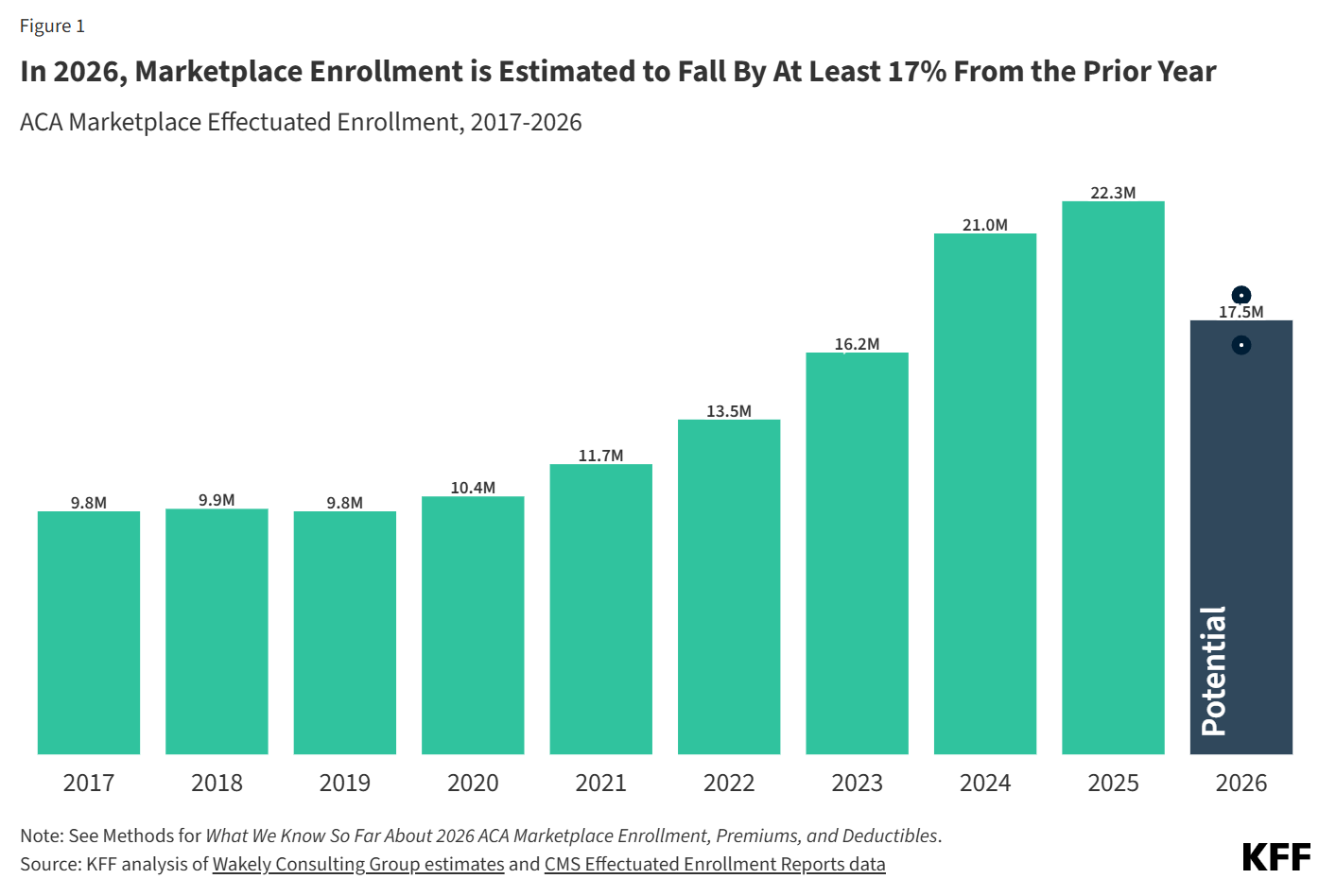
Blue Cross Blue Shield of Arizona watched 30% of its ACA members drop coverage. And per CBO, we're only in the shallow end: the uninsured increase goes from 1.3M in 2026 to 5.2M in 2027, when Medicaid work requirements and 6-month redeterminations take effect, en route to 10M by 2034. 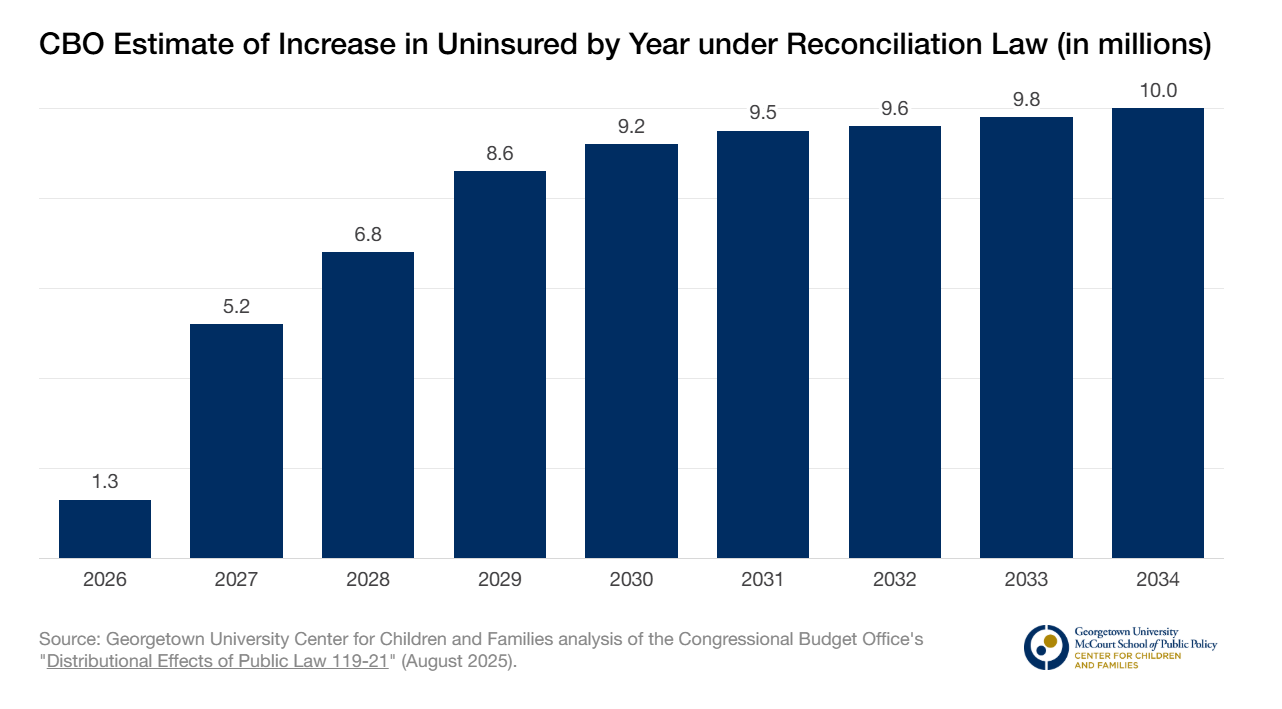
This combined hit strips $68.5B from hospital revenue across 2026–2027, with uncompensated care rising 38.6% to $44.9B. Cedar's platform data confirms the leading edge already arrived: uninsured patients are 10–15% of volume across their 55 health system clients but nearly 40% of outstanding patient dollars, a share that grew 54% in 3 years — most of that before this year's policy changes even landed. There’s one glaring throughline here. Health systems need to become more consumer-oriented, with better patient-facing behavior, quickly. Fastest Growing, Most Expensive, Worst Yield: the Report Card From HellIf patients were a commercial payor, you would have fired your managed care team over this contract years ago. Health systems spend 25–30 cents to collect each patient dollar versus 4–5 cents per commercial dollar, and where a system expects to capture 95–97 cents of every dollar Aetna or Cigna owes, most collect somewhere between 30 and 50 cents of every patient dollar. The Cedar team expressed it pretty clearly to me - patients are, as a class, the fastest-growing payor, most expensive to collect from, but by far the worst yield. Any other payor relationship with that profile would trigger a board-level escalation and a press release about going out of network. As patient share increases, financial impact of this ‘payor’ compounds and worsens over time. Say that 10% of your NPR is owed by patients and you collect 40% of it. Write-offs run into the hundreds of millions for a mid-sized system. If collectability increases on these accounts, then for a 2% margin system, recovering that leakage can make a massive difference in sustainability of the health system. As denials and patient bad debt tick up year over year, and as affordability issues pile on while employers dump ever-increasing premiums onto patients, the current paradigm is broken. And yet when patient AR gets stacked against denials management and payor contracting in the annual budget fight, it loses. Cedar's team was candid that their biggest competitor isn't another vendor; rather, their biggest adversary is the general theme that health systems lack the visibility and transparency from a data perspective to understand how big of a risk this dynamic is to their financial viability, and they undersize the size and scope of the problem. So rather than blindly paying for ‘propensity to pay’ scores or other data sources sorely lacking in helpful context, it’s time we drove into granular detail about consumer payment behavior with thoughtful, contextualized patient engagement leveraging technology like Cedar’s. Propensity to Pay Is a Credit Score Cosplaying as a StrategyHealthcare's systems of record are excellent at recording and terrible at acting. Patient billing is the cleanest expression of that gap I've found yet since every patient receives a cookie cutter experience and EHRs are solving for the lowest common denominator technologically. Epic and its peers send the same MyChart text, the same email, the same paper statement, on the same dunning cadence, to the patient who owes a $5 copay and the patient who owes $10,000 from an ER visit they never saw coming. That's not a criticism of any EHR. After all, it's the job of a system of record to run the machinery uniformly. But let’s take an extreme example here. If you owe $12,000 from an emergency room visit, it does not matter that your MyChart text says you can pay with Apple Pay. Nobody is going to foot a $12k bill with Venmo, either. Engagement for these patients needs to be handled extremely differently. Layer the industry's segmentation tool on top and it gets worse. Standard propensity-to-pay models run on credit history, zip codes, and census data — historical, non-intuitive inputs that are static, stale, and blind to the actual reason a bill goes unpaid. The Cedar team walked me through an example where this outdated approach wouldn’t work. Take a patient with pristine credit whose EOB doesn't match her bill. She isn't going to pay, and no credit file on earth will tell you why. Cedar's 2026 study quantified the failure in a stat that should end the P2P era on its own: across 10M bills analyzed, accounts with high external propensity-to-pay scores yielded 51% less than bills with no score at all. Providence found something similar within its own dataset: 77% of its bills require specialized intervention strategies, and only 23% are the easy, digitally engaged collects that one-size-fits-all billing was designed for. Cedar’s proprietary model now enables health systems to engage that long tail of patient balances, contextualized and personalized to cater to the patient’s communication preferences, ability to pay, and dozens of other relevant data points. 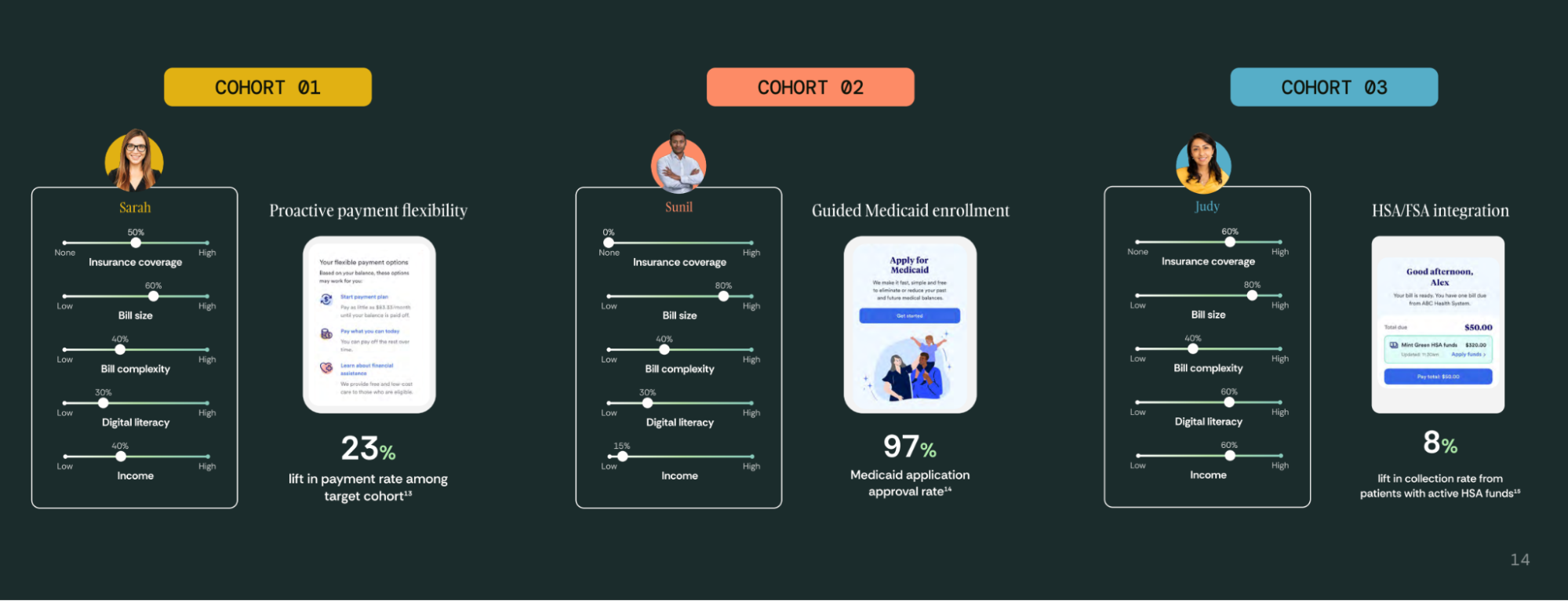
Inside Cedar’s Patient Engagement EngineCedar's product starts by replacing the credit score with a more dynamic, proprietary behavioral model: 80+ attributes spanning what you did with past bills, whether you responded to a text or ignored an email, whether you're a guarantor on someone else's balances, what else you're juggling — refreshed dynamically, so a patient who doesn't engage the way the model predicted gets re-bucketed rather than re-dunned. From there, engagement fragments by need into any permutation needed.
Amy Stillman, Cedar's CPO, came up through ad tech building growth systems for Zappos and Airbnb, and runs product like it — squads of engineers, designers, and PMs shipping rapid multivariate tests, a habit set that looks more like consumer tech than healthcare IT. Her team's north star is a detail I loved: the same health system that knows you intimately in the exam room treats you like a stranger in the billing office. Patients in her research studies say it outright — don't they see I haven't missed a payment plan installment? I loved Dr. Smith, I'd never want her not to get paid. Cedar's answer borrows the best pattern in consumer software (Amazon's "is this about your last order?") and applies it to the moment of maximum financial anxiety: pick up where you left off, acknowledge the three call-center calls, ask what was confusing about the payment plan you abandoned. And sometimes the product tells you not to pay. If Cedar detects a coordination-of-benefits issue, it will hold the bill and walk the patient through calling their payor first — advocacy over collections, in the literal workflow. Kora, the AI voice agent, extends that posture around the clock: she absorbs 20–30% of call volume, cuts live-agent handle time ~25%, and gets QA'd by other AI agents that listen to and score every call, flagging confused patients and unhandled edge cases back into the roadmap. Coming next is Spanish and other languages, plus Kora placing peer-to-peer calls to payors with the patient on the line — which, having personally spent 45 minutes on hold with an insurer over a misapplied deductible, might be the single highest-NPS feature in healthcare history. Cedar Cover, launched at HLTH with Novant, Baystate, and ApolloMD live, points the whole apparatus at the January 2027 cliff: Medicaid enrollment, proactive renewal workflows timed to work requirements and 6-month checks, denials resolution, and medication assistance. Through its partnership with Fortuna Health layered on Cedar's own enrollment workflows, Cover is posting a 97% Medicaid application success rate — a number worth sitting with, because every successful application converts a would-be write-off into a paying government account, and 923K of the projected Medicaid losses stem purely from redetermination paperwork rather than actual ineligibility. The CFO Diligence FileCedar's headline economics cites a clear, compelling ROI for any CFO to begin conversations with them. Post implementation, Cedar’s first-year patient collection lift averages 22% over historical baseline (Cohen quoted a 15–30% range), 89% patient satisfaction, and 81% of collected dollars flowing through self-service digital channels, which is where the cost-to-collect savings live. On a $100M patient collections base, that's $15–30M of found income. For the average system margin, that's the difference between a Moody's downgrade conversation and investing significantly into that ambulatory expansion you’ve been needing for years. For CFOs and other health system finance folks, let’s walk through what other considerations exist when it comes to vetting this space:
The Time to Invest in the Patient Financial Experience is NOWHealthcare invested 2 decades and billions of dollars in clinical decision support and effectively nothing in financial decision support, and the bill for that asymmetry comes due over the next 18 months. Between now and January 2027, the uninsured increase quadruples, consumerism rises, redetermination churn begins, deductibles reset at record highs, and every hospital's fastest-growing payor becomes even harder to collect from as the affordability crisis further develops. Seth Cohen at Cedar told me something in our conversation that I found somewhat counterintuitive: patients want to pay for their care. Americans emerge from a hospital stay grateful, sometimes fiercely so, and carry real pride about compensating the people who took care of them. What they can't do - and get frustrated by - is pay a bill they don't understand, through a channel that ignores their circumstances, on a timeline built for a copay world that ended 15 years ago. In 2026 and beyond, the dominant strategy will continue to be meeting patients where they are. If you do, you will be rewarded, and the money follows - 22% more of it, apparently. Want to see how Cedar helps providers protect revenue, reduce uncompensated care, and give patients a clearer path to resolution? Request a demo. This essay is a sponsored post in partnership with Cedar. I write these posts for companies with products or missions I believe can provide value-adds for Hospitalogy subscribers, many of whom work with/for ACOs, FQHCs, integrated health systems, health plans, and other risk-bearing organizations that want to learn more about potential value-based care partners. If you’re interested in a sponsored deep dive, please reach out to blake@workweek.com! Thanks for the read! Let me know what you thought by replying back to this email. — Blake |
|||||||
|




No comments