

🏥 Who’s absorbing the liability for AI?
 |
|||||||||
|
|||||||||
|
|
|||||||||
Happy Tuesday, Hospitalogists, Recently I sat down with Teira Gunlock (CEO, First Stop Health) and Dr. Eric Bricker (yes, of healthcare finance YouTube fame) for a debate on AI, EMRs, ICHRA, and healthcare's cost curve. What a great conversation. Check out my recap below. Enjoy! PS - for hospital and health system folks, join me in Phoenix at the Hospitalogy AI Retreat. Apply and learn more here! Was this email forwarded to you? BLAKE’S BREAKDOWN The Co-Host Experiment: What Happens When You Throw Out the Interview FormatI've been wanting to try this for a while. Every episode of Claims Denied is a guest interview, which I love, but there's a format I keep enjoying on other pods where the host brings on two smart people who approach the same problem from different angles and just lets it rip. So recently I did that.
They used to work together at First Stop Health. Eric was CMO, and Teira was one of the earliest employees who built the company from startup to a national virtual care practice in all 50 states. We picked three topics. We got through two which should tell you something about how this great conversation went. A lot of my convos have indexed on affordability, specifically on the employer side of things lately, since there’s so much happening in this space in 2026. Sorry, can’t help it. Let’s dive in! (Also, for the record: Eric once stood me up at Fish City Grill because a chicken got caught in wire fencing on his farm. His defense: "That's part of the chicken business." I've since forgiven him.) .png?sig=c2f5b4e16889de0075b99ad9158f4f573309b40a465d4f58c5a4fa4884acde68&size=email-body&dpr=2)
To listen to the podcast, click the image. AI, regulation, and the walled garden problemThe opening topic was the one everyone is tired of hearing about and yet nobody has actually solved: AI governance and regulation in healthcare. My framing going in was the self-driving car analogy which I’ve mentioned to you guys before. It goes something like this…Waymo can reduce accidents at the population level, but the one time it hits something, or the second it gets befuddled by traffic cones, that's the story that runs for a week and lingers in our fallible human brains. Healthcare AI has the same asymmetric risk profile: massive aggregate benefit, disproportionate attention to the miss. Teira's opening move was to reframe the whole regulatory conversation.
Her sharper point, though, was that most regulatory debate treats AI as a tool, when it's increasingly behaving like a member of the care team — an agent with its own scope of practice, its own workflow responsibilities, its own failure modes. Which maps poorly onto both FDA device frameworks and state-level provider licensing. An open-ended question for regulators and governing bodies. Eric took the liability question and ran with it. Right now, if a physician practice is deploying AI, the physicians themselves are absorbing the liability through malpractice coverage. Something bad happens, the plaintiff's bar goes after everyone in the chain. That's just how it works until there's case law or regulation that says otherwise. But Eric's more interesting argument was that liability is actually a distraction from the bigger prize. The real unlock is agentic AI inside clinical workflow software. Which brings us to his most provocative point of the hour. Electronic medical records, Eric argued, are a bad name for what EMRs actually are. They're clinical workflow software. The record-keeping is a fraction of what clinicians actually do inside them. Orders, documentation, routing, communication — that's where the mouse-click economy lives. And agentic AI could plausibly take a huge bite out of that. Except Epic and the other large vendors have not operated as open architectures. They've operated as walled gardens.
Healthcare runs on mouse clicks, and agentic AI could take a huge bite out of them, except Epic and the other large vendors haven't operated as open architectures. Eric compared this to Steve Jobs' original instinct with the iPhone: "Steve Jobs didn't want the App Store. He's like, 'I want Apple to create all the apps because I need control.' His colleagues talked him out of it, and that decision is why the iPhone became what it is. EMRs haven't had that moment yet, and Eric's take is that it may require further regulation to force the garden open. I pushed on this, because there's a corollary for the ambient AI companies. If you're capturing 100% of clinical documentation at the point of care, you're arguably becoming the system of intelligence — and over time, plausibly the system of record — even while the EMR keeps the workflow. Teira then chimed in: EMRs aren't just clinical workflow software. They're clinical workflow and billing software. Which is why they've been so structurally resistant to change. The billing side is where the revenue lives for the vendor, the health system, and the physician practice. You don't just casually reform that. The point I kept coming back to internally was the one that didn't get enough airtime: this is going to be, in my opinion, one of the defining strategic questions of the next 5 years for enterprise health IT. Whoever figures out the interoperability-plus-agentic-AI stack — whether through regulation, partnership, or a challenger building underneath the incumbent — captures enormous leverage. Epic has obvious incentive to keep the garden walled. Everyone else has obvious incentive to pry it open. Radiology and solving the subsidy crisis?From there we got into what AI actually changes for specific specialties, and I asked whether letting AI read, say, 85% of routine scans in rural and critical access settings is good, bad, or somewhere in between. Eric didn't mince words: "It's 100% good." Radiology is in a severe shortage. Residents get job offers at the start of their second year because imaging volume has outrun the supply of readers. Eric has med school friends running RAD groups that now employ radiologists across multiple states doing teleradiology coverage for rural hospitals. AI-assisted reads let some groups push more volume through fewer FTEs, and those groups are starting to underbid competitors on hospital stipends. They'll walk into a health system and offer to shrink the subsidy because they don't need a half-million a year to cover the same volume.
I asked the obvious question: doesn't this cannibalize radiologist RVU productivity? Eric's answer was that the competitive dynamic is winning. If AI lets you read more volume, you underbid, you win contracts, you scale. The individual RAD's economics may not change dramatically in the short term because they're still reading high-complexity studies and doing procedures, but the group's economics shift significantly. This is the kind of story I haven't seen show up in hospital earnings calls yet, but I suspect we'll start hearing about it in the back half of 26 and into 2027. HCA, Tenet, UHS — all of them have been talking about professional fee inflation for several quarters. If there's a specialty where the subsidy line item compresses first because of AI-driven labor arbitrage, radiology is the canary. Who actually benefits from all of this?Teira pulled the conversation back to the question: if AI really does reshape workflows this dramatically, who captures the benefit / dividend?
She also shared a number from personal experience that was pretty eye opening. First Stop Health's first fully AI-native software development cycle — a real workflow redesign, where engineers review documentation and pass work between agents rather than writing code — produced a 5x productivity gain right out of the gate. And her point was less about the measured efficiency gain, but rather the monumental paradigm shift happening in the workplace in real time. The open question is what the equivalent workflow redesign looks like for clinicians. Eric made a point here that I think will be controversial and I'm going to quote directly, with some context added from me: "HCA and Tenet and UHS have shareholders. If anybody's going to [implement and operationalize AI], the publicly traded hospital systems are going to do it before anybody else will." The quiet part said loud is that stage-two AI adoption, the kind that actually compresses costs, involves layoffs. Nobody on a non-profit health system investor call is going to say this, but the publicly traded operators are going to do it first because their board demands it, or because future margin compression (AKA, what just came out of HCA’s preliminary Q2 print) necessitates the change. 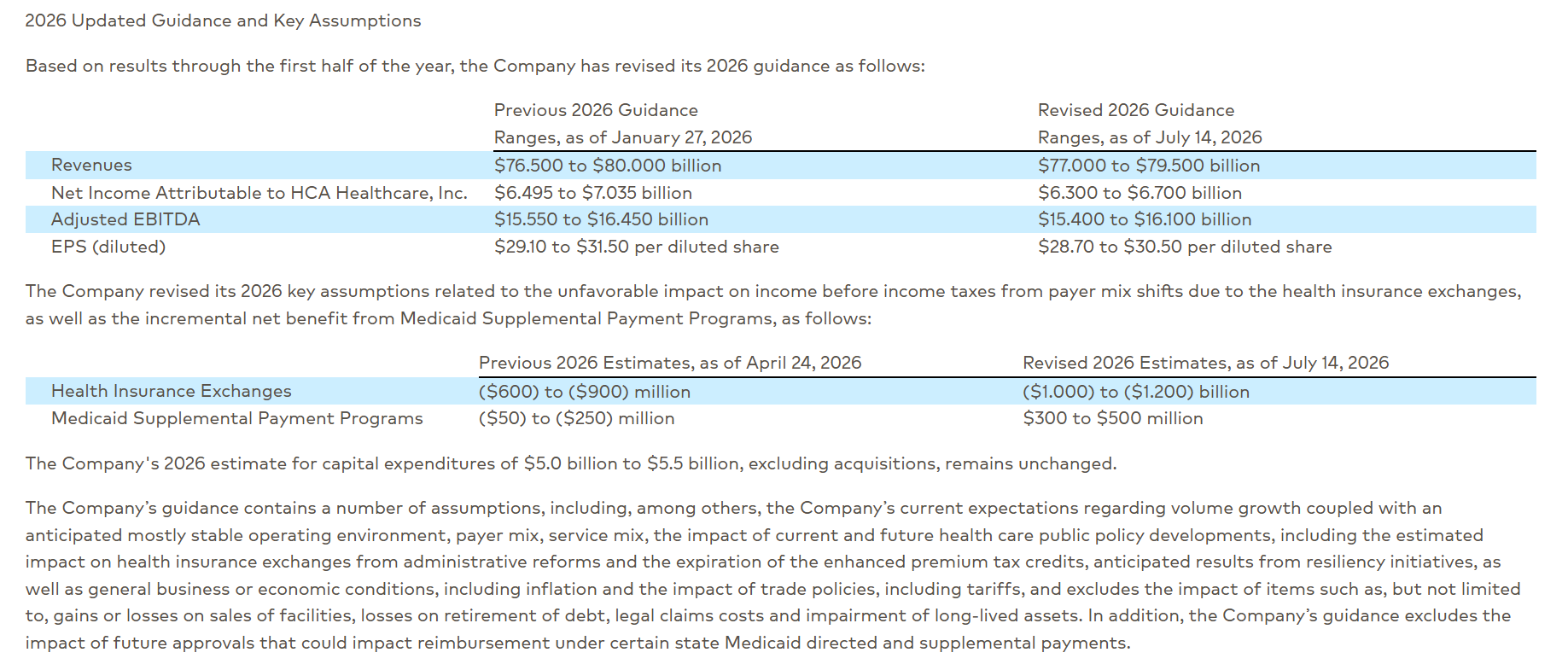
I've posed this exact scenario to health system executives over the past year: if an AI use case could cut two-thirds of a department's cost but meant phasing out the department, would you do it? Almost every answer has been some version of "there's so much work to go around, we'll reskill and redeploy." On the pod I called that a cop-out, and Eric agreed before I could even finish the sentence (and you have to give yourself internal praise when someone like Eric agrees with you. Hell yeah). Teira's read was more generous and, I think, presented a bit more nuance and precision. Yes, it's partially a cop-out…but also partially sincere.
Health systems aren't just employers. In plenty of markets they're the largest employer, the tax base, and the community anchor all at once. Pretending headcount won't change is polite avoidance. Handling the change carelessly is worse. Another open ended question for us, and our economy at large, to grapple with. Eric Bricker’s emotional labor thesisBest line of the episode belonged to Eric, and it had nothing to do with technology per se:
He got there by way of a demystification that only a physician could deliver: a doctor compares two datasets — the patient in front of them and the compendium of medical knowledge — and produces a diagnosis and treatment plan.
Eric argued that we’ve spent a century optimizing for brainiacs who can hold dataset 2 in their heads, when the actual bottleneck is dataset 1 — AKA, the patient interaction. What’s crazy here is that plenty of APPs are better at patient interaction, which is going to absolutely destroy some physician pride while reading this. Then if you arm them with an LLM-based compendium, which physicians are already adopting spontaneously with zero top-down mandate, you've addressed the shortage from a direction medical societies won't love. Eric is watching urologists train APPs on specialty-specific knowledge right now and thinks AI collapses training boot camp from months to weeks. He implored the following on the pod to builders, saying, "Don't let the Luddites stop you." Teira asked whether the physician of 30 years from now is the smartest person in the room…or the most trusted. Eric's answer was that the human interface isn't going anywhere. We're wired to engage with human faces, which is literally why we watch podcasts instead of just listening to them. (By the way, you can watch all of my podcasts on Youtube here.) Now, being a non clinician, I had to get in my 2 cents so I related it to myself in self-centered fashion. In media, AI is creating a sterilization effect.
The way I stay relevant is to lean harder into authenticity, intimacy with the audience, and the human elements that are very hard to fake. The healthcare parallel is almost identical. The clinicians who thrive in an AI-augmented environment are the ones who double down on the parts of the job that were always supposed to be human to begin with. This change presents real challenges and requires significant change to the status quo the profession operates within. ICHRA, captives, and the employer exitWe only had time for one more topic, so we skipped the third and went straight to the employer cost debate. This one was meaty and, as mentioned, I’ve had several conversations already in this arena since it interests me so much. Managed care is dismantling in real time at the hands of the affordability crisis and industry regulation. Small and mid-market employers are getting crushed. Fully insured renewals have been running 30, 40, 70, even 80% this past year for groups under 200 lives. The commercial carriers got hit on their Medicare Advantage MLRs and turned the dials hard on the fully-insured commercial book to make it up. So in 2026 and beyond, if you're a small employer staring down an 80% renewal, you have very few options and are choosing, more or less, between two potential escape hatches. Hatch one: ICHRA. Defined contribution, not defined benefit. The employer gives each employee a pre-tax dollar amount per month — say $800 or $1,000 — and the employee goes out to the individual market and buys coverage. ICHRA was pitched two years ago as the 401k-of-healthcare moment, and a wave of startups got funded on that thesis. While the space held a ton of promise, ICHRA hasn't quite played out the way venture capitalists (or Centene) have wanted. The market has settled into small and mid-sized employers, with some interesting municipal adoption, but it hasn't broken into true mid-market in the way bulls predicted. Why not? Eric had the answer here (as he often does): it all boils down to network adequacy on the exchanges. Since the individual market is dominated by narrow-network plans and HMOs, there are parts of the country where you literally cannot get a broad-network PPO on the exchange. Which means when a small business owner does the math on ICHRA, the calculation isn't about the median employee. It's about Sally, the top salesperson, whose kid's specialist is out of network on every available exchange plan. In this setup, Sally will quit. Then since she’s a top performer, the business quite literally can't survive Sally quitting.
So ICHRA gets deferred, the employer eats another deductible hike, and the cycle repeats. Eric's view is that ICHRA adoption is countercyclical — it accelerates where revenue pressure leaves employers no choice, which is why municipalities are moving first. Hatch two: group captives. An area that I learned about live on the pod and fascinates me for SMBs. Group captive functionally works as collective bargaining for stop-loss coverage. Small self-funded employers pool together so a reinsurer will underwrite the aggregate risk without carving out a dialysis patient with a "laser," which is the industry term for an exclusion or premium surcharge on a single high-cost member.
Captives have been getting more airtime in my conversations in the space, and notably so. But here’s the part of the equation neither escape hatch solves: the underlying cost curve. Teira made a point I want to flag:
Complexity as a business model is bullshit. ICHRA, in particular, layers in a lot of acronyms and a lot of decision complexity for employees who don't have the tools to choose well. Portability is a real benefit. Choice is a real benefit. But without better decision support, ICHRA risks pushing employees into suboptimal plan selection in a way that shows up later as delayed care and worse outcomes. Eric also surfaced a sleeper catalyst. Carriers currently underwrite ICHRA members identically to individuals buying on their own, even though ICHRA members lack the adverse selection of people who shop for coverage because they have a specific expensive need. If carriers ever segmented those pools properly, ICHRA pricing improves materially. Decentralization, campaign finance, and the thing we can't fixWe wrapped on the biggest question: what is the employer's role in healthcare in 2026? Teira called the whole system a game of not-it — the federal government says not it, employers say not it, everyone tries to hand the cost curve to the next stakeholder, and honestly, at 8-12% trend (the highest post-’Rona), who can blame them? Eric went bigger. He invoked Uwe Reinhardt and then quoted Donna Shalala — a Democrat and Clinton's HHS Secretary — who said "the path to healthcare reform is campaign finance reform." And then he delivered the most provocative 30 seconds of the episode:
Either you pass campaign finance reform, or you decentralize and take the game away from the regulators entirely. His advice for operators followed from it, which was not to solve healthcare as a whole, but rather find a niche, then a smaller niche inside it. For instance…restaurant workers in Florida alone could support a $100M business. (At OpenEvidence multiples, I told him, that's a $10B company. Somebody go raise the seed round. I wonder what Hospitalogy is worth? Someone hit me with an offer. OpenEvidence multiples only.) I mentioned on the pod that we currently have the worst of all worlds ( Teira closed with a quote that resonates deeply with me, as a fellow optimist:
And Eric backed it with perspective. His parents got married in 1968 — two assassinations, cities burning, Vietnam — and life went on. As many problems as healthcare has, it's meaningfully better than it used to be. I also couldn’t help but bring up that things, do in fact get better. For instance, Texas won the national title in 1969. Sorry. Can’t help myself. Keep pushing, Hospitalogists. And let me know what you’re pushing on. Sponsored by Layer Health Faced with rising case volume, a growing backlog, and a staffing model that couldn’t absorb both, Froedtert & MCW’s heart failure registry team put AI-assisted abstraction to the test. Result: 3x ROI, a cleared backlog, and an expanded relationship now screening ASC patients against 74 custom eligibility criteria, catching 100% of red-flag patients at 99.6% accuracy. THE MOST STRATEGIC APPROACH TO AI IN HEALTHCARE Something I keep hearing from healthcare leaders? The best strategic thinking never makes it out of the silo. Everybody's heads-down, nobody's comparing notes. That's exactly why I’m hosting the Hospitalogy AI Retreat this November in Phoenix. 100 healthcare execs from finance, strategy, M&A and digital health, working to untangle healthcare AI and digital transformation together. You want to be in the room! Apply for the Hospitalogy AI Retreat at hospitalogyretreat.com or reply to this email directly to learn more about attending and speaking opportunities. ON YOUR RADAR
*This resource is brought to you by one of my brand partners who help make this newsletter possible! Thanks for the read! Let me know what you thought by replying back to this email. — Blake |
|||||||||
|



No comments