

$600B of Robots Arguing

 |
|||||||
|
|||||||
|
|
|||||||
In partnership with
Happy Monday, Hospitalogists! I've written about R1 twice in the last few months — once on the Phare OS launch, and once around the virtual session I hosted with Eric Larsen, who sits on R1's board. Today I want to put those two threads together, because R1 just announced a major new product innovation that brings even more intelligence upstream, sitting in the area with some of the most friction in healthcare: utilization management. So naturally today, we’re diving into R1’s launch of Phare Utilization Management. That’s right, baby. Utilization management, and how this new launch changes the whole game. The Bot Wars. Let’s get after it! Today's deep dive is sponsored by R1. As always, the analysis and the opinions are mine. Was this email forwarded to you? Subscribe here and join 81,000+ healthcare executives, investors, and operators. The Bot Wars’ 3rd Chapter is Here. R1 Is Building For It.Or, conversely, how utilization management AKA the least glamorous back room in the hospital, became the place where $600 billion gets decided (and wasted). Executive summary
Stop fighting bots and start optimizing your revenue cycle today. $600 billion of robots arguingDepending on who you ask, the annual cost of adversarial warfare between payors and providers (the conflict I and others belovingly call the Bot Wars) sits somewhere around $600 billion. And to be clear, this does not account for the service rendered but the casual, half-trillion-dollar cost of fighting about the cost of care. And waiting to be paid. As my good friend Eric Larsen put it in his latest paper, AI is the first technology in history that multiplies intelligence itself rather than muscle or low-level cognition. Every prior wave — the steam engine, the calculator — augmented something downstream of thinking. But AI goes upstream. Our healthcare system holds the largest surface area of exposure to this intelligence explosion of any sector in the economy, for 4 main reasons:
Larsen also gave Hospitalogists 2 words that explain why revenue cycle has been hit so hard by AI to begin this healthcare industrial revolution: functional verifiability. Or, stated more simply for us peons, being able to automate tasks with a provable right or wrong answer. Math, coding, payments are the most automatable work in the economy right now and think about how much of this sits in healthcare specifically. The machines got there before they approached anything clinical. Which brings us to the bot wars, and the 3-part series we’re currently experiencing as part of them. With launches like Phare UM, we’re now close to Chapter 3.
So, today we’re cresting into chapter 3. Roughly 86% of denials get overturned on appeal. Denials have obviously been a huge sticking point in the industry, both by policymakers and key stakeholders on both sides of the aisle. We need a fix, and the fixes are coming. The big business of denials only worked because historically almost nobody appealed. More or less the labor cost of contesting a denial exceeded the expected recovery on most claims. But here’s where a distinct paradigm shift in UM land is happening with AI. LLMs don't have that constraint. They're tireless, they work 24/7/365, they don't get discouraged by a payor portal that times out, and they can generate a clinically grounded appeal in the time it takes a human to open the chart. So now everything gets appealed. Two robots, one letter, and zero humans who wanted any of this. And this exact moment is the part of the story where healthcare media usually reaches for a villain. Where they see villains, I see rational actors on both sides. Payor medical directors and provider CFOs are both responding rationally to a system that pays them to be adversarial.
Complaints about the structure of MLRs or fee for service land aside, neither incentive is illegitimate. What's illegitimate is a $600 billion (600 billion!!!) referee layer that produces $0 of clinical value and, at this point, increasingly little economic value to either side. When both sides have equally good models, the arms race is a hamster wheel. Nobody gains. Everybody pays. How do we escape the endless cycle though? It feels like a timeless question or a black hole nobody can escape. No - getting past the event horizon happens by making the disputed decision correctly the first time, upstream, before there is anything to dispute. And this critical juncture is the seam R1 is building into with Phare UM, and Phare OS at scale. 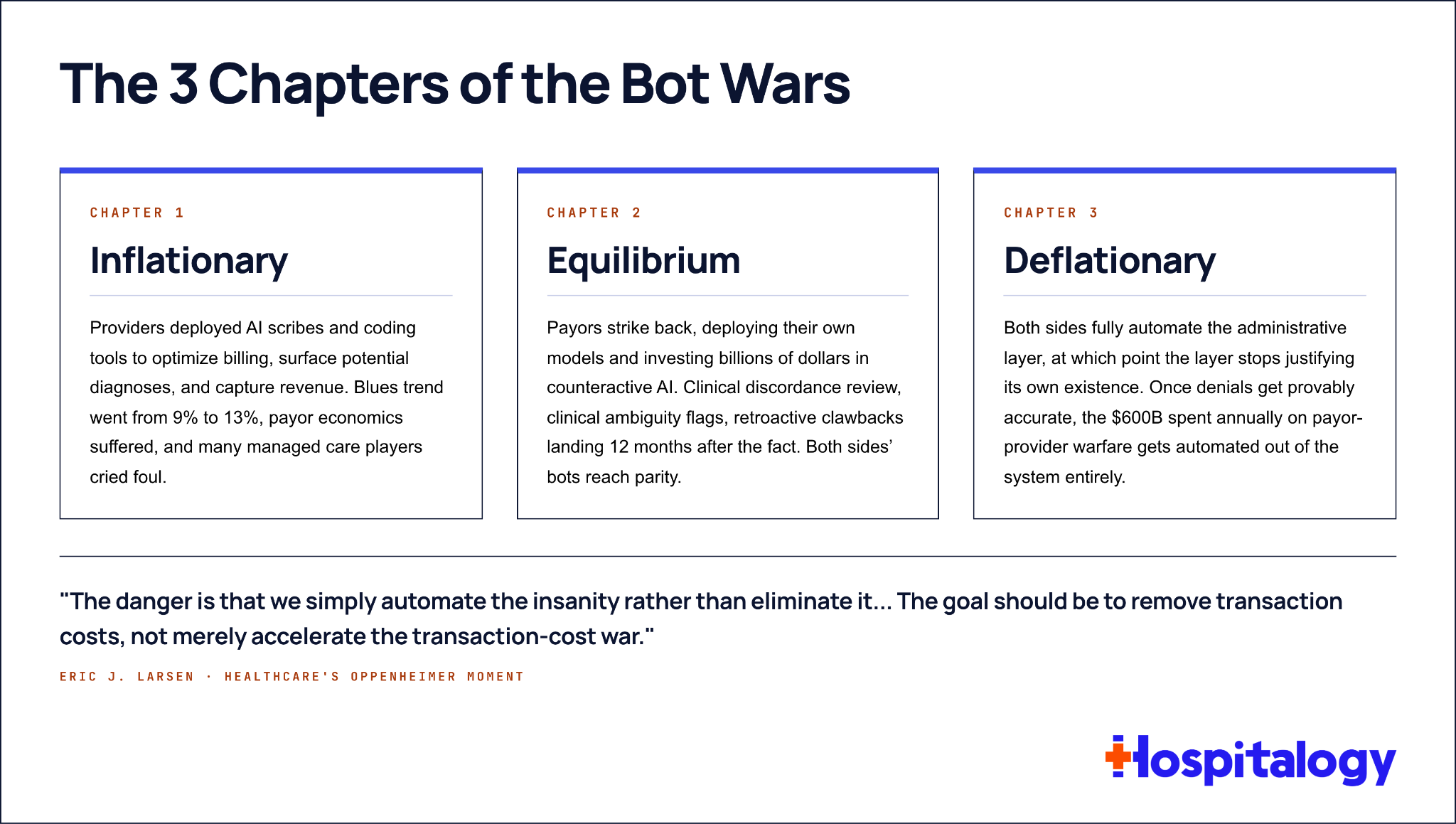
Incumbency is a head start, not a moatHolding an incumbent advantage in a hyper-regulated, hyper-oligopolistic industry buys you a head start. What you do with the head start is a choice: self-disrupt, or sit behind the ramparts and hope. R1 is an incumbent player moving at the pace of an insurgent startup. They sense this moment, and they sense the urgency to build a new revenue cycle operating system for healthcare, crafted with AI natively, at its foundation and core. The team’s raw position is hard to overstate.
R1 works with 95 of the top 100 health systems. As a proprietary data asset in a world where the frontier labs are starved for exactly this kind of corpus, that's about as good as it gets in American healthcare. Data alone doesn't win, though. Plenty of incumbents are sitting on enormous datasets and doing nothing with them. What R1 did over the last 24 months is the interesting part:
R1's AI innovation lab is called R37, which is a nod to Move 37. If you know, you know, and if you don't, it was the move AlphaGo played against Lee Sedol that no human would have played and that turned out to be correct (I totally did not just Google this move). Melissa Hannan over at R37 (and whose baby is Phare UM - figuratively, not literally because she also has twin boys, God bless her) gave me the internal view of what R37’s product development velocity feels like as AI shortens product development cycles. You can fail fast, and move on:
10x code output, and the subject matter experts stay in the loop the whole way because they can see something the same week they described it. Her caution — and I think this is the correct one — is that the constraint has moved. It's no longer "can we build it," but rather product sense around what to build and what to add to the roadmap. Outcomes over outputs. Her word for the failure mode of 10x output is AI sprawl, and she named it as the thing CIOs are most worried about heading into the end of 2026. Really interesting concept I hadn’t heard before. Phare OS, and the platform question you should actually askEverybody in healthcare says "platform" now. It has been buzzword-laundered into meaninglessness, and I say that as someone who writes about these companies for a living. We’re all trying to avoid being labeled a point solution right? So I asked Melissa for a litmus test a health system leader could run in a vendor meeting:
A platform shares foundations. Phare OS clears that bar because of what sits underneath it:
(Phare, incidentally, is French for lighthouse by the way). R1’s whitepaper breaking down Phare UM and utilization management as a decision system was an awesome read, and one I learned a lot from. This feedback loop creates a bidirectionality that compounds over time. UM becomes a strategic decision layer that helps the organization identify risk earlier, prioritize work more effectively, and improves the defensibility of care before payor challenges occur. An intelligent UM model provides real-time guidance to avoid denials and get the provider paid. And it learns, continuously. Why UM is where the bot war actually gets settledUtilization management is one of the most underleveraged functions in the revenue cycle. Melissa said the same thing in different words: "a place in the revenue cycle that's very underappreciated for the outcomes that it can drive." Almost every expensive downstream fight traces back to a decision someone made in the first 24 hours of an admission.
Get that decision right and defensible on day 1, and the denial, the peer-to-peer, the appeal, the 90 extra days in A/R, and the eventual write-off never happen. Get it wrong, and you spend the next 6 months and $57 a claim relitigating something the chart could have settled for free. UM has historically been treated as 4 separate reviews:
Four functions, usually 4 different teams, 4 different tools, 4 different sets of metrics. Each one may be excellent in isolation. R1's line on this is the one I keep coming back to: "The problem is not effort; it is continuity." What fragmentation breaks is the feedback loop.
So the organization works extremely hard and still reacts after the risk is already priced in. R1 lays out a 3-stage maturity model for organizations to understand:
As I understand it, most health systems are somewhere between stage 1 and stage 2. It’s nothing to be ashamed of, but you should do something about it. These functions grew up separately because they were built separately, over decades, by different leaders solving different problems. Stage 3 runs on 2 mechanics:
Each function hands the next one the criteria applied, the clinical indicators, the payor-specific considerations, the documentation gaps, the unresolved risks. And each function's outcomes — overturn rates, payor-specific patterns, recurring documentation gaps, cases where earlier clarification would have changed the number — flow back to the front of the chain. Melissa's framing of why moving to more sophisticated stages as an enterprise can't be solved by hiring was interesting. You can’t just throw people at this problem and expect things to be fixed, like has been the norm in the past:
Picture the job honestly. A UR nurse with 3 monitors, an InterQual tab, a payor portal that logs her out every 15 minutes, a queue that regenerated overnight, and a sticky note on the bezel with the fax number for the one plan that still wants a fax. Now ask her to continuously re-evaluate every open case against every new lab, note, and vital as it posts. Poor woman (or man). Feed that visual through AI and tell me what image it pops back out at ya. Continuous chart analysis across 100% of cases is the thing software/AI does and humans can't. And then the system surfaces what R1 calls a meaningful change to a clinician at the moment their judgment actually alters the outcome. Old sequence: deny, appeal, wait, maybe win, eat the A/R days regardless. New sequence: the system has already learned from thousands of denials what this payor does with this documentation pattern, flags the case pre-bill, and a physician advisor closes the gap while the patient is still in the bed. Phare UM flags denial risk. Humans then decide what's clinically true. Timing on this is fortunate for R1, and I don't think it's an accident. Regulation is shifting underneath UM as we speak. CMS keeps pulling procedures off the Inpatient Only list, which forces status determination upstream into pre-surgical review for cases that used to have an obvious pathway. CMS's 2026 interoperability rules require Medicare Advantage and most Medicaid plans to return a specific reason for a prior authorization denial rather than a shrug that says "medical necessity not met," and to turn urgent requests in 72 hours. Prior authorization now tops the list of patient-reported friction in KFF polling, with 32% calling it a major burden. Every one of those changes rewards the organization that can make and defend a decision early and punishes the one that finds out 6 weeks later. Designing for both sides of the tablePayor connectivity is now a layer of Phare OS, which means R1 is building toward the other side of the table rather than away from it. This movement is by design and is a real strategic bet. It's the same bet Eric Larsen is making when he argues that if everyone works off the same data and the same rules, the bot war becomes unnecessary because both sides agree on the answer, and thus potential for deflation through vast administrative simplification. During my convo with Melissa, she also flagged the thing Payer Atlas exists to solve: every payor evaluates medical necessity differently, and that variance is pure complexity dumped on the provider. Knowing how this payor, specifically, reads this clinical picture is worth more than knowing the published policy. Encoding that is a data problem R1 is unusually well positioned to solve, because they see the outcomes across 670 million encounters a year. (This is also, interestingly, a challenge that AI wants to solve in the coming years - how do we codify human knowledge, AKA, trade secrets? Humans aren’t standardized - at least I’m not). When I asked what's actually holding back real-time adjudication, her answer was unglamorous:
On clinician adoption she didn't oversell it either. Change management is real, the response has been mixed, and trust gets built one instance at a time. And funnily enough, usually change management starts to unfold the first time the system surfaces something buried deep in a chart that a human would have needed 40 minutes to find. I do want to flag 2 more things for execs and other finance leaders reading this piece.
CFO ConsiderationsAs part of the whitepaper I linked earlier, R1 published a set of target KPIs across the decision chain. Start with the industry baseline. The industry observes initial denials rates at 11.8% of claims in 2024, which is up from 10.2% in 2020. Net revenue leakage across hospitals is rising 25% year over year, from $38.6 billion to $48.4 billion. Premier pegs the cost of reworking a single denied claim at $25 to $118. CAQH and MGMA put average administrative cost per denied claim at $57.23 in 2023, up from $43.84 the year before. Then administrative cost per denial climbed 31% in a single year. Productivity gains everywhere you look! Sheesh. Now map R1's UM targets against 5 financial lines a CFO actually reports: Time to cash. Targets of 100% of admissions reviewed within 24 hours and 1 hour from admission decision to initial UR aren't nurse-productivity metrics. They're Notice of Admission compliance metrics. A missed NOA is a technical denial with no clinical defense and frequently no appeal path — 100% of the claim, gone, because a filing window closed. Every one of those you prevent is dollars that never enter A/R in the first place. Days in A/R. A denial that goes to appeal adds somewhere between 30 and 90 days to collection on that account, plus the rework cost. Move the intervention pre-bill and the account never enters the denial queue. That's not recovery. That's avoidance, and avoidance is worth multiples of recovery because you skip the labor entirely. Cost to collect. Two targets do the heavy lifting: fewer than 5% of escalations to peer-to-peer should be cases that weren't appropriate for inpatient in the first place, and fewer than 5% of appeals should be lost to timely filing. Both are pure waste metrics. Every inappropriate escalation burns physician advisor time — the most expensive minutes in the revenue cycle — on a case that was always going to end up in observation. Redirect that capacity to the cases where a 75% peer-to-peer overturn rate is achievable and you've raised the yield per physician-advisor hour without hiring anyone. Throughput and length of stay. Reviewing observation cases twice daily until they meet inpatient criteria or discharge is a revenue metric wearing a clinical uniform. Observation days reimburse at outpatient rates while occupying an inpatient bed. Shortening the observation tail improves the payor mix on the same physical capacity, which is the cheapest bed you will ever add. Prior authorization volume. Nobody eliminates prior auth. But pre-service peer-to-peer on outpatient determinations, plus proactive pre-surgical review for procedures coming off the IPO list, converts a category of denial-after-the-fact into a conversation-before-the-fact. Fewer cancellations, fewer reschedules, less leakage to the competitor across town who got their authorization sorted. And the one that compounds: the feedback loop. A 45%+ appeal overturn target is a good number in a static system. In a system where every overturn teaches the front end what that payor wanted to see, the denial rate itself should decline over time. That's the difference between a better appeals shop and a better hospital. Where this goesI've been critical of healthcare AI in this newsletter, because a lot of it is vaporware and a lot of it is noisy as hell. But this one is worth paying attention to. UM is functionally verifiable enough for machines to be useful, clinically nuanced enough that humans stay in the loop, upstream enough that fixing it changes everything behind it, and expensive enough that the ROI doesn't require a leap of faith. R1 is also one of a very small number of companies with the immense data, the depth of experience, scale, clinical engine, and the payor relationships to attack the $600B status quo black hole. Joe Flanagan and team have built something here that most incumbents of R1's size would have been structurally incapable of building. If Phare UM works the way it's designed to, R1 will have built something payors benefit from as much as providers do. Whether the industry takes it en masse is a different question, and the answer probably has less to do with technology than with whether both sides can agree that a referee costing $600 billion a year was never actually a business model, nor something that anyone - from nurses to doctors to CEOs to patients - ever wanted. This essay is a sponsored post in partnership with R1. I write these posts for companies with products or missions I believe can provide value-adds for Hospitalogy subscribers, many of whom work with/for ACOs, FQHCs, integrated health systems, health plans, and other risk-bearing organizations that want to learn more about potential value-based care partners. If you’re interested in a sponsored deep dive, please reach out to blake@workweek.com! Thanks for the read! Let me know what you thought by replying back to this email. — Blake |
|||||||
|
.png?sig=ed1bd2f3e73a8388908812ba8601ade9dcc6da14269dc9db4882c5178f9c9524&size=email-body&dpr=2)


No comments