

🏥 Healthcare needs an SEC

 |
||||||
|
||||||
|
|
||||||
Hey Hospitalogists, Back in July, I teased some of the conversation I had with Collective Health's Ali Diab. Today, I'm sharing the rest of it: what he says about the tax code, small employers being lobbied out of self-funding, and his case for borrowing an approach from the SEC. There's also a detail about who has started calling Collective Health that I found telling. A short take on the RCM AI wars and resources to put on your radar round it out. One more note, event season is upon us! Hope to see you at: 11/2-11/3: Hospitalogy AI Retreat → Two full days at a golf resort, talking about AI, revenue cycle, and transformation. Costs covered. Apply here. 11/15: Happy Hour at HLTH → HLTH is huge. Take a breather from the chaos and join me and a small group of healthcare's finance leaders at Sugarcane, just steps from the expo hall. RSVP. Was this email forwarded to you? Sponsored by Navina Navina and Out of Pocket Health's free 3-day course on scaling value-based care is now available on-demand. The course covers:
BLAKE’S BREAKDOWN Who Wrote the Rules? Ali Diab on the Tax Code, Lobbying, and the Missing Price TagMost of my affordability writing this year asks what's driving costs. When I sat down with Ali Diab, CEO and co-founder of Collective Health, I wanted to ask a different question: who keeps it this way? During our conversation for “Claims Denied,” his answer kept returning to policy design, some of it buried in the tax code and some of it lobbied into place. Here are some highlights, but you can watch the full episode here. 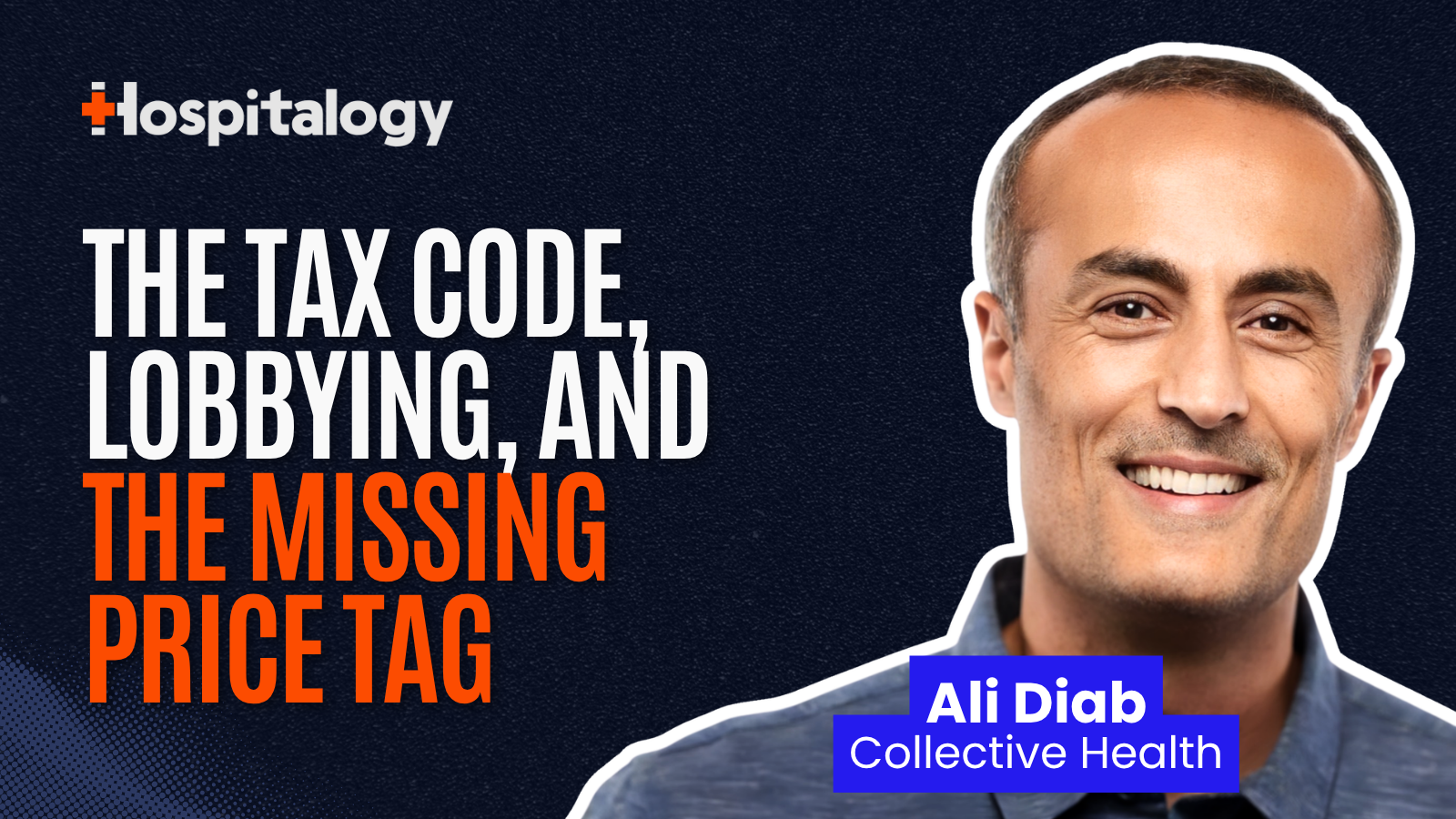
The origin story has a tellAli founded Collective Health after his own hospital stay was denied. He called a friend, an internal medicine doc at Stanford, where Ali was treated, to ask how to fight it. His friend told him it was the tenth conversation about health insurance he had that week, and he spent more time on it than on patients. That doc left clinical practice and co-founded the company with Ali. I assumed the economist in Ali drove the decision. He told me the opposite: it was the consumer internet product guy asking why a basic question about his own coverage was impossible to answer. "Look at the tax code"I close every episode by asking what has changed how a guest lives. Ali pointed to a line from someone who shaped him growing up: if you want to understand why anything is the way it is, look at the tax code. He applied it to healthcare on the spot. Employers cover the cost of care because it's a tax-shielded benefit. It's one of those facts that seems obvious once somebody says it, and it reframes every "why does it work this way?" question. Self-funding fixes the incentive, not the priceAli tells employers to self-fund once they're big enough. But he added a caveat. Leaving the fully insured model sheds the MLR's built-in incentive, yet those plans typically still ride on the same insurance networks and the same privately contracted rates. He used a flying analogy. Buy a business-class seat and you expect better food and a lie-flat bed. In healthcare you get the same economy seat, food and drinks, and pay in some cases five, six, or seven times what Medicare does. The lockoutAli says the insurance industry has lobbied the federal government and state insurance departments for decades to limit smaller employers' ability to self-insure. Stop-loss coverage caps the risk and, he said, is much more affordable than the fully insured equivalent. In Texas, he noted, quite small groups can self-insure today. He also made a point about data: a small employer has a hard time getting claims data out of an insurer, while a very large one can demand it. Collective hands it over to every client, because it's the employers' and members' data, not theirs. Ali's account suggests at least part of the small-group cost gap is a policy outcome, not a market one. A price tag before you buyHis wish list starts with price signals. You walk in, pay a nominal copay, and wait for an explanation of benefits weeks later showing an $800 charge for a 10-minute visit. There should be a published cash price, or some mechanism, before you're served. Transparency laws exist but are poorly enforced, and employers banding together takes time. His fix is to borrow from financial services, not healthcare. The SEC polices price transparency and information asymmetry for financial instruments, which are far harder to model than a knee replacement. An exchange-style record of prevailing prices for private services and drugs, he argued, isn't landing-a-rocket hard. CMS already sets prices for one part of the market and could offer a reasonable cap or price distribution for private care. It's the same procedure whether you pay with a Medicare card, cash, or a private insurance card, and charging differently for it is price discrimination, which he noted is illegal. As an economist and a capitalist, he sees this as a place where a little heavy-handedness helps the market work. He also credited CMS for adding clinical and performance criteria, like Medicare Advantage star ratings, so providers aren't just chasing volume. Employers organizingWhen I raised the skeptic case that direct contracting is a fad, Ali's reply was blunt: the people saying that work in insurance or PBMs. He pointed to hospital systems standing up front doors for large employers, and to employer cooperatives like the Health Transformation Alliance pooling volume to contract directly, then working with an administrator like Collective Health to run the plan. Who's knockingCollective's core customers are large self-insured employers with a few thousand to tens of thousands of eligible employees, and that remains the core business. What's new is who's calling: insurance companies, large integrated health systems, regional plans, and other payers are increasingly asking about Collective's platform for their own operations. Ali sees a Stripe or AWS-style opportunity. Given everything above, I find that detail telling. The employer movement Ali describes is built to route around the incumbent model, and some of the incumbents are now asking about the platform that does the routing. My takeThe clearest signal is how many people are already opting out. Ali described individuals tapping out of insurance entirely, betting they can negotiate cash prices, even for catastrophic care, below what they'd pay in premiums, and others negotiating maternity bundles directly with the hospital. Add payors and health systems asking for the plumbing, and the picture is consistent: the current rules aren't working, and the market is looking for what replaces them. Sponsored by SmarterDx Better AI should come with better numbers. Here are ours: SmarterPrebill now averages $4.5M in realized annual net new revenue per 10,000 DRG discharges, up from $3.5M just months ago. SmarterPrebill reviews every inpatient chart before billing with advanced clinical AI, surfacing missed documentation opportunities with supporting evidence. That same clinical intelligence layer powers our entire platform. As our AI improves, so do your results. REVENUE CYCLE The RCM AI arms raceRevenue cycle has become the de facto proving ground for AI in health systems (watch Healthcare’s Oppenheimer Moment, a virtual session with Eric Larsen). And if you're following the results closely, an interesting bifurcation is starting to emerge. On one side: systems that deployed AI narrowly (prior auth automation here, coding accuracy there) are largely breaking even on their investment or seeing modest, incremental gains. On the other: systems that went broader (integrating AI across the full revenue cycle stack and pairing it with operating model redesign) are reporting margin improvement in the range of 2-4 percentage points. The difference is the strategy behind the deployment. AI in RCM is a workflow redesign problem. Systems that treat it as a point solution problem are leaving the majority of the value on the table. AI in RCM is a workflow redesign problemI've been hearing a version of this from just about every RCM leader I’ve talked to this year, and the data backs it up. According to Experian Health, 63% of providers are now using AI somewhere in their revenue cycle, but the vast majority are still parked in low-risk tasks like data analysis and automation rather than the harder, higher-value redesign work. Meanwhile, organizations that go all-in on AI-driven denial prevention and claims optimization are seeing denial rates drop by as much as 40%, and nearly 60% say AI has helped them catch missed reimbursement opportunities they'd have never found manually. Mercy did this the hard way. Steve Mackin's team didn't bolt AI onto their existing mess. They ripped the mess out first. As Mackin told me on “Claims Denied”: "We turned off over 1,300 point solutions. We moved all of our data to the cloud." That's an organization deciding it would rather rebuild the plumbing than keep patching leaks with a different app every quarter. What this means in practice: the health systems getting the most out of RCM AI are the ones that started with a clear-eyed read on where revenue is actually leaking, chose platforms or designed AI deployment around those specific failure points, and then built new workflows rather than automating old ones. The ones struggling are those that purchased a vendor solution and expected it to retrofit cleanly onto a 20-year-old process. The financial stakesThe financial stakes here are not trivial. For a system running $1B in net patient revenue, a 2-point margin improvement represents $20M in recaptured cash. For systems already hemorrhaging cash on labor costs and payor headwinds, integrating AI across the revenue cycle is an existential lever. The questions health system CFOs and RCM leaders should be asking right now: Where are our highest-cost, highest-volume failure points? Are we deploying AI against those specifically? And are we measuring against outcomes, not adoption metrics? RCM, margin improvement, and the financial models healthcare executives are betting on will be a core conversation at the Hospitalogy AI Retreat, November 2-3 in Phoenix. Think: ~50 senior execs, 2 days at a golf resort (coincidence?) and spa, curated roundtables, and off-record conversations you won't find on a trade show floor. Plus, it’s free to attend for qualified leaders, and your flight and hotel are covered thanks to our amazing brand partners (see details on the site). Apply to attend: hospitalogyretreat.com. ON YOUR RADAR
*This read is brought to you by one of my brand partners who help make this newsletter possible! Thanks for the read! Let me know what you thought by replying back to this email. — Blake |
||||||
|


No comments