

🏥 A Kiwi pharmacist walks into US healthcare

 |
||||||
|
||||||
|
|
||||||
Happy Thursday, Hospitalogists. Recently on Claims Denied, a Kiwi pharmacist-turned-founder explained US healthcare purchasing to me in about 50 minutes, and was able to say in 30 seconds what CMS has spent 15 years of demo models circling. Also from my conversation with Ahmed Marmoush of Handl Health: why employers are done with cost shifting and what comes next. New here? Welcome aboard. Let’s get into it. Was this email forwarded to you? THE COUNTDOWN BEGINS
This isn’t a content-heavy conference. It’s built so you walk away with strategic solutions and a strong network of senior healthcare leaders facing similar challenges. Travel and hotel covered. Applications close next Friday BLAKE'S BREAKDOWN Handl Health and the death of cost shiftingClaims Denied has turned into an accidental employer-benefits miniseries this year. Nick Stefanizzi walked me through Northwell's direct-to-employer play, Ali Diab of Collective Health made the case for transparency as table stakes, Will Johnson of Gyde argued the broker is the point of maximum influence. And now Ahmed Marmoush, co-founder and CEO of Handl Health, ties the whole thread together from the infrastructure side. Fresh off a Series A, Ahmed came on to break down why he thinks we're watching a once-in-a-lifetime shift in how employers purchase healthcare. Big claim. Let’s see how it plays out. 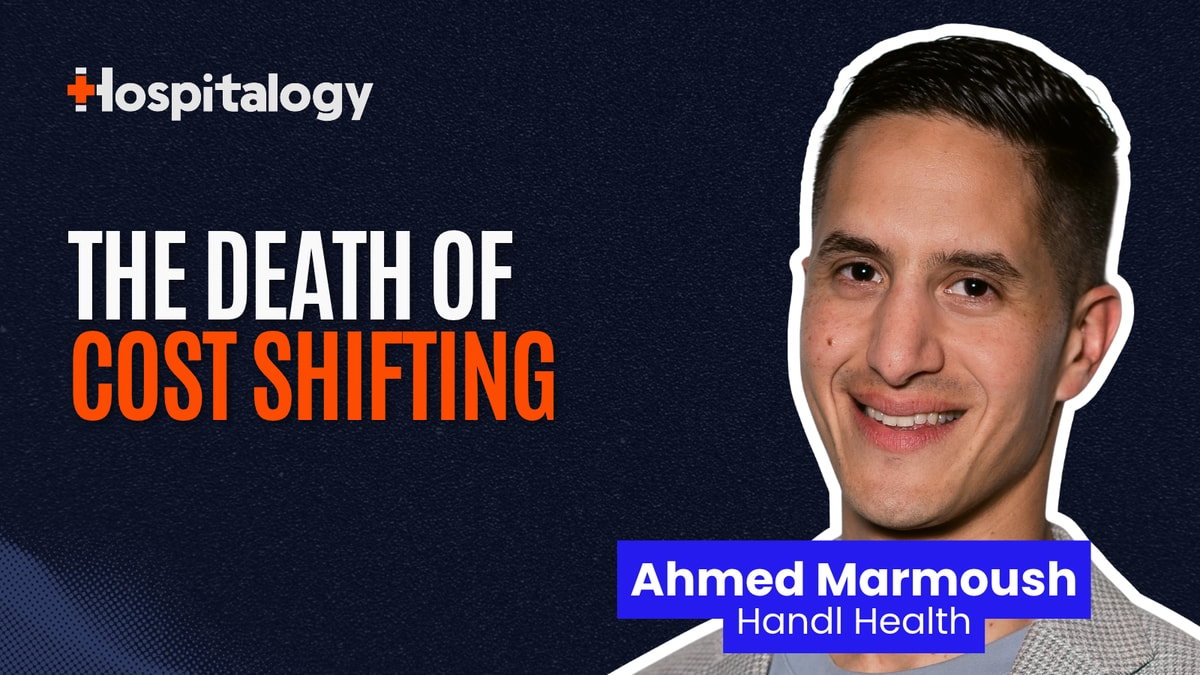
From Auckland to an $800 physicalAhmed's origin story is one of my favorites we've run. Egyptian by heritage, raised in New Zealand in a family of pharmacists. His father worked for Roche, and counting pills was, in his words, his rite of passage into professional life. He practiced as a clinical pharmacist in an acute Kiwi hospital, moved into quality improvement, went to business school at Auckland, and ended up consulting alongside the former Director General of the New Zealand health system. That's a masterclass in the business of healthcare before he ever touched the American version. His read on NZ is instructive for US operators. Single payer, free acute care at the point of entry. But primary care carries a copay, so patients skip the front door and flood the ED. Sound familiar? And because the system was built for episodic care rather than continuous care, chronic patients kept boomeranging back into hospitals because nobody had been incentivized to manage them longitudinally. Same disease, different flag. Then there's the structural whiplash. New Zealand recently collapsed its 21 district health boards into a single national mothership, after previously decentralizing from a centralized model. Ahmed's old mentor told him healthcare is cyclical and repeats itself every 10 or so years, and I couldn't help but bring up our own $50B Rural Health Transformation Fund, currently being dispersed across 50 states in tranches. New Zealand centralizes while America decentralizes. Time is a circle; healthcare policy doubly so. His American baptism came in 2019. Working at EY on value-based plan design for government-sponsored programs, he ran into the wall every analyst here knows: you cannot define value when the actual cost of care is treated as commercially sensitive information. Then he went for a routine annual physical at a well-known LA health system and got an $800 bill for what he assumed was free. When he called to ask why, they offered him 50% off if he paid within days. Ahmed compared it to negotiating with market stalls in Egypt, which is both hilarious and devastatingly accurate. His co-founder Rhea's response, "Welcome to US healthcare," is the whole industry in four words. Every founder gets a welcome-to-the-NFL hit; his came with a superbill. Price transparency legislation had just passed, an NIH grant materialized, and Handl was born. The goldmine nobody could readThose machine-readable transparency files turned out to be exactly what skeptics and optimists both predicted: an analytical goldmine buried in trillions of rows of JSON that no buyer could ingest. Pricing showed no rhyme or reason across geographies or providers, and (this should surprise nobody who reads this newsletter) no correlation between what you pay and the quality you get. Ahmed's line here: "If we went out and asked our clients today what JSON was, I think they would all look at us blankly." Handl started by normalizing and vending that data, then made two decisions I think were exactly right. First, they aligned to the employer-sponsored market, on the logic that employers and governments want the same thing: keep people as healthy as possible, as long as possible, as cheaply as possible. Second, and this is the part I respect, they admitted their consumer shopping tool wasn't working. It checked the TiC compliance box and got real momentum on that basis, but adoption flatlined because member behavior wouldn't move. Rather than torching more capital on consumer engagement, they went upstream to the broker: pricing and repricing engines, network evaluation that goes beyond discount math, tiered benefit design analytics. Plan shopper becomes plan orchestrator. 800+ producers now run analyses that used to require an actuary, and the platform now connects plan-level and member-level data across the full employer lifecycle: evaluate, design, activate, monitor continuously. Will Johnson made a version of the same bet at Gyde; the pattern across this space is unmistakable. Brokers, long cast as the villain of benefits discourse, are getting armed instead of disintermediated. Cost shifting is dead; long live tier and steerHere's the macro thesis I found most compelling. For a decade, the employer answer to cost growth was shifting it: HDHPs, "consumer-driven" design, higher out-of-pockets. That experiment ran its course while trend kept compounding at double digits, and Ahmed says employer willingness has now crossed a threshold: they'll fundamentally restructure. Narrow networks, reference-based pricing, direct contracting, and real scrutiny on point solutions bought in silos that never talked to the underlying plan. His marquee design is the variable copay plan. Keep the broad network (nobody wants a 1990s HMO reboot), but make member choices carry price signals, and let people shop by event rather than code. A hip replacement. A birth. Human units of healthcare, priced against a value index. That index has three pillars: cost measured at both unit and total-episode level, quality sourced from best-of external vendors (mortality, complication rates, down to specialty), and appropriateness (whether the orthopod is operating when PT was the right first call). Ahmed noted that where he's from they call that pillar efficiency; America calls it appropriateness. Somewhere a US compliance attorney earned their retainer on that word choice. His cost equation is refreshingly simple: claims equal unit cost times consumption. Unit cost lives in the network: contracting structure, FFS versus bundled, tiering. Consumption lives in site-of-care matching and whether members get preventive and primary care before things get expensive. His summary deserves quoting in full: "You tier to understand the value, you steer to create the incentives in the plan design to get the member to the right place." I pushed on whether providers get feedback in all this or just wake up in Tier 3 one morning, and the answer was more nuanced than I expected. Tiering is heavily regulated, some archaic contracts prohibit it outright, and Handl encourages open dialogue with providers about methodology and how to move tiers. I'll cop to being ignorant of the tiering rulebook going in; good to know one exists. Selling outcomes, not softwareOn AI, Ahmed said something that maps onto how I've been thinking about this across healthcare: Handl is productizing a services industry, and a traditional SaaS wrapper was never going to carry it, because benefits is high-touch by design. Brokers absorb risk alongside employers who hold fiduciary duty. So they built agentic workflows and LLM interfaces over the data layer, letting clients ask plain-language questions (how are my high-cost diabetic claimants trending?) instead of excavating dashboards. I framed it back as SaaS being deterministic while AI lets you flex around customer-specific needs, and got an "exactly." Sell the outcome, irrespective of mechanism. This is the system-of-action argument playing out in benefits: whoever embeds intelligence into the broker's daily workflow owns the position, and the dashboard graveyard grows either way. His SMB take was sober. Small employers have less negotiating power, less personalization, less in-house expertise, and often worse trend than the jumbos, hence the surge into level funding, ICHRAs, and captive structures that pool claims credibility. His worked example, a heavily diabetic population routed into advanced primary care with capitated point solutions carrying real downside, doubles as a quiet indictment of American primary care generally. Coming from a system where gatekeeping is the cornerstone, he still can't fathom PCPs on FFS: "Episodic care for primary care simply doesn't work." Correct, and it took a Kiwi pharmacist 30 seconds to say what CMS has spent 15 years of demo models circling. The enablement layer betWhere's this all headed? Handl now splits 50/50 between the demand side (brokers) and the supply side (carriers and TPAs), and the supply side exists because of a complaint I'd bet every benefits founder has heard: Handl, your analytics are great, we can see the waste, but our carrier can't actually implement an episode-based, provider-tiered, dynamic copay plan. Benefit configurators, adjudication logic, and eligibility systems built around CPT codes choke on encounter-level designs, all while payment SLAs keep ticking. So Handl made the deliberate call to be the enablement layer connecting broker strategy to carrier administration, not another health plan piling into an already crowded field. My take: the plumbing argument is right, and it's the least glamorous, most defensible part of the pitch. Analytics have commoditized faster than administration. Plenty of vendors can show an employer the waste, and almost none can adjudicate a claim against a variable copay schedule. Sitting between demand and supply is a strong position, with the standard enablement layer risk that your carrier partners eventually decide to build the plumbing themselves. Ahmed's counter, implicitly, is speed and focus. We'll see. As I told him on the mic, we solved US healthcare right there in 50 minutes. Someone alert CMS. AI AND POPULATION HEALTH AI-enabled population health: where the model worksPopulation health has been a promise in healthcare for the better part of 20 years. The data infrastructure is finally catching up, and AI is the accelerant that's making some of those models finally work. Today, AI-enabled population health is delivering meaningful results in narrow, well-defined use cases. Risk stratification. Chronic disease management outreach. Care gap closure at scale. These are areas where the data is relatively clean, the intervention is well-understood, and the ROI is measurable. Systems that have deployed AI in these specific areas are seeing real improvements in quality metrics and, in value-based arrangements, real financial upside. But here’s the rub…As I mentioned back in May, the entire digital health graveyard is full of companies that had wonderful clinical evidence and catastrophic utilization. RPM is the poster child. The sector's been promising connected-care transformation for years, and the dirty secret is that most programs can't keep patients engaged past the onboarding honeymoon. Oura is one of the few posting compliance numbers that would make a population health team weep with jealousy: 77% of members active 5+ days a week, wearing the device roughly 24 hours a day, per its Medicare Advantage pilot data. Engagement, not just accuracy, is the actual bottleneck for AI-enabled pop health, and most vendors still aren't solving for it. The harder problem is the broader one. Population health at the system level (managing the health of an attributed panel across MSSP, ACO REACH, MA, and commercial VBC contracts simultaneously) is still notoriously difficult even with AI in the stack. The challenge isn't the predictive model. It's the care delivery infrastructure, physician alignment, and data interoperability that allows the model's output to translate into an actual patient intervention. “This is an evolution. This is not a revolution.”Ochsner's rollout of Lumeris’s Tom is the clearest real-world proof point I've come across for what this looks like in primary care. David Carmouche walked me through the math on “Claims Denied”: hiring their way to Ochsner's growth targets the old-fashioned way would have meant 162 new primary care physicians and the clinics to house them, a nonstarter given reimbursement economics. AI-enabled primary care redesign was the alternative. But Carmouche was clear-eyed about the timeline: "This is an evolution. This is not a revolution. We're not gonna flip a light switch." The LEAD model (explained well in this Arcadia webinar) is worth watching closely here. CMS's ACO REACH successor is slated to launch January 1, 2027, with a 10-year performance period. It’s designed to attract new-to-ACO clinicians, including independent, small, and rural practices, alongside current ACO REACH participants and specialized high-needs care providers. Given ACO REACH itself stops accepting new applicants for the rest of its run, LEAD could become the default on-ramp for population health leaders thinking about their next model. But, for an interesting perspective on why some health systems should wait until the model earns a few more reps, read my conversation with Tim Elliott, CEO of Navvis. The ACO REACH and MSSP track records are also worth watching right now. Systems that invested in care management infrastructure 3-4 years ago are just starting to see the compounding financial returns. The ones that waited are facing a widening gap. The path forward for population health leaders isn't a better predictive model. It's the organizational capacity to act on what the model is telling them. Population health strategy is a core content pillar at the Hospitalogy AI Retreat, November 2-3 in Phoenix. This retreat is tailor-made for senior executives from hospitals, health systems, and leading care organizations. Across 2 days at a beautiful golf resort and spa, you’ll have meaningful conversations on how AI, automation, and new operating models are reimagining healthcare. It’s free to attend for qualified leaders, and your flight and hotel are covered thanks to our amazing brand partners (see details on the site). Apply to attend: hospitalogyretreat.com. ON YOUR RADAR
*This resource is brought to you by one of my brand partners who help make this newsletter possible! Thanks for the read! Let me know what you thought by replying back to this email. — Blake |
||||||
|


No comments