

🏥 The RHTP $4B report card

 |
||||||
|
||||||
|
|
||||||
Happy Tuesday Hospitalogists, I come to you beaten down, dismayed, after a very poor effort from my Horns on Saturday afternoon. I TOLD YOU guys anything can happen in that game. And it did. Congrats to the Sooners, you still have to deal with a terrible offense and Brent Venables until your program’s solvency gets called into severe question. Anyway, back to today’s programming! You guys know I have been interested in the rural health transformation efforts and whether things will be truly transformational. Well, CMS just dropped its first report card on how states are actually spending Rural Health Transformation Program dollars; around roughly $4B of the nearly $10B awarded for Year 1, with a few states (Georgia, Hawaii, New Hampshire) already at 100% deployed and a couple others (looking at you, New York and West Virginia) sitting at exactly zero. Breakdown below, plus some sharp takes from the HIHpoint community on healthcare’s most broken processes and agency nurse dependency. FINALLY… I’ve set the agenda for the Hospitalogy AI Retreat in November, so take a peek and see why Phoenix should be in your future. Let’s get into it. Was this email forwarded to you? BLAKE’S BREAKDOWN RHTP Year One obligated funds: the $4B report cardCMS has released its first obligated funds report for the Rural Health Transformation Program (RHTP). Built entirely from what states have reported themselves, the 105-page report breaks down how each state has obligated RHTP funds between December 29, 2025 through July 31, 2026. CMS notes the report captures obligations only, not funds actually disbursed to or received by grantees, and the cutoff lands 3 months before Year One (AKA Budget Period 1) closes on October 30. CMS plans to refresh the numbers once states submit their November 30 quarterly reports, then quarterly after that. For now, it reflects how states have so far obligated roughly $4B of the almost $10B awarded across all 50 states for Year One. Pace varies widely by stateTen states had obligated at least 75% of their award by July 31; Georgia, Hawaii, and New Hampshire had committed 100%; and 15 states had obligated less than 10%, including New York and West Virginia at exactly $0. Texas, which received the largest Year One award ($281.3M), had obligated just 18.9% ($53.3M): a reminder that award size and obligation pace move independently. Six of the slowest states — Alabama, Arkansas, Florida, Idaho, New Mexico, and Wyoming — reported that every obligated dollar so far went to program operations (staffing, administration, grant management) rather than to any of their actual initiatives. Where the money is going
Technology-related categories (IT Advances, Consumer Tech Solutions, and the technology-relevant share of Innovative Care) account for roughly 22% of obligated dollars (about $876M), making technology the single largest theme in Year One spending so far, just ahead of workforce (about $651M, 16%). Chronic disease prevention and management (about $481M, 12%) and capital expenditures/infrastructure (about $280M, 7%) round out the largest named categories. More than half of obligated dollars sit in line items that describe a use rather than naming a recipient type (state agency, contractor, hospital, etc.). Within the technology bucket, three sub-areas stand out: 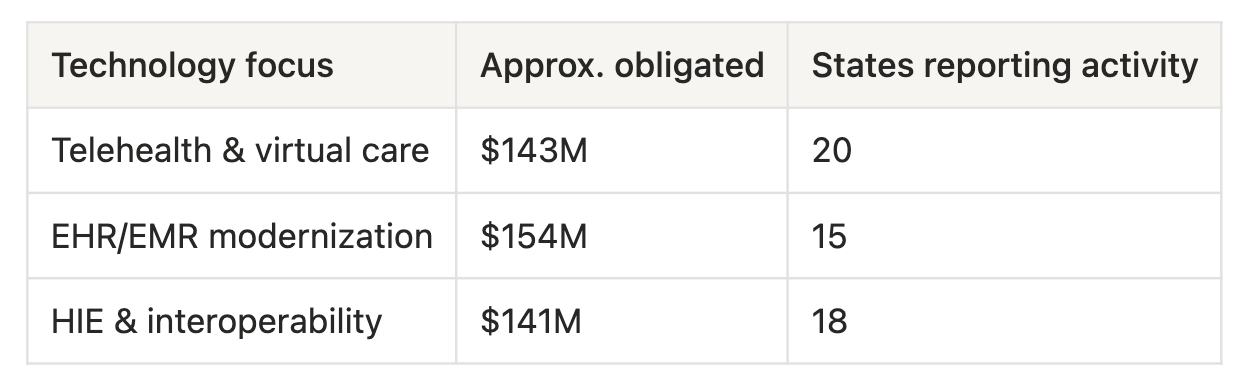
Meaningful obligated dollars also sit under categories like Appropriate Care Availability, Behavioral Health, and Program Administration that aren't broken out here. Notable state spending examplesThis chart shows some notable spending examples. Hospitals show up in some states' line items (38%), but very few name specific hospitals. 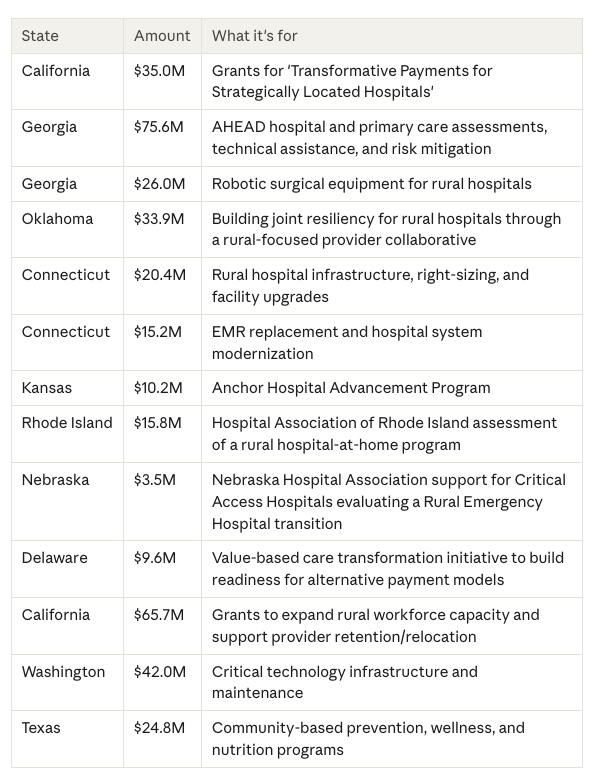
What's nextUp to $40 billion more is scheduled to flow over the next 4 years of this 5-year, up-to-$50B program. But, per a companion GAO review of CMS's implementation, each state's share depends on demonstrating 'satisfactory progress' toward its approved initiatives, and CMS may withhold, reduce, or recover funding for noncompliance. States have limited ability to appeal those decisions under the program's authorizing legislation. Sponsored by Lumeris Primary care shouldn’t be a cost center. It should be a competitive advantage. For 15+ years, Lumeris has helped health systems and physician organizations succeed in value-based care, aligning clinical and financial performance through proven expertise, technology and operational partnerships. Now, we’re building on that foundation with Tom™, our AI-powered Primary Care as a Service™ platform. Tom helps health systems expand capacity, improve patient access and strengthen engagement without proportionally increasing costs. Discover how Lumeris and Tom can turn primary care into a strategic growth engine. ASK HIHPOINT We’ve had some great questions posed to the HIHpoint community with thoughtful answers, so I’m sharing some today. The most broken process in healthcareWe asked the HIHpoint community: What’s the most broken process in healthcare that somehow still hasn’t been fixed? Provider specialization. Medical schools and health systems have diversified providers so much that general practitioners refer everyone out and now collaboration and continuity of patient care is collapsing. - Niki Smith We’ve digitized healthcare, but we haven’t really connected it. Too many medical practices and healthcare organizations are still relying on disconnected systems, manual processes, and data that’s difficult to turn into useful insights. - Katherine Pacheco Health insurance. - Janis Naeve Processes are aligned with the incentives that drive them. In the absence of a functional free-market system in healthcare, processes will always seem "broken" especially compared to other industries. - Matthew Brown Payment processing. - Luisa Davis Skilled Nursing over regulation and reimbursement. Just because facilities are cited for discrepancies in documentation or miscommunication is no reason to enforce punitive measures that require financial damages be imposed. In addition daily reimbursement rates are far below costs that are required because regulations demand improvements be made. - Aaron Rance Fragmentation as an active process to create a moat (high entry barrier) preventing information sharing and free market competition. I also think AI will start bridging this eventually. - Nelson Valentin Internal and external accountability. - Leslie Mason Vendors have tried piecing technologies together, but so far, diagnosing providers rarely have all the information available about the patient and related medical archives at the point of care; they need to diagnose the patient quickly and accurately. Providers tend to go with what they are familiar with, when there could be rarely occurring diagnoses that could apply. AI can help us get there. - David Harrell Interoperability testing, automated and otherwise! - Tone Southerland Prior authorization. The administrative cost lands on everyone: staff time on the provider side, review costs on the payer side, and delayed care on the patient side. When a process creates that much waste for all three parties, it’s high time to rethink it. - Anonymous Agency nurse dependency: structural vs. temporary fixWe asked the HIHpoint community: At what point does agency nurse dependency become a structural vs. a temporary fix? It becomes a structural problem if the agency does not do due diligence in reporting higher need or family neglect, while continuing visits for billable hours.- Lynette Streator The need for agency RNs is both a structural problem and a temporary fix that will remain unless significant shift in reimbursement policy occurs. The time of a 100% home unit staffed with permanent teammates is a rarity and incongruent with today's nursing workforce. Current and future staffing models consist of a certain proportion of fully employed part or full time, PRN, agency, and internal float RNs. In my experience, this is due to the following: RN labor market changes post-Covid, health system inability or unwillingness to meaningfully and permanently address the work environment, and the fact that no meaningful, replicable, and a politically palatable valuation of nursing services exists to make the case that nursing should be a revenue generator. One final thought: in 2023, the NLN reported that the dropout rate in pre-licensure programs in US nursing schools is between 15-30% and the overall RN turnover rate as reported by NSI is ~17.6%. Without creative solutioning, the inertia the industry is experiencing will remain. - Leslie Mason RETREAT UPDATE The Hospitalogy AI Retreat agenda is lockedThe Hospitalogy AI Retreat, 11/2-11/3 in Phoenix, is the opportunity for healthcare’s top leaders to navigate healthcare’s hardest problems with their peers. Here’s your first look at the agenda:
Content runs two hours a day. The rest is roundtables, 1:1s, workshops and probably some golf. Travel and hotel are covered for approved attendees. Apply here. ON YOUR RADAR
*This resource is brought to you by one of my brand partners who help make this newsletter possible! Thanks for the read! Let me know what you thought by replying back to this email. — Blake |
||||||
|


No comments