Plus: How accurate is Apple's hypertension feature ͏ ͏ ͏ ͏ ͏ ͏ ͏ ͏ ͏ ͏ ͏ ͏ ͏ ͏ ͏ ͏ ͏ ͏ ͏ ͏ ͏ ͏ ͏ ͏ ͏ ͏ ͏ ͏ ͏ ͏ ͏ ͏ ͏ ͏ ͏ ͏ ͏ ͏ ͏ ͏ ͏ ͏ ͏ ͏ ͏ ͏ ͏ ͏ ͏ ͏ ͏ ͏ ͏ ͏ ͏ ͏ ͏ ͏ ͏ ͏ ͏ ͏ ͏ ͏ ͏ ͏ ͏ ͏ ͏ ͏ ͏ ͏ ͏ ͏ ͏ ͏ ͏ ͏ ͏ ͏ ͏ ͏ ͏ ͏ ͏ ͏ ͏ ͏ ͏ ͏ ͏ ͏ ͏ ͏ ͏ ͏ ͏ ͏ ͏ ͏ ͏ ͏ ͏ ͏ ͏ ͏ ͏ ͏ ͏ ͏ ͏ ͏ ͏ ͏ ͏ ͏ ͏ ͏ ͏ ͏
| Health Tech Correspondent |
|
|
Good morning health tech readers!
Today, we've got a ton of updates including news about venture capital funding, telehealth policy, the government's progress on information blocking, and research into the accuracy of Apple's new hypertension feature. STAT's reporting on health technology is only possible because of the support of subscribers. We're running a 50% off promo right now — a perfect opportunity to show your love for our journalism. Share it with friends and family?
Reach me: mario.aguilar@statnews.com |
|
|
Venture Capital Notable mental health companies raise funding This morning I bring you a bevy of mental health tech fundraises: - Talkiatry raised a $210 million Series D round to advance its virtual psychiatry platform. Cofounders Robert Krayn and Georgia Gaveras told me that while they plan to develop artificial intelligence tools to help engage patients between visits, their plans are "ambiguous" and "undefined" for now. Krayn believes that mental health chatbots out there haven't proven themselves yet. Read more from me here.
- Big Health raised $23.7 million as investors bet that Medicare reimbursement for digital therapeutics will finally fuel meaningful adoption of smartphone-based treatments. In a new story, CEO Yael Berman told me about the company's progress selling its Food and Drug Administration-cleared apps that treat insomnia and anxiety. Investors in the latest round include .406 Ventures, AlleyCorp, and CVS Health Ventures. Read more from me here.
- Somethings is the latest youth-focused mental health company to raise capital. The company picked up a $19.2 million in Series A round led by Catalio Capital with participation from General Catalyst and Tusk Ventures. The company "responsibly leverages AI to scale human care" and the "technology never interacts directly with youth."
Data inter-operability Information blocking enforcement is coming? Brittany Trang writes: Two tidbits from ASTP/ONC head Thomas Keane during his opening remarks at ASTP's annual meeting yesterday.
First, an update on information blocking: Since launching a complaint portal several years ago, the office has received over 1,500 submissions, but no enforcement actions have been taken. That's changing, said Keane. "We are in the process of issuing notices of potential nonconformity to developers of certified health I.T," he said. "These notices request information and explanations related to potential nonconformities under the certification program."
Keane also announced that in coming days, his office plans to launch the "EHI Ignite Challenge," which he described as "a two-phase prize competition intended to spur development of new tools to make EHI exports more understandable and actionable for patients and clinicians."
The agenda for the second day of the meeting looks to be interesting: a keynote from HHS deputy secretary Jim O'Neill, who is driving many tech projects at HHS; a fireside chat with Keane and Amy Gleason, the point person for the CMS Health Tech Ecosystem program; and panels on AI and data liquidity. All of these sessions will be livestreamed from the ASTP meeting site starting at 8:45 am ET today.
Are you at the meeting in-person? Got any juicy gossip? You know where to find me: brittany.trang@statnews.com
Research Accuracy of Apple's hypertension feature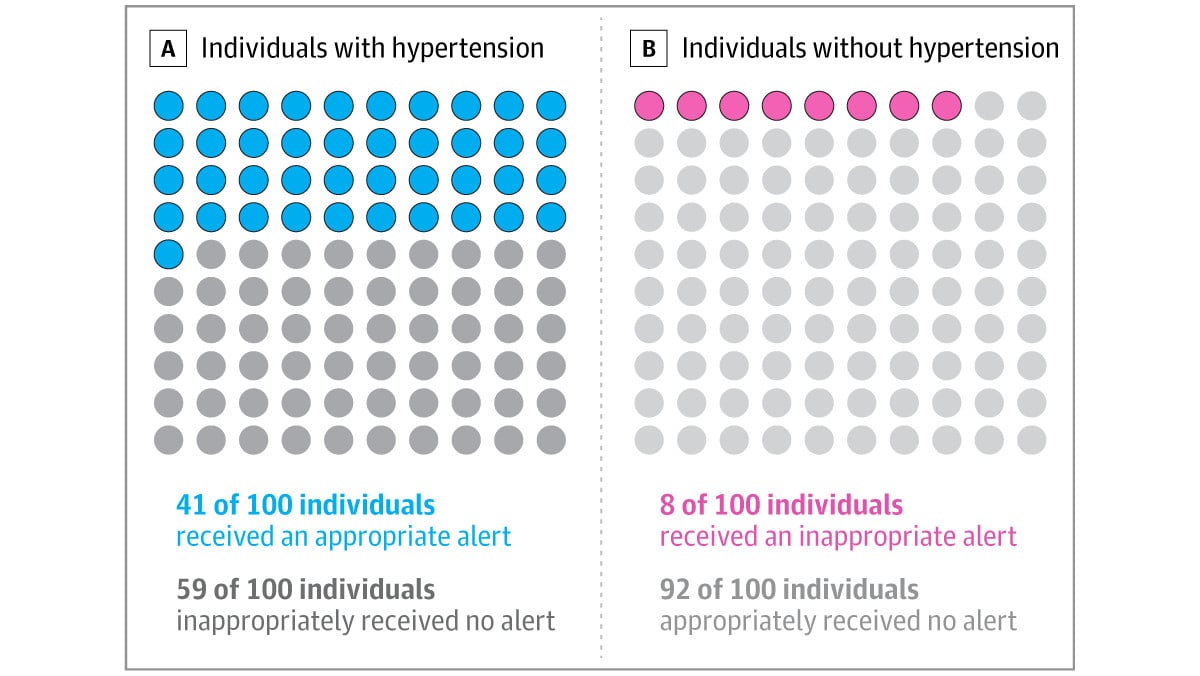 Last Fall, Apple released a feature for its smartwatch that alerts users of possible hypertension. At the time, I reported on the company's published data, which shows that the feature catches fewer than half of undiagnosed people who have high blood pressure. Some experts worried that the feature might provide false reassurance to people who don't receive a notification. The feature might also help alert people unaware of their high blood pressure. In a new JAMA paper, researchers analyzed data from the National Health and Nutrition Examination Survey to explore how the alert might affect detection rates in the real world. They turn to the somewhat wonky language of probabilities. For example, according to the survey , 26% of the undiagnosed population in the 30 to 45 age group has hypertension. That's the pre-test probability of having the condition before Apple's feature performs its analysis. Of those who receive an alert, 65% will have hypertension — this "positive post-test probability" reflects a reasonably good likelihood that someone identified by the alert has high blood pressure. However, among those who don't receive an alert, 18% will still have hypertension.
Coauthor Jordana Cohen, an associate professor at the University of Pennsylvania's medical school, pointed out that this "negative post-test probability" increases as risk of the condition increases. People over 60 who don't get an alert still have a 34% chance of having hypertension; people with obesity have a 29% chance of hypertension despite no alert.
The researchers believe the analysis shows that though the Apple feature may identify many people who have the condition "an even larger proportion of individuals with undiagnosed hypertension could receive no alert at all." The worry is that users with hypertension might forgo recommended routine screenings because they think their Apple Watch took care of it. Apple, for its part, informs users that lack of an alert does not mean you don't have high blood pressure. |
|
Check out more exclusive coverage with a STAT+ subscription | Read premium in-depth biotech, pharma, policy, and life science coverage and analysis with all of our STAT+ articles. |
|
What we're reading - We tested the government's official new AI nutrition tool: Grok, STAT
- After a near-death experience, ChatGPT gave me closure my doctors didn't, Axios
- AI-powered apps and bots are barging into medicine. Doctors have questions, Reuters
|
|
Thanks for reading! More next time - Mario Mario Aguilar covers how technology is transforming health care. He is based in New York. |
| STAT, 1 Exchange Place, Boston, MA | ©2026, All Rights Reserved. | |
|













No comments