Breaking News

Medicare may nix breakthrough device payment pathway

April 16, 2026
avatar-mario-a
Health Tech Correspondent

Good morning health tech readers!

Stay cool!  

Reach me: mario.aguilar@statnews.com

medical devices

CMS may nix breakthrough device payment pathway

Medicare regulators are proposing to repeal a payment pathway available to medical devices used by hospitals if they are designated as 'breakthrough' by the Food and Drug Administration. If finalized, the policy would require breakthrough devices, like other new technologies, to show substantial improvement over the status quo to qualify for those supplementary payments. Currently, the products must only show that they are expensive.

The FDA breakthrough device pathway helps speed up the regulatory process for experimental products that are novel and fill unmet needs. However, companies complain that it's still too difficult to get devices paid for once they are on the market. The first Trump administration granted the current payment pathway, and industry hoped the new administration would push things further. Medicare appears to be going in the opposite direction. “As we have gained experience, we have concerns with the limited evaluation process" for the supplemental payments, regulators wrote in the proposed rule. I expect a lot of pushback.

Read the full story from Katie Palmer here


artificial intelligence

Are CT calcium screenings worth it?

Katie has a very interesting story about the rise of opportunistic coronary artery calcium screening, which uses AI to examine chest CT scans taken for other reasons, and can help identify people who may benefit from statins. Or I should say, the potential rise in the use of these algorithms. The technology exists, is marketed by several companies, and Medicare just set a payment rate for it. But so far the uptake has been modest as hospitals weigh the benefits and risks.

The upside: Hospitals can now get paid $15 a pop for some screenings and they may help some patients. The downside is there’s no definitive evidence screenings lead to better long-term health outcomes. On the flip side, the screenings could kick off more risky follow-up testing, and specialist consultations at a time when cardiologists are already overloaded with patients. Applying the new tech without careful guidelines could result in increased demand for clinicians that are in scarce supply.

Read more here


telehealth

Not so Zealthy

Katie writes: The Department of Justice filed an amended complaint against Cerebral co-founder Kyle Robertson last week, alleging patterns of deceptive billing at his newer telehealth company, Zealthy. Cerebral fell into the DOJ’s crosshairs for prescribing stimulants like Adderall en masse; Zealthy, like so many other telehealth companies in the last 4 years, has built its business on GLP-1s.

The complaint also alleges that Zealthy used the name and provider identifier of a doctor — a former medical director not involved in medical care at the company — to order thousands of prescriptions without his knowledge. The government requested an asset freeze and receivership for Zealthy “to halt Robertson and Zealthy’s runaway campaign of lawbreaking, which is actively deceiving telehealth patients, endangering their safety, and raiding their bank accounts.”

Read STAT's coverage of Robertson's previous troubles here.


data

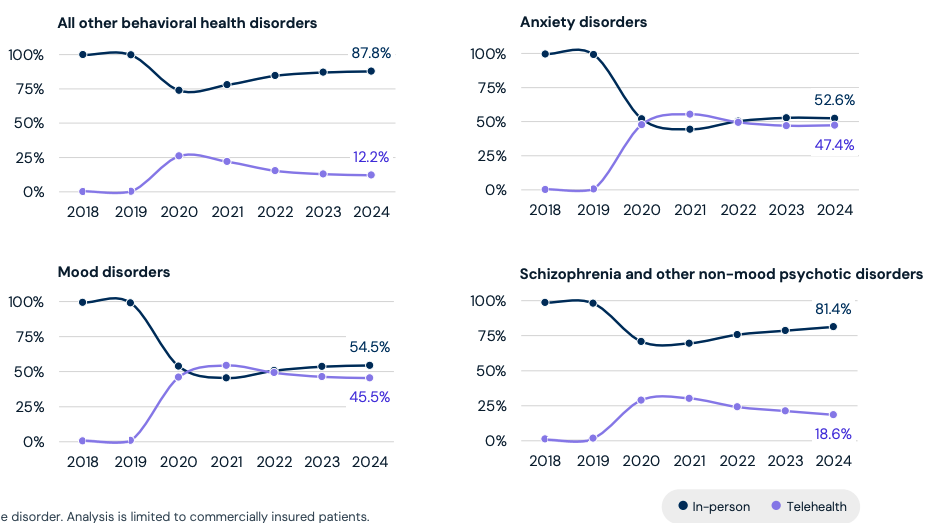
Despite telemental health boom, in-person care rules
Screenshot 2026-04-15 at 5.07.34 PM

By now we know that behavioral health was the big winner of the telehealth boom during the pandemic. It accounted for 66% of telehealth claims to commercial payers in 2024 according to a new report from health care analytics and intelligence company Trilliant Health

While in-person care is now most common for all behavioral health specialties, nearly half of  anxiety treatment happens over telehealth, which in turn accounts for 58% of all behavioral health telehealth use.



policy

House considers FDA general wellness bill

A House & Energy Commerce subcommittee on Tuesday discussed a battery of health care legislation including a Digital Health Screeners bill introduced by Rep. Troy Balderson (R-Ohio). The bill is meant to "codify" updates the FDA made in January to guidances that interpret when wellness products are not medical devices as well as when clinical decision support tools, including AI prediction algorithms used by hospitals, are not devices. These updates made clear there were versions of blood pressure and blood glucose monitors that did not need FDA marketing authorization. They also clarified that clinical decision support tools may output only one recommendation without becoming a medical device. 

On the wellness front, the screeners bill would modify the Food, Drug, and Cosmetic Act to make clear that general wellness products aren't just software — they can be hardware as well. It would also specify that a product does not stop being a general wellness product just because it outputs biometric readings and uses them to provide wellness guidance. 

René Quashie of the Consumer Technology Association testified at the hearing that the update would "provide much needed clarity and certainty for developers." I imagine part of the concern is that a future administration that felt FDA went too far in its updated interpretation of statute could roll the guidance back. Better a law that leaves no wiggle room for an undo.


Health tech news roundup

  • RING RING: An increasing number of digital health companies are working smart rings into their offerings. Virtual cardiometabolic care provider Vida Health announced it will incorporate data from Oura's ring by "adjusting care plans based on changes in recovery or cardiovascular signals, personalizing coaching based on sleep and stress patterns, and identifying early warning signals before additional clinical intervention is required." Women's health provider Maven Clinic announced a while ago it was working with Oura, but this week said it will pull ovulation prediction insights from the ring into a newly expanded fertility offering. And OpenLoop, a white label telehealth provider, announced it will offer partners sleep diagnostics from Happy Sleep, which has an FDA-cleared sleep testing system that uses a smart ring.

  • Researchers from Mass General Brigham published the results of a study evaluating 21 different AI models (many GPTs, Claudes, Groks, etc) on a new benchmark they developed that evaluates five domains of clinical reasoning: differential diagnosis, diagnostic testing, final diagnosis, management, and miscellaneous clinical reasoning questions. This is meant as a significant upgrade to more rudimentary benchmarks, like using medical licensing exam questions. The researchers found that "frontier LLMs achieved high accuracy on final diagnoses but performed poorly in generating differential diagnoses and navigating uncertainty relative to other reasoning stages." Brittany Trang wrote about why this matters in detail in her newsletter, AI Prognosis.
  • With all this hype I better see some miracle cures fast: AWS announced Amazon Bio Discovery, an AI application meant to "speed drug development." Bloomberg reported that Novo Nordisk will work with OpenAI to "speed development of new obesity drugs." OpenAI also released a document about how AI is "reigniting the discovery engine for tomorrow’s cures." The trust that oversees Anthropic, which is fresh of a $400 million acquisition of an AI biotech, appointed Novartis CEO Vas Narasimhan to the AI giant's board. "AI is accelerating solutions to some of the hardest scientific challenges, from deepening our understanding of disease biology to designing better medicines," he said in the release.
  • Rune Labs, maker of an Apple Watch-based platform that allows people with Parkinson's and their clinicians to monitor symptoms of the disease, announced a chatbot for their app that can answer questions about medication,  help people understand their symptoms, and provide coaching.

More around STAT
Check out more exclusive coverage with a STAT+ subscription
Read premium in-depth biotech, pharma, policy, and life science coverage and analysis with all of our STAT+ articles.

What we're reading

  • CMS-0062: The Entrée Has Arrived, Health API Guy
  • Flawed study on the antidepressant Paxil came with a cautionary note — if you knew how to find it, STAT
  • First Opinion: Voice-first chatbots will exacerbate AI’s mental health threat, STAT

Thanks for reading! More next time - Mario

Mario Aguilar covers how technology is transforming health care. He is based in New York.


Enjoying STAT Health Tech? Tell us about your experience
Continue reading the latest health & science news with the STAT app
Download on the App Store or get it on Google Play
STAT
STAT, 1 Exchange Place, Boston, MA
©2026, All Rights Reserved.

No comments