

🏥 The M&A lawyer who quit asking, “What about the risk?”

 |
|||||||
|
|||||||
|
|
|||||||
In partnership with
Happy Tuesday Hospitalogists, Today I'm sharing a great conversation I had with Tim Elliott, CEO of Navvis Healthcare. He started it off with a bang, saying he's retiring the term "value-based care" from his own vocabulary. Why? Because the label has become an ideological tripwire that makes operators shut down before you even get to the good stuff. Some other gems from the discussion: why LEAD is a no-go right now for most systems, org charts should include FTAs (full-time equivalent agents), and leading with the comp model needs to be reconsidered. Also in today's issue: the HIHpoint community weighs in on whether CMS actually has the appetite to enforce price transparency, or if it's still mostly theater. But before we get into it, some things I’m looking forward to: 9/4 → Community Roundtable: Come with your thoughts and questions on the current and future state of Medicaid. 9/23 → Healthcare Happy Hour: Meet me and the ShiftMed team for drinks at The Venetian. 9/30 → Building the VBC Playbook for 2027 and Beyond: Regulation is coming for VBC. How's your V28 fluency? 11/2-3 → Hospitalogy AI Retreat: Have you seen the speaker lineup? This is can’t-miss, folks. Was this email forwarded to you? Sponsored by Laudio Disconnected workflows drain time and focus from frontline leaders, leaving them chasing data instead of driving impact. Laudio arms leaders with evidence-based intelligence right where they work to support and develop clinical teams that stay, grow, and deliver quality care. Laudio provides leading health systems with a single solution bringing together key workflows like recognition, staffing & scheduling, time & attendance, patient rounding, and more. It’s the system of action that shifts organizations from scattered point solutions and reactive dashboards to prioritized daily actions that elevate care. BLAKE’S BREAKDOWN The M&A Lawyer Who Quit Asking "What About the Risk?"Tim Elliott did not set out to run a value-based care company. He set out to be an M&A lawyer, landed at McDermott Will & Emery (now McDermott Will & Schulte) in Chicago, and got seated next to a healthcare partner — which, combined with a mother who was a nurse, a sister who is a professor of physical therapy, a wife who is an optometrist, and a sister-in-law in nursing, eventually registered as a message worth listening to. A decade ago he helped found the current iteration of Navvis Healthcare and moved off the legal side onto the business side, where he now sits as CEO. I open with the biography because it explains the conversation that followed. Healthcare lawyers, Tim pointed out, are unusual among outside counsel in that they're pulled into strategy and execution, not just risk avoidance. So the transition that mattered most for him was unlearning the instinct to be the person in the room asking "what about" and "have you thought of." His reframe: start with what we want to achieve, then figure out how to stay compliant getting there. I've argued for years that health systems suffocate good ideas under a "run it past compliance first" culture, so hearing a former healthcare lawyer describe that exact reflex as something he had to actively shed felt like vindication. 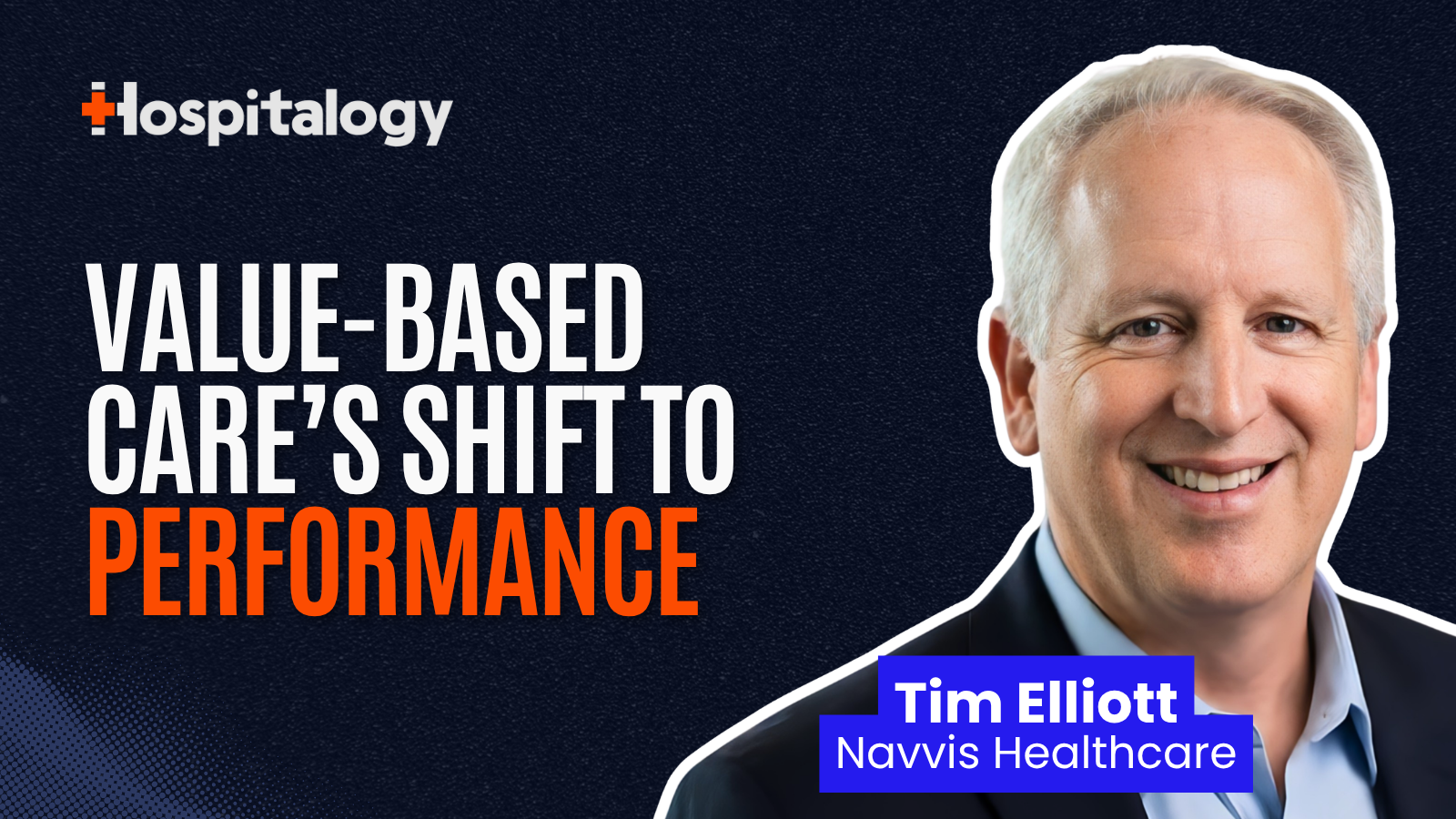
To listen to the podcast, click the image. Retiring a buzzword on airA few minutes in, Tim said something I didn't expect a value-based care CEO to say: the term itself has run its course. No common definition, too much baggage, and a tendency to make operators carve the world into two buckets — a VBC world over here, a fee-for-service world over there — which breeds inefficiency and confusion. Navvis has shifted its language to performance, and that's not a rebrand for its own sake. When the company used to introduce itself as a "value-based care enablement" shop, prospects would wave it off and then, in the same breath, describe physicians who aren't aligned to managed care contracts, post-acute transitions running too long, and a cost-of-care problem they couldn't crack. All of which is value-based care. Calling it performance just removes the ideological tripwire. I find this genuinely useful framing, and not only as semantics. A lot of Hospitalogists have watched "VBC" calcify into a synonym for "putting contracts at risk," which scares operators who associate risk with the downside scar tissue of the 2010s. Performance is harder to argue with. Nobody convenes a board meeting to oppose it. The CHF bed that paid for itselfTim's best illustration of the overlap between volume and value came from a client losing money on every congestive heart failure admission. Primary diagnosis of CHF walked in the door, and it was a loser, driven largely by ancillary costs and the difficulty of discharging those patients to an appropriate next level of care. The instinct is to say "we want fewer of those fee-for-service patients." What Navvis did instead was build a program to identify CHF patients at the physician visit, reach out proactively between visits, and manage the disease outside the hospital's four walls. There was no value-based contract rewarding the system for any of it. There was, however, margin improvement, because beds that had been occupied by money-losing CHF stays opened up for patients who weren't. As Tim put it, the Venn diagram between fee-for-service and value is bigger than most people think. This is the kind of unsexy, P&L-anchored work that I think gets lost in the VBC discourse. Everyone wants to debate full capitation and downside risk. Meanwhile the actual money is sitting in a CHF cohort and a discharge-planning workflow. Optimizing what the client already hasTwo things Navvis does on day one with a new partner stuck with me. First, a contract review, because a surprising number of systems are leaving money on the table inside agreements they already signed, usually because the team negotiating payor contracts sits a continent away from the operators and physicians who'd have to execute on the quality incentives. Second, an honest look at care management, a function Tim dislikes naming for the same reason he dislikes "value-based care" (everyone means something different by it). What he found across clients was a diffuse group of people running uncoordinated, sometimes duplicative outreach. His prescription is "Care Management 2.0": move off an RN-heavy model toward a multidisciplinary team with community health workers, a pharmacist, a social worker, and a shared set of workflows aimed at more than box-checking gap closure. On technology, Tim showed a humility I wish more enablement vendors had. Navvis used to insist partners adopt its white-labeled platform. It stopped. Most systems run on Epic, switching costs are brutal both financially and in the rebuild-and-retest of data feeds, and forcing a migration delays any real impact on cost and quality by at least 12 months. So Navvis now optimizes whatever the client already owns, builds its expertise into Epic workflows, and calls out gaps rather than ripping and replacing. A lot of underperforming technology, he noted, isn't a tooling problem at all. It's bad data going in and people who never fully learned the platform. SSM, and the argument I lostThe SSM Health partnership is where the philosophy got concrete. SSM ran its own buy-build-partner analysis, concluded that building value-based capabilities from scratch would take 8-10 years, and brought Navvis in to compress that timeline. Together they mapped a five-year journey across SSM's existing contracts: which agreements to evolve, where to take on risk, what it meant financially, and what infrastructure had to exist underneath. Then came the physician enterprise, and the moment I pushed back. SSM's first instinct was to align physician comp to the value-based contracts. Navvis argued against leading with comp. Instead, start with a cultural assessment (what does it mean to be an SSM employed physician, what should the group stand for?), then build governance, then introduce a differentiated comp model once there was context for it. I told Tim my instinct runs the other way: money moves behavior, so why not lead with the incentive? His answer reframed it for me. Economic alignment is powerful and, in his words, also a little dangerous. An independent physician under a full-risk MA arrangement is perfectly aligned economically and still may have no idea how to actually deliver the quality programs that win. A health system's edge is the context and the support around the contract, not the contract itself. He wouldn't even grant comp change the label "necessary but insufficient," because he's seen engagement and information carry organizations a long way down the path of sustainable change without it. That conviction shows up in Surround Care Academy, with a set of modules Navvis built by leveraging its sister company Esse Health's experience taking full percent-of-premium risk in MA. One module covers the business of healthcare, the economics physicians are rarely taught. Another covers early disease recognition, reframing "risk coding" as what it actually is: identifying and treating a disease state earlier. There's even a module on annual wellness visits, born from physicians asking why an AWV is worth their time beyond making the insurer money. Tim's throughline, which echoed across the whole conversation, is that what gets measured gets managed: shine a spotlight on outcomes, cost, low-value care, and specialist patterns against a common goalpost, and behavior follows. LEAD, mandatory models, and if he had a magic wandWe pivoted to policy, and Tim was refreshingly blunt. He's a believer that durable payment innovation comes out of the government (DRGs being his proof point) and that demographics make change non-optional. Aging population, rising acuity, the share of every federal dollar going to healthcare: not sustainable. So his advice to clients is to stop fixating on individual payment models, which will keep shifting, and build the capabilities that get rewarded under any model: managing high-risk, high-cost patients, length of stay, transitions of care, physician engagement. On LEAD specifically, Navvis ran the analysis across its entire book and concluded that very few customers should move. There are too many open questions, and benchmarking and settlement mechanics that make the economics sting. Tim's read is that LEAD targets the right things and will improve, but for now he'd rather his clients stay in enhanced-track MSSP ACO until the model earns a few more reps. Given the magic wand, he'd keep multiple tracks alive (he name-checked Dr. Oz's stated intent to keep both MA and the MSSP ACO program advancing), preserve shared accountability for cost and quality, hold providers at risk for their attributed patients only with genuine line of sight to success, and, above all, stop moving the cheese. Tweak the model constantly and you erode trust; erode trust and mandatory participation generates pushback. He'd also push hard for a uniform set of quality measures, because 40 different metrics across programs makes operators throw up their hands and walk away from the quality dollars entirely. I share his view that mandatory is where this goes, for the plain budgetary reason that CMS will eventually be forced into it. So I asked the obvious follow-up: if mandatory models are the future, where does the capital go? Not the inpatient tower. Where the money goes nextTim's answer was ambulatory and access, and his timing was almost too good. He cited Ascension finalizing its AMSURG acquisition as the tell, and that closed the very day we recorded: Ascension officially completed the roughly $3.9B deal on June 4, pushing its network to 300 ambulatory surgery centers after the FTC signed off June 2 with seven divestitures. A behemoth nonprofit putting that kind of capital into outpatient surgical capacity is exactly the directional signal Tim was describing. Beyond ASCs, he sees investment flowing into access — to physicians, yes, but also to light-clinical, mental health, and social-determinant support services that get systems upstream of the patients they're now accountable for. And then AI, where Tim's framing was the most quotable of the hour. He's started telling his organization to think in FTAs (full-time equivalent agents) and to literally add agents to the org chart. His case: these capabilities are nearly infinitely scalable, run 24/7, never have a bad day, and can show real empathy. He doesn't buy a clean AI winners-and-losers split, since anyone with a Microsoft Copilot license already has a foot in the door. The differentiator will be integration into the actual business. Navvis itself runs AI in three buckets: internal efficiency (a few agents now driving real scale), client-facing solutions (lots of pilots, nothing at scale yet), and helping customers think through their own AI strategy the way Navvis already helps them optimize existing tech. On the solutions side he invoked Jim Collins: fire rifle shots to get sighted in before you fire the cannonball. That's a discipline I'd love to see more healthcare AI buyers adopt before they spend. Lead by example, and the second curveI close every Claims Denied episode the same way, asking what fundamentally changed how a leader lives. Tim gave two. The first was leading by example, anchored to 5 words on his office whiteboard that Navvis has adopted: respect, excellence, authenticity, accountability, compassion. He looks at them daily and argues you can't hold people to a standard you don't model. The second was the "second curve," from Ian Morrison and Charles Handy: companies establish, grow, mature, and decline unless they start a new curve while still strong. Tim realized he'd been living it personally, something new every 7 or 8 years, long before he had a name for it. It's also, he said, what Navvis does institutionally: ask what's around the corner and meet customers there. For a company built on dragging healthcare's blocking and tackling into the present, that future-orientation is the right tension to hold. Sponsored by Laudio Managing and retaining a high-performing frontline workforce requires healthcare leaders to constantly adapt to industry shifts, new generations of workers, and financial pressures. There has never been a more important time to bring leaders together to discuss these challenges. ASK HIHPOINT CMS’s Appetite to Enforce Price TransparencyNote: In case you missed it, the Hospitalogy Member community is now called HIHpoint. We asked the HIHpoint community: What's your read on CMS's appetite to actually enforce price transparency, given the enforcement track record so far? THE NOT NECESSARY TAKE “Given the high visibility of ‘affordability’ as a hot topic and the relatively long period since price transparency was first mandated, it seems like consumer groups and advocacy groups and CBOs will make it impossible for systems to play dumb or resist or play passive-aggressive with ASCII pages and other games. I don't think CMS will have to be, or will necessarily be, the jambreakers.” - Matt Weeks, CEO, Healthy Ops THE VIRTUE-SIGNALING TAKE “My (uninformed) assumption is that CMS's virtue-signaling on transparency is to indicate that they are either advocating for beneficiaries or seeking to codify some DRG-type consistency in cost for procedure. Everyone in the business knows that the "published" cost is not what gets reimbursed.” - Anonymous THE COMPLIANCE CHECKBOX TAKE “We've watched price transparency rules get watered down, deadlines slip, and penalties stay toothless for years. I think CMS has shown it CAN enforce when it wants to (case in point: MA audits picking up) but has historically treated price transparency as a compliance checkbox rather than a market-restructuring tool. I question whether the current administration has actual political will to make enforcement hurt, or whether it's still theater.” - Anonymous THE REAL PRESSURE TAKE “I think there's a gap between the rule's intent and the enforcement reality. Hospitals posting machine-readable files that are functionally unusable, minimal penalty revenue collected relative to the size of the industry, and CMS staffing/bandwidth constraints make aggressive enforcement structurally difficult. I'd argue that real price transparency pressure is coming from employers and commercial payers pushing reference-based pricing, not from CMS.” - Anonymous HIHpoint members can join this discussion here. Not a member yet? Apply to join here. ON YOUR RADAR
*This resource is brought to you by one of my brand partners who help make this newsletter possible! Thanks for the read! Let me know what you thought by replying back to this email. — Blake |
|||||||
|




No comments