

🏥 August Recap

 |
|||||||
|
|||||||
|
|
|||||||
Happy Thursday, Hospitalogists. You guys continue to love the month-end recaps so I’m hitting you with another one! This edition includes announcements from me, Hospitalogy-original content, and then the top key themes from August. Hope you guys enjoy! Was this email forwarded to you? Sponsored by SmarterDx Most health systems already have more data than they can use. What's missing is the truth buried inside it. BIG NEWS: You can now publish newsletters in HIHpoint.Meaning… you can publish and share articles alongside me and build your readership in the network and beyond! This is your opportunity to start your own newsletter and write for other health system execs, payor leaders, and digital health operators who get it. We’ve made it easy with a free newsletter platform, a built-in audience of healthcare pros, and the fastest way to share your expertise with the world. If you've got something to say about healthcare and want the right people reading it, check this out: https://hihpoint.com/newsletter-creator 
Things I’m Paying Attention to in Healthcare: August EditionHATCo published an update on its tech stack as Summa Health transformation work continues, one of the most fascinating experiments in health system innovation and transformation. Yes I just used the word transformation twice. No I’m not going to have the AI correct it.
A busy month for Epic between UGM and antitrust scrutiny. I thought this was a thoughtful overview of UGM announcements as Epic begins its foray into attempting to be both the system of record and system of intelligence.
As some of the only buyers of large physician and services assets, McKesson acquired Precision Medicine Group for $2.25B, then made another multi-billion dollar services acquisition of Spectrum Vision Partners, per Healthcare Dealflow.
I haven’t seen this news publicly, but I’ve received word that Baylor CFO Jenn Mitzner has stepped down effective a few weeks ago, with Pete McCanna to assume interim duties. Jenn Mitzner had been CFO at Baylor since 2021. Journalism! DaVita expanded a chronic kidney disease value-based care partnership with Humana - 10K members. Amazing innovations: Moderna and Merck’s breakthrough in cancer vaccines, plus the FDA approved a new pancreatic cancer drug proven to double the lifespan of patients. Health Tech M&A: Sword is acquiring Headspace for $300M (a far cry from what was once a high flying behavioral health unicorn valued at over $3B back in the peak ‘Rona days when they merged with Ginger). Hinge acquired Cylinder (GI player) for $105M. And Switchboard acquired Livara Health in the MSK space. Plain to see consolidation in this space as employers look to drill down into costs. Plus one news story that hits close to home: Myocardial Solutions partnered with Prenuvo to include its proprietary, bleeding edge heart scan to Prenuvo’s whole-body MRI offering. Shout out to my dad and the rest of the Myocardial team looking to transform heart health. Trends and Macro ThemesHospital medians improvedFitch published its 2026 medians on audited fiscal 2025 data covering 222 rated nonprofit systems. Median operating margin rose to 1.5% from 1.1%, a third consecutive year of improvement off the 0.2% trough in fiscal 2022.
Hiring flattened in the same window. July BLS data showed healthcare adding 22,000 jobs against a 36,000 monthly average over the prior 12 months, down from 42,000 in June and 35,000 in May. Hospital payrolls declined by roughly 400. Ambulatory services added 18,100, including 4,600 in home health. Total nonfarm payrolls fell 23,000. Some notable M&A and capital allocation decisions by health systems:
Washington and the Fifth Circuit both moved moneyCMS finalized the FY2027 IPPS rule on July 31, effective October 1. Net update of 2.3%, built off a projected 3.2% hospital market basket less a 0.9 percentage point productivity adjustment. Aggregate IPPS payments rise roughly $2.1 billion, with another $779 million flowing to new technology add-on payments. Uncompensated care payments land at $7.94 billion, up $230 million, while empirically justified DSH falls $200 million to $3.94 billion. Same rule nationalized joint replacement bundles as CJR-X, mandatory from January 1, 2028, covering hip, knee and ankle replacements across inpatient and hospital outpatient settings. 340B reform talks continued too. HRSA published a revised rebate model pilot on August 3, expanding scope from 10 drugs and 8 manufacturers to 25 drugs and 13 manufacturers. Manufacturer rebate plans were due August 24, HRSA approvals follow by September 24, implementation begins January 1, 2027. Mechanically, covered entities purchase selected drugs at WAC and collect the difference to the 340B ceiling price as a retrospective rebate. HRSA framed the program against 15,249 covered entities, more than 49,000 associated sites and $100 billion in 2025 purchases. August 10 brought an executive order, "Delivering Gold Standard Childhood Vaccine Recommendations," cutting universally recommended childhood vaccines from 17 to 11, directing MMR to be split into separate shots once domestically available, and directing childhood vaccines to be administered at separate appointments. RSV and hepatitis A and B move to high-risk recommendations. CDC attempted the same schedule change in January and a federal judge blocked it in March. Smh. No Surprises Act Buffoonery continues. August 11, the Fifth Circuit vacated portions of the July 2021 interim final rule governing qualifying payment amount calculation. Insurers may no longer include "ghost rates" (AKA $0 reimbursement) for services a provider does not perform, and bonus and incentive payments must be included. The court noted IDR awards exceeded the QPA in 85% of arbitrations. CMS data cited in coverage of the ruling puts IDR awards to out-of-network providers at $14.9 billion in 2025, up from $4.1 billion in 2024. Existing QPAs remain in use under enforcement discretion while replacement rules are written. Enjoy your time in the sun while it’s still there, scalpers. Employer affordability sees its usual August news cycleThree separate 2027 pricing datasets landed in August, covering three different risk pools, and all three came in near or above 10%.
Key commonalities across rising costs: utilization intensity, chronic condition prevalence, high-cost claim volume, specialty pharmacy and GLP-1s. Both Aon and the 2026 Milliman Medical Index flagged provider adoption of AI for clinical documentation and coding as a contributor to billed charges, which is the first time that variable shows up in mainstream trend commentary. Payor Q2 highlightsCentene reported $1.09 billion in net earnings against a $253 million loss a year earlier, with a consolidated health benefits ratio of 89.6% versus 93.0%. Commercial HBR moved from 90.6% to 79.2%. Marketplace membership fell to 3.49 million from 5.86 million. CVS posted an Aetna medical benefit ratio of 87.4% versus 89.9%, Health Care Benefits adjusted operating income of $2.43 billion (up 85.5%), and raised full-year revenue guidance to at least $414 billion from $405 billion with adjusted EPS to $7.90–8.10. Humana said on its July 29 call that 2027 plan exits will affect approximately 600,000 members, about 8% of its 7.2 million MA membership, cutting what management described as the lower tail of profitability and return. Majority of affected plans carry 3.5 stars or lower for the 2027 bonus year. Humana expects to recapture roughly 40%, consistent with its 2025 experience, against a stated goal of a sustainable 3% pretax margin in 2028. As of early August, other national carriers had not confirmed their own 2027 exits, with bid details becoming public October 1. Providence went all the way out. After negotiations with a national carrier for its Medicare Advantage book failed, the system moved from exiting most insurance lines to shutting the plan entirely: more than 260,000 commercial members, more than 58,000 Medicaid enrollees, roughly 64,000 MA members and 1,150 employees, on a $102 million net loss against $2.5 billion of 2025 revenue. Meanwhile, Costco and SCAN Group announced co-branded Medicare Advantage products in 2 states and a Medicare supplement in a third, pending CMS approval, across markets containing roughly 5 million Medicare enrollees. Makes me wonder whether we’re coming out of the MA trough with new deals seeking opportunities. Rural supports came out within 48 hours of each otherGarden County Health Services in Oshkosh, Nebraska filed Chapter 9 on August 19, seven months after converting to rural emergency hospital status in January 2026. REH designation carried a stipend of nearly $300,000 per month, which CEO Sam Pennington credited for consistent cash flow while pointing to legacy contracts from a prior health system affiliation. Hospital, clinic, EMS and nursing home operations continue through the restructuring. Garden County has roughly 1,800 residents. Two days earlier, Dartmouth Health confirmed it had begun conversations about sunsetting Tele-ICU and Tele-ED, services covering 13 rural hospitals across New Hampshire and Vermont. Both sit inside a 14-year-old Connected Care program running nearly 20 telehealth service lines. Spokesperson Audra Burns described them as "two services whose costs, at our current scale, without external support, are simply unsustainable." No sunset date set, and Dartmouth said it will work with affected hospitals on alternatives first. Dartmouth declined to disclose what the services cost. Venture capital moved on the same population from the other direction. Cityblock agreed to acquire Homeward in an all-stock deal and closed a $116 million Series E led by General Catalyst, bringing total funding to roughly $1 billion. Homeward contributes a rural-first Medicare Advantage model covering close to 50,000 members across 50 counties with about 5,000 providers. Combined membership lands near 250,000. Sponsored by Capacity Health Boarding is more than a bed problem. It's an information problem spread across every patient, handoff, and disposition decision. Capacity Health is the Clinical Action Engine for acute care. It brings each patient's clinical picture, evidence, and hospital context into one traceable view, so care teams spend less time piecing together the record and more time moving care forward. That patient-level intelligence scales up into department and system-wide optimization of flow, boarding, and length of stay. A new class of AI for the ED, built by emergency physicians and AI researchers at Stanford. Prior authorization got measured, built, and boughtIn mid August, KFF published the first year of federally mandated prior authorization metrics, covering calendar 2025, required under CMS-0057-F and due March 31, 2026. 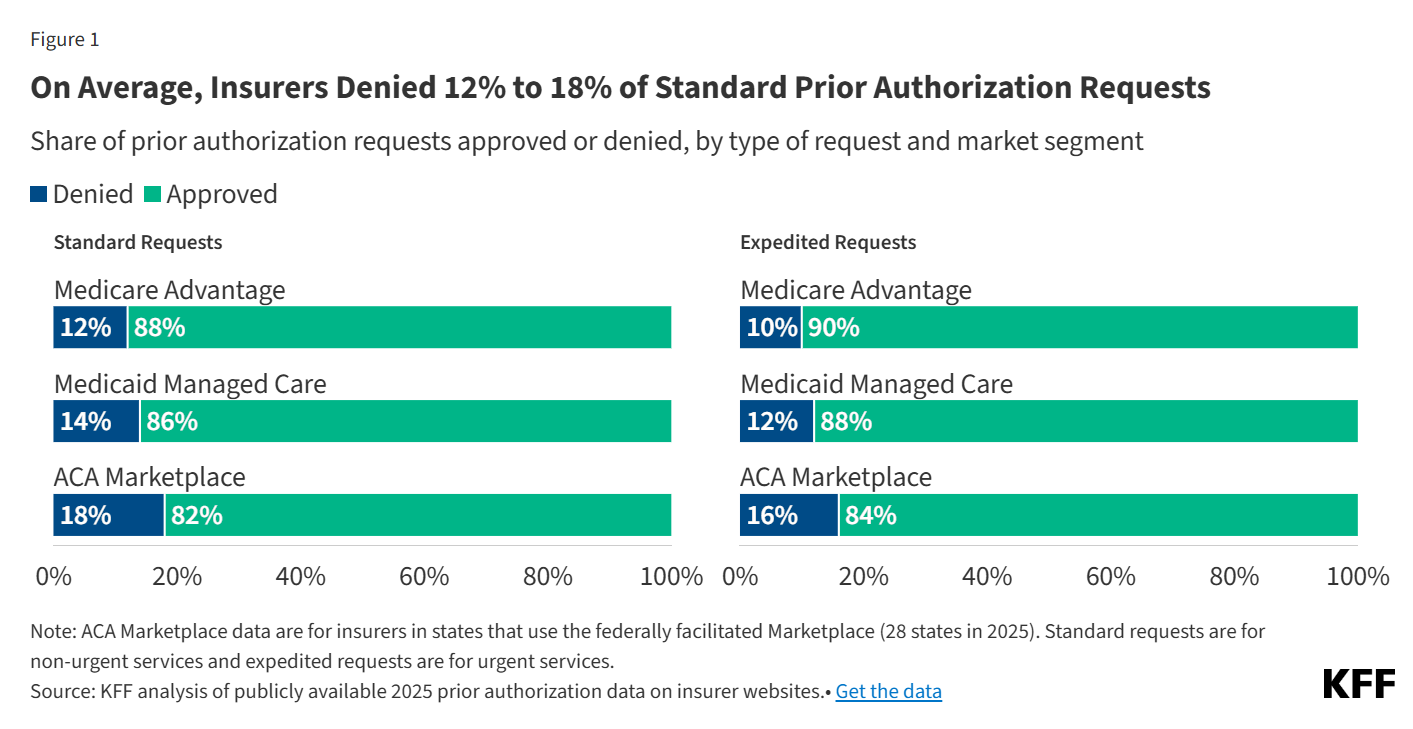
Standard request denial rates came in at 12% in Medicare Advantage, 14% in Medicaid managed care and 18% in the ACA marketplace. Expedited requests ran 10%, 12% and 16%. Plan-level range spanned 2% to 25%. Within Medicare Advantage alone, Elevance sat at 5% and UnitedHealth Group at 17%. Overturn rates on appeal reached 67% in MA, 47% in Medicaid managed care and 43% in the marketplace, with appeal volume low. Data is aggregated across all items and services with no service-type breakdown and no reported denial reasons. Data control drew regulators from three directionsReuters and STAT both reported on August 14 that the FTC opened an antitrust investigation into Epic Systems, with civil investigative demands going to other health technology companies seeking information on how Epic grants or withholds access to patient data. Reporting also describes questions about employee non-compete agreements. Epic's response: "We're leaders in interoperability to support patient care, and we do not engage in anticompetitive behavior." Texas Attorney General Ken Paxton's December suit and Particle Health's private antitrust action both remain pending. Epic's products serve providers treating more than 280 million people in the US. Consumer-side data movement ran on a parallel track. OpenAI made Health in ChatGPT broadly available to US adults in late July, connecting Apple Health along with records from hospital systems on Epic and Oracle Health through b.well. OpenAI's own documentation states the consumer product is not intended for covered-entity use and offers no BAA. Patient-directed transfer rights under the 21st Century Cures Act are what enable the connection; HIPAA does not follow the data into the consumer app. On July 29, the FTC, joined by California and Utah, sued Hims & Hers over sharing customer health information with Meta and Snap through customer-list uploads and website tracking code, alongside allegations on billing and cancellation practices. Company called the allegations baseless. And UnitedHealth confirmed in its August filing that it is contesting IRS Notices of Proposed Adjustment issued March 6 covering intercompany transfer pricing with a foreign subsidiary for tax years 2017 through 2020. IRS is seeking to "significantly increase taxable income" for each of those years and may propose similar adjustments for later years. UnitedHealth says its positions are properly supported and that it will "vigorously contest" the adjustments. Subsidiary, jurisdiction, transactions and dollar amount all remain undisclosed. A quick pod plug...I have a favor to ask you guys: if you’ve listened to my Claims Denied podcast (Apple, Spotify), would you mind subscribing to it and leaving a review for it? It helps me immensely with the algorithmic gods that be. Appreciate you fam. Hospitalogy Top Reads and Resources
*This resource is brought to you by one of my brand partners who help make this newsletter possible! Miscellaneous MaddeningsThe time is almost here. Blake Madden season preview coming next week. Enjoy Week 0! %20(1).png?sig=1439a417403f9dd8e9a94f6fc357ca7e55f1225dd9f685c1c3f63b83db899c6d&size=email-body&dpr=2)
Thanks for the read! Let me know what you thought by replying back to this email. — Blake |
|||||||
|


No comments